6
Test
Neon Abyss 2: four-player co-op, where only the host unlocks anything
The 1.0 lands today. The game is as twitchy as ever, but one design decision undercuts its entire selling point.
Alexandrosse
9 min
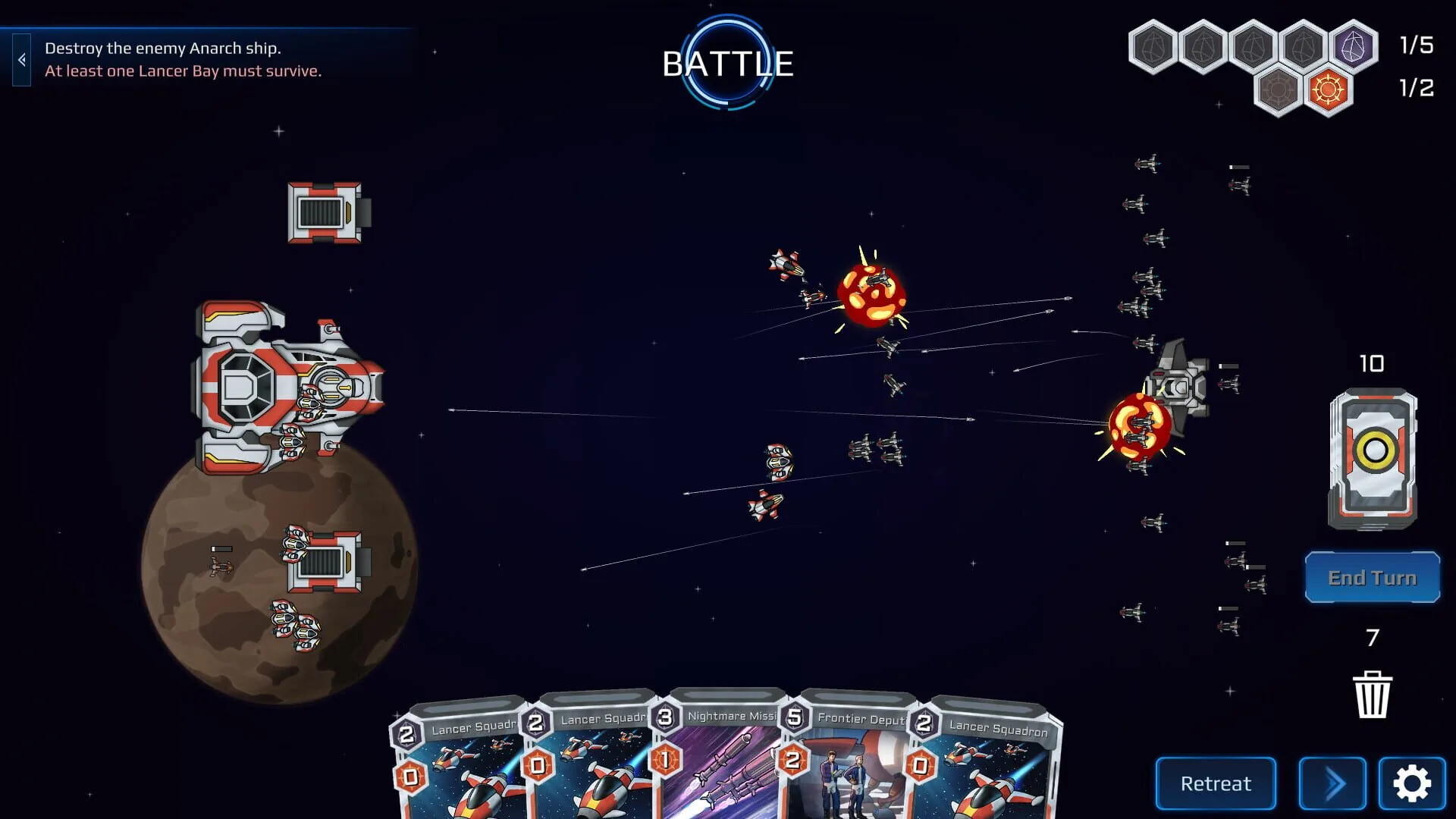
You build a deck, then watch it pilot a space fleet in real time. Flaregate Network crosses Slay the Spire with the RTS, and the marriage holds up surprisingly well.
Alexandrosse
InsertCoins.press Score
7/10
Verdict
Recommended
The roguelike deckbuilder has become such a crowded genre that it now takes a real idea to get noticed. Flaregate Network has one, and it's frankly bold: what if, instead of playing your cards turn by turn like everyone else, you built a deck that then pilots a whole space fleet in real time? On paper, it sounds like two games taped together. In practice, it works better than it has any right to.
Flaregate Network is a roguelike deckbuilder with RTS-inspired space combat, developed by Keycard Studio, available on 9 July 2026 on PC. The pitch is crystal clear: you build a unique deck, then pilot it, and its fleet, to victory. The game offers two distinct modes, a narrative campaign unfolding humanity's expansion thanks to flaregate technology, those interstellar portals, and a roguelike mode with randomized missions and permadeath. Two ways to approach the same hybrid mechanic, one for the story, one for pure challenge.
The heart of the game is its split into two beats that elegantly solves the problem of marrying cards and real time. During the play phase, combat pauses: you deploy your cards calmly, no pressure, you position your fleet, you plan. Then comes the battle phase, which plays out in real time without you having to touch anything: you watch your ships engage the enemy and find out whether your choices hold. It's a smart autobattler system that keeps the deckbuilder's thinking while offering the exhilarating spectacle of a space battle that plays out before your eyes.
That alternation is Flaregate Network's real find. It dodges the main pitfall of hybrids, that of drowning you in too-demanding real-time management, while preserving the adrenaline of emergent combat. You prepare cold, you endure hot, and that tension between serene planning and a result that escapes you gives every clash a real flavor. It's simple to understand, hard to master, and that's exactly the balance a good roguelike must aim for.
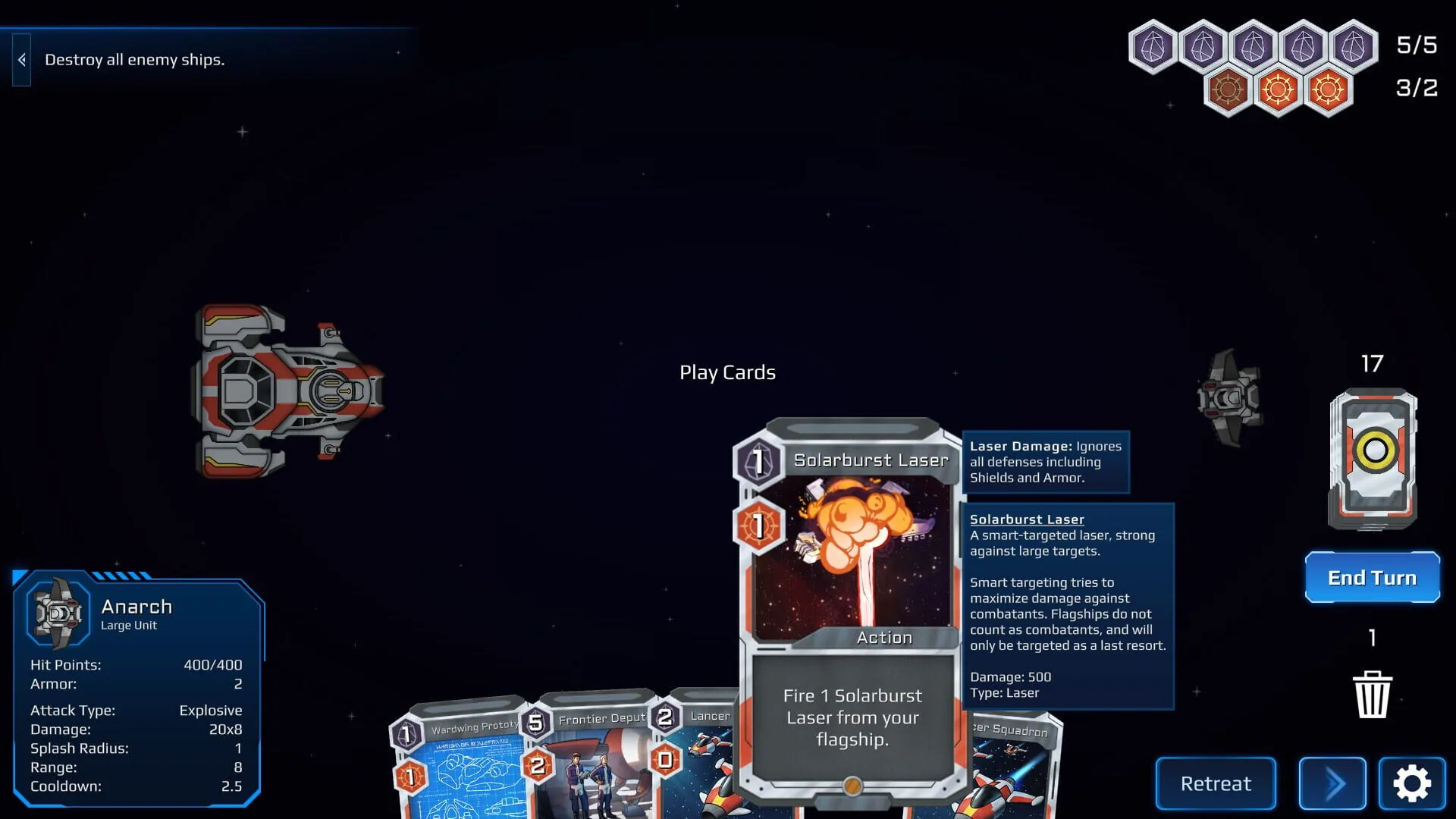
Beneath this mechanic, you find a real strategic layer. You build your deck by selecting cards that form synergistic fleets, and the game pushes you to understand its damage-type system to counter the enemy: explosive damage for the big ships, lasers that pierce shields, and a whole rock-paper-scissors logic you have to anticipate. The building philosophy ranges from balanced versatility, which covers everything, to the high-risk high-reward ultra-specialized strategy that bets everything on one approach. That's where replayability sets in, in those build choices that completely redraw a run.
The roguelike mode adds on top a trait system that offers, at the start of a run, a choice of economic or military bonuses to orient your setup. Those small initial decisions, combined with the randomness of the missions and the permadeath that punishes the loss of your flagship, guarantee runs that don't resemble each other. You find the genre's addictive loop, that urge to immediately relaunch to test another fleet composition, and that's a good sign.
Not everything is perfect, and the game shows the limits of an independent production. The presentation, decent, sometimes lacks the visual punch that would make these space battles as legible as they are spectacular, and it takes an adjustment period to read what's happening during the real-time phase. We'd also love the game to explain its subtleties a bit better, because the depth of its damage and synergy system doesn't always reveal itself, and the first runs can leave an impression of drifting before the click comes.
There remains, finally, the question of content over time, which can only be settled after long hours. The idea is excellent, the loop is solid, but a roguelike lives off the variety of its cards and situations, and that's where its longevity will play out. The potential is obvious; we'll have to see whether the arsenal is enough to feed dozens of runs without tedium setting in. As it stands, the base is already clearly cleverer than the genre average.
Flaregate Network is an excellent surprise, the kind that proves there are still fresh ideas to find in a genre we thought mapped out. Its marriage of deckbuilder and real-time strategy, built around those two phases of preparation and battle, is a clever find that offers the best of both worlds: the thinking of cards and the spectacle of emergent combat. The damage-type system gives real tactical depth, the campaign and roguelike modes complement each other well, and you relaunch a run with the characteristic urge of the genre's good representatives.
It lacks a bit of finish and legibility to become essential, and its longevity remains to be confirmed, but the essentials are there. For anyone who's done the rounds of classic deckbuilders and seeks a variation that truly shakes the formula, Flaregate Network is an easy recommendation. It's the kind of ambitious little game you want to see grow, and one that fully deserves its chance.
A roguelike deckbuilder that dares to cross cards and space RTS, and wins its improbable bet: clever, tense, a little rough, but packed with ideas and devilishly replayable.
Strengths:
Weaknesses:
Tested on PC.
Your verdict differs from ours? The Discord is the place to make your case.
Community
Your rating
Advertisement
Loading comments...
You might also like
The 1.0 lands today. The game is as twitchy as ever, but one design decision undercuts its entire selling point.
Jonathan Blow's third game after Braid and The Witness. It took ten years, a home-made language, and ideas he did not invent.
The movement has never been better and Unreal Engine 5 delivers. But Horde lost its 50 waves and there are only six maps.