7
Test
Cricket Management 26: one person built the Football Manager of cricket
Thirty-nine patches in two months, 64 international sides, facilities to maintain and a match engine that understands swing.
Alexandrosse
12 min
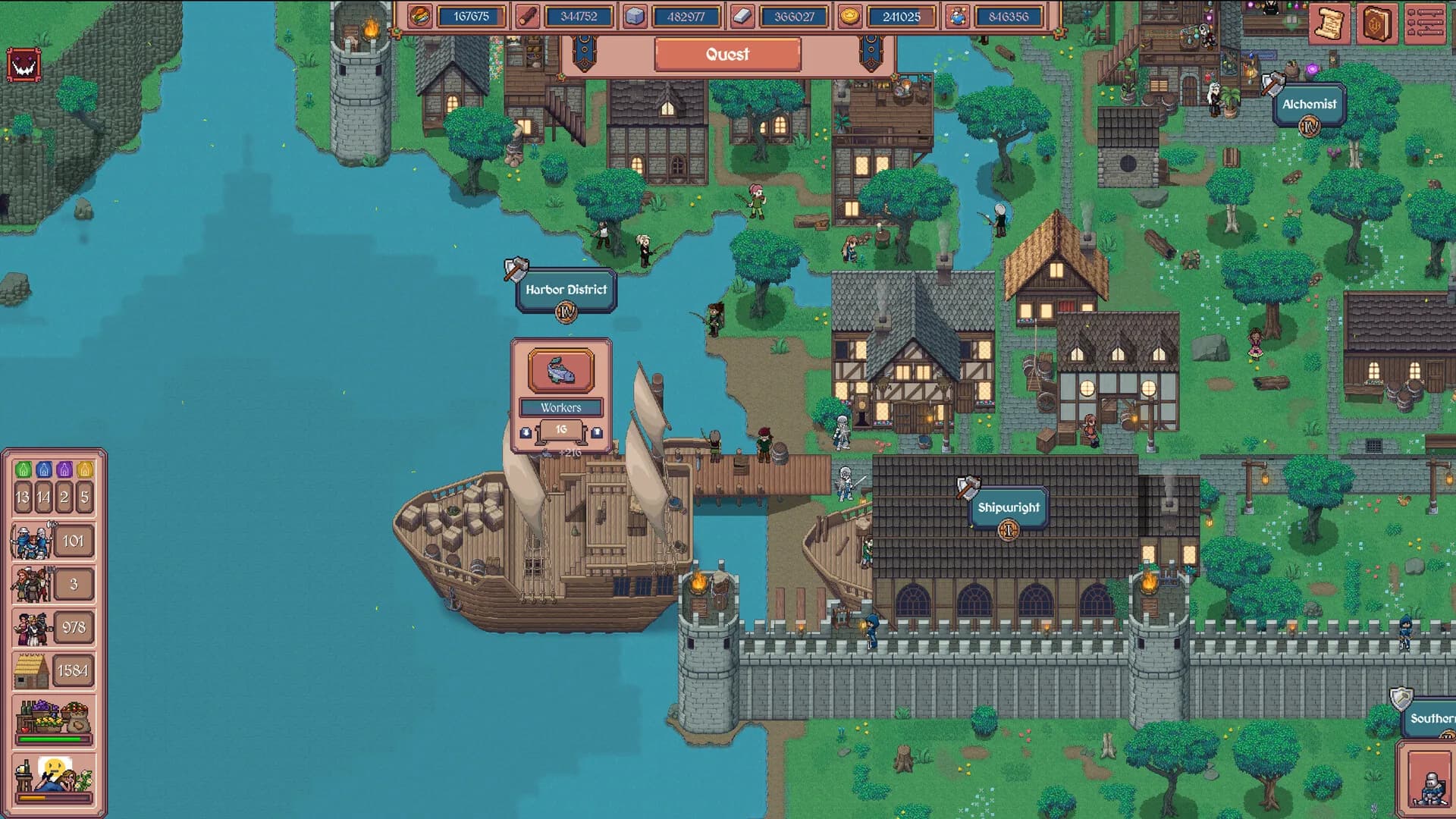
Superb medieval pixel art, laws to pass, a research tree and magic. The most peaceful clicker in the genre, and the best held together.
Alexandrosse
InsertCoins.press Score
7.5/10
Verdict
Recommended
The clicker genre has a bad reputation, often deservedly: numbers going up, a bar filling, a loop designed to keep you at the screen rather than to occupy your mind. Most of these games are gentle harassment machines, with their notifications, their temporary bonuses and their permanent urgency.
Hearth and Hamlet does none of that. It is a game that leaves you alone, and that is its central quality.
We have to start there because it is what catches the eye before any mechanic. Phorust Studios has taken care over its medieval world: lakes and rivers, magical swamps, faraway lands, and a warm light that makes you want to move in.
This is not nostalgic pixel art thrown together to save on artists, of which there is plenty about. It is a work of density and legibility, where every building reads at a glance and where the village gains real character as it grows. The shift from tent to castle is visible, and worth watching.
The starting point is the genre standard: you gather resources, assign workers, build. Four resources structure the economy, food, wood, stone and gold, and the population is distributed across them.
Where the game leaves the herd is that it does not stop at construction. The studio puts it plainly: building is only the beginning, and managing becomes as important as expanding.
In practice, you pass laws and policies. Taxation rules to raise income. Worker rules to keep morale high. City guard drafts to protect the population. And civic decisions that change the character of your kingdom.
That is what turns an incremental into a management game, and it is rarer than you would think in this family. The ordinary clicker asks which upgrade to buy first; this one asks what kind of kingdom you want to run. Heavy taxation fills the coffers and costs you morale. A large guard protects you and takes hands out of the fields. These are real trade-offs, even if they stay gentle.
Every upgrade feeds a research tree that permanently unlocks new technologies. It is what carries a session over time, and its presence explains why the game does not collapse after two hours the way so many of its competitors do.
The principle is simple and well judged: progress is not lost. You are not endlessly reclimbing the same tiers, you are opening doors that stay open. More advanced buildings, new policies, stronger magic.
Because there is magic, and it is the game's best surprise. As the city advances you unlock alchemical labs and magical academies, which add a whole dimension to how the kingdom operates. Going from a village of woodcutters to a capital with an arcane academy gives progression a horizon that resources alone would never have supplied.
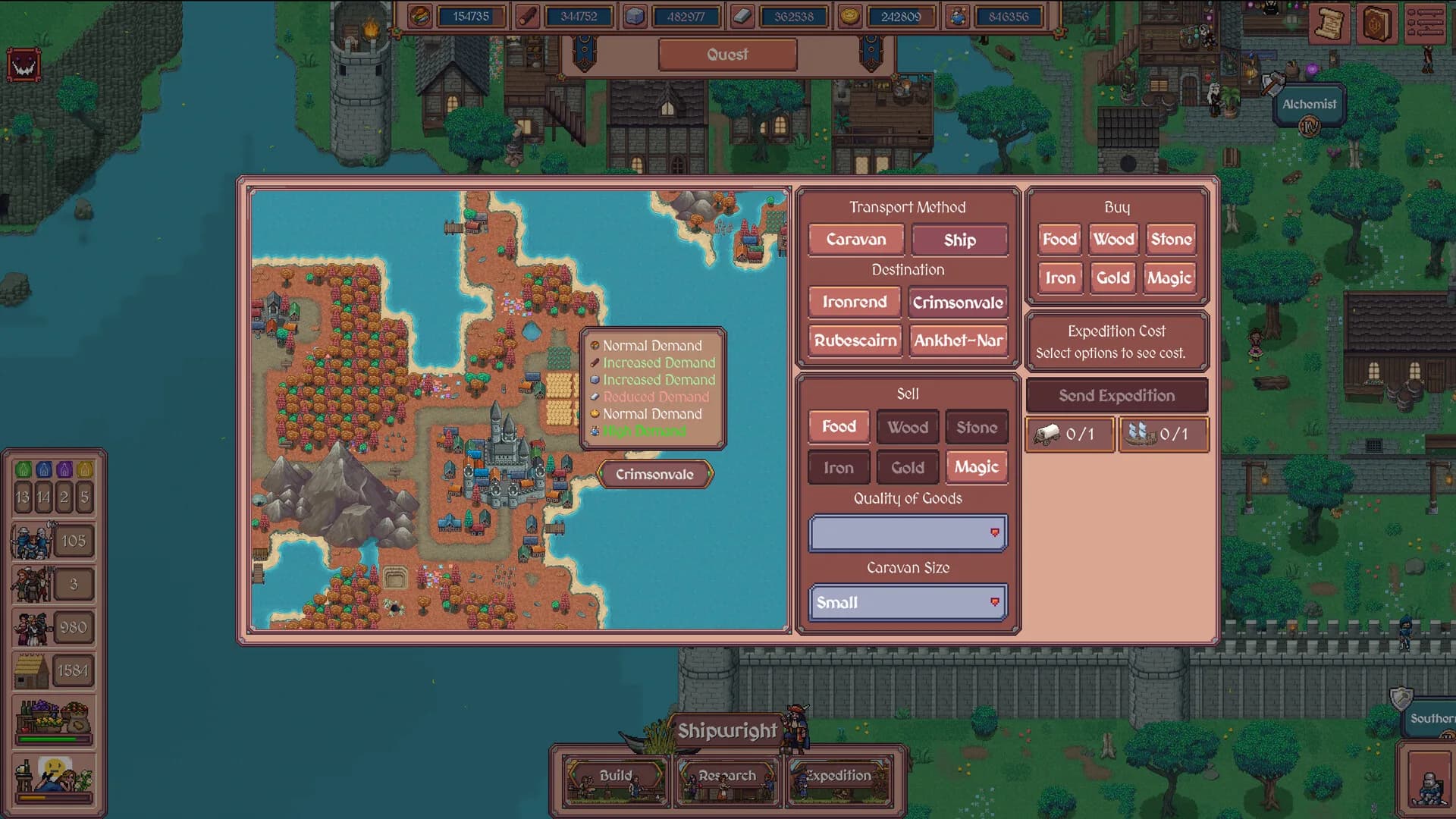
Two systems round things out and are worth knowing before buying, because they govern the pace of the second half.
Trade with faraway lands lets you establish routes to neighbouring kingdoms, and so grow your economy beyond what your terrain produces. It is the game's answer to the geographical ceiling: when your map stops yielding stone, you buy it elsewhere.
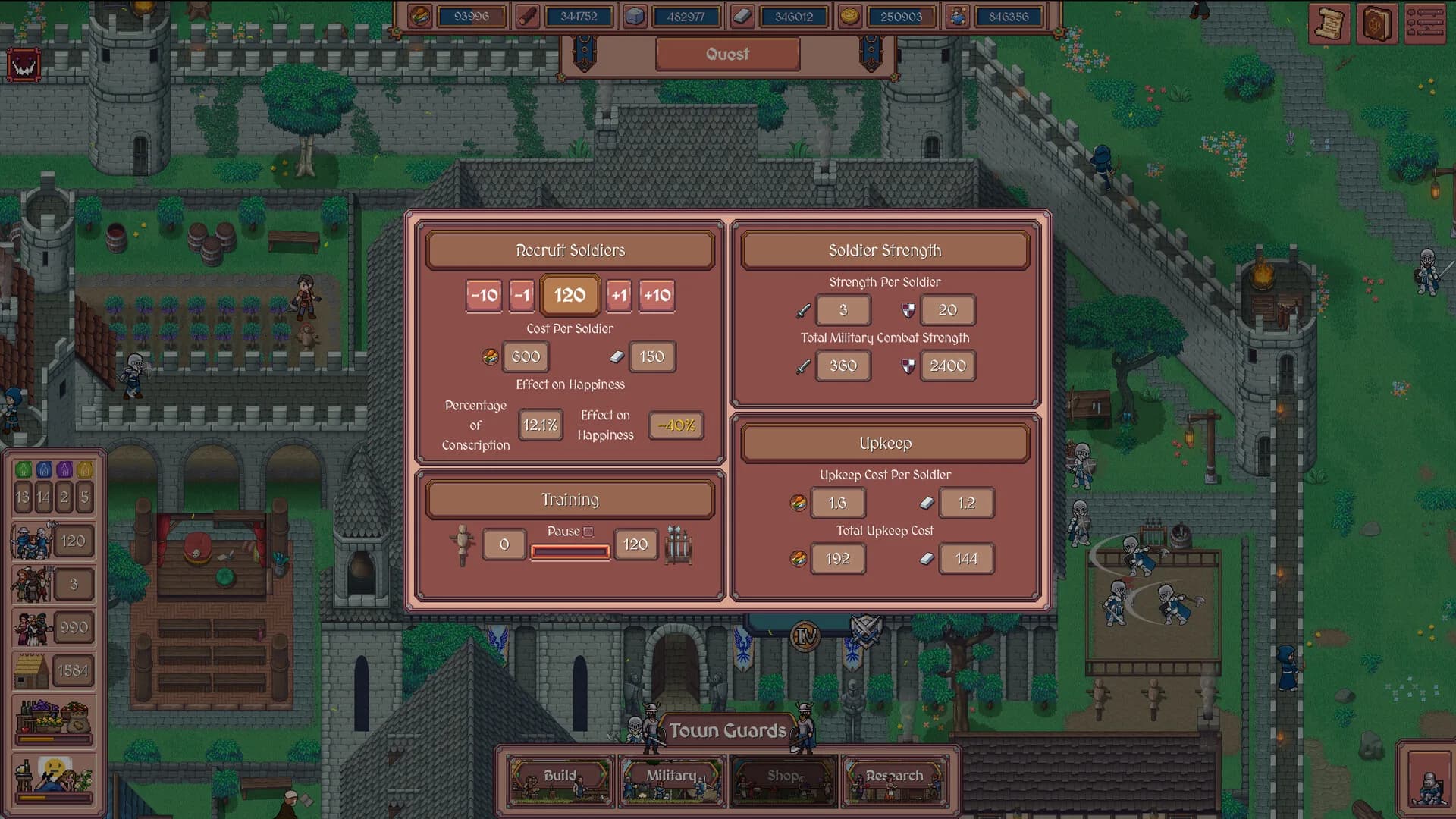
Recruiting soldiers accompanies the realm's expansion, to protect what you have built. It is the game's lightest strand, and you should not expect military strategy: defence is a constraint to manage, not a game within the game.
Back to what strikes you most with a mouse in hand: this game never puts pressure on you.
The studio owns it openly, writing that gameplay is engineered to be relaxing and satisfying, and that you watch your kingdom grow on your terms and at your pace. That is not an empty line, it shows in the design: no aggressive countdown, no window of opportunity closing, no punishment for having gone to dinner.
That is precisely what most incrementals lack, since their business model runs on mild anxiety. Here you put the game down, you come back, the city has advanced, and that is fine.
The flip side exists and should be said: anyone looking for tension or difficulty will not find it. There is no moment where your kingdom nearly collapses, no crisis to scramble through. It is a game of quiet growth, and it claims nothing else.
The game launches today, 19 August 2026, developed by Phorust Studios and published by Runic Forge and Gamersky Games. This is not early access: it is a complete version.
One important point: there is no French translation. It offers English, German, Russian, Japanese, Korean and Chinese in both scripts. For a game where you pass laws and read a research tree, that is not a detail, and it is better known before paying.
Anticipation around the title was considerable for a production this size: the studio announced passing 150,000 wishlists a week before launch, after a demo at Steam Medieval Fest in April and then Next Fest in June. That is a signal of audience rather than quality, but it explains the game's visibility.
It rewards pixel art with real identity and exemplary legibility, a research tree that gives progression permanence, and above all a layer of governance, laws, taxation, morale, guard, that the genre almost always neglects. The pivot into magic and alchemy arrives at the right moment and restarts a session that might have dozed off.
It marks down the total absence of tension, which is a deliberate choice but will cap longevity for many, a military strand reduced to a formality, and the missing French version in a game where you spend your time reading menus.
For anyone after a game to leave running in the evening without it demanding anything, it is a success. For anyone wanting to be pushed, this is not the address.
So tell us: in a management game, do you prefer the crisis to handle or the quiet growth?
We compare our villages on the InsertCoins Discord, come and show us yours.
Community
Your rating
Advertisement
Loading comments...
You might also like
Thirty-nine patches in two months, 64 international sides, facilities to maintain and a match engine that understands swing.
A hundred and fifty talent nodes, a smart ban system, and rocks that stayed white spheres.
Your railcars are your health and your skills at the same time. Assuming the game gets past the loading screen.