7
Test
Cricket Management 26: one person built the Football Manager of cricket
Thirty-nine patches in two months, 64 international sides, facilities to maintain and a match engine that understands swing.
Alexandrosse
12 min
Falsify the records, scream through the Five Minutes Rage, suppress your own doubts. A playable 1984, short and well held, from a Ukrainian studio.
Alexandrosse
InsertCoins.press Score
7/10
Verdict
Recommended
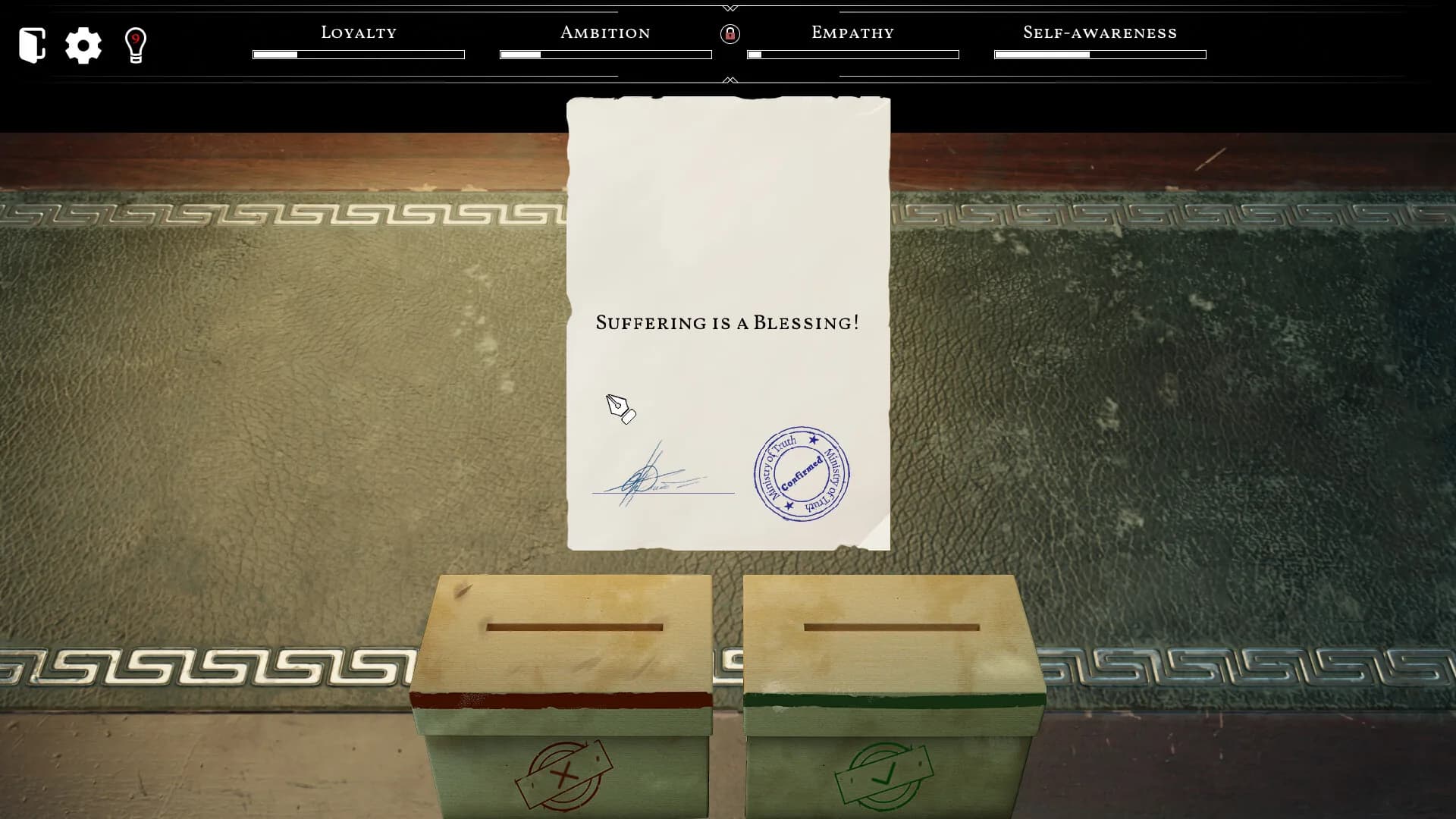
Suffering is a blessing. Silence is wisdom. Obedience is loyalty.
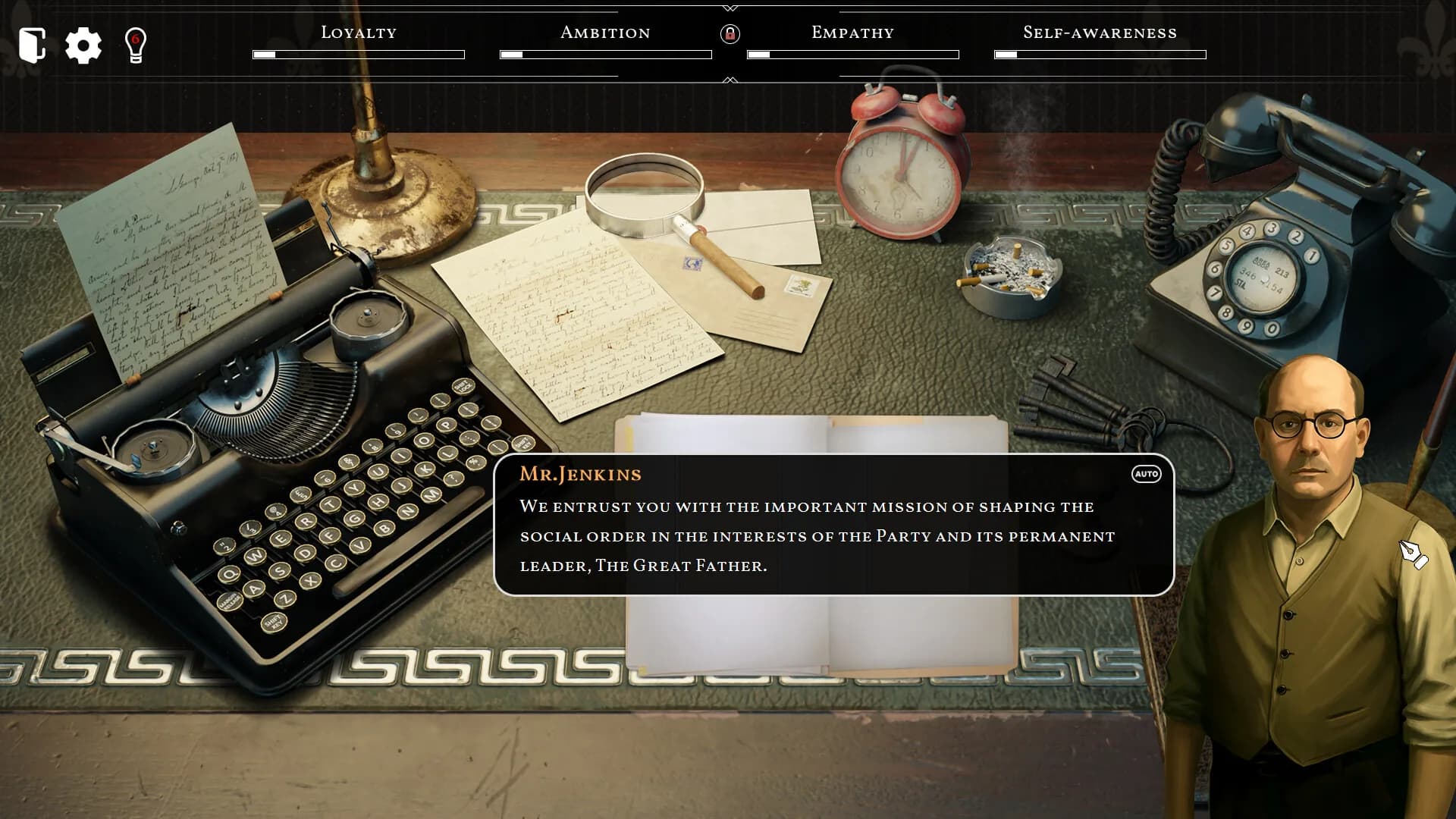
That is how the game greets you, and it will not change its tone. Congratulations, comrade: you are now an official of the Ministry of Truth. Your job is to rewrite history, control information and deliver to the public the truth the Party has decided on.
No point circling it: this is 1984 turned into a game. The Ministry of Truth, the Great Father watching you, the systematic falsification of records. The studio does not hide its source, it displays it.
The risk with this sort of exercise is familiar: producing a school illustration of the novel, ticking references without doing anything with them. This game avoids the trap for one specific reason, and it is its real idea: it does not merely ask you to lie to others, it asks you to police yourself.
The game rests on three pillars, each matching a face of totalitarianism.
Rewriting. This is the core of your work. You alter events, change records, decide what the public will believe. Every choice shapes the official truth, and the game leaves you free to shape it either way.
The Five Minutes Rage. A daily ritual, a direct transposition of the novel's Two Minutes Hate. You gather, you watch the enemies of the Party on giant screens, you scream, you surrender to the crowd's fury. The game puts the mechanism better than I would: fear and hatred become loyalty.
Making it a daily ritual rather than a one-off scene is the best design decision in the package. Propaganda is not an event, it is a routine, and giving it the slot of a repeated chore in your schedule says something a long dialogue would not have.
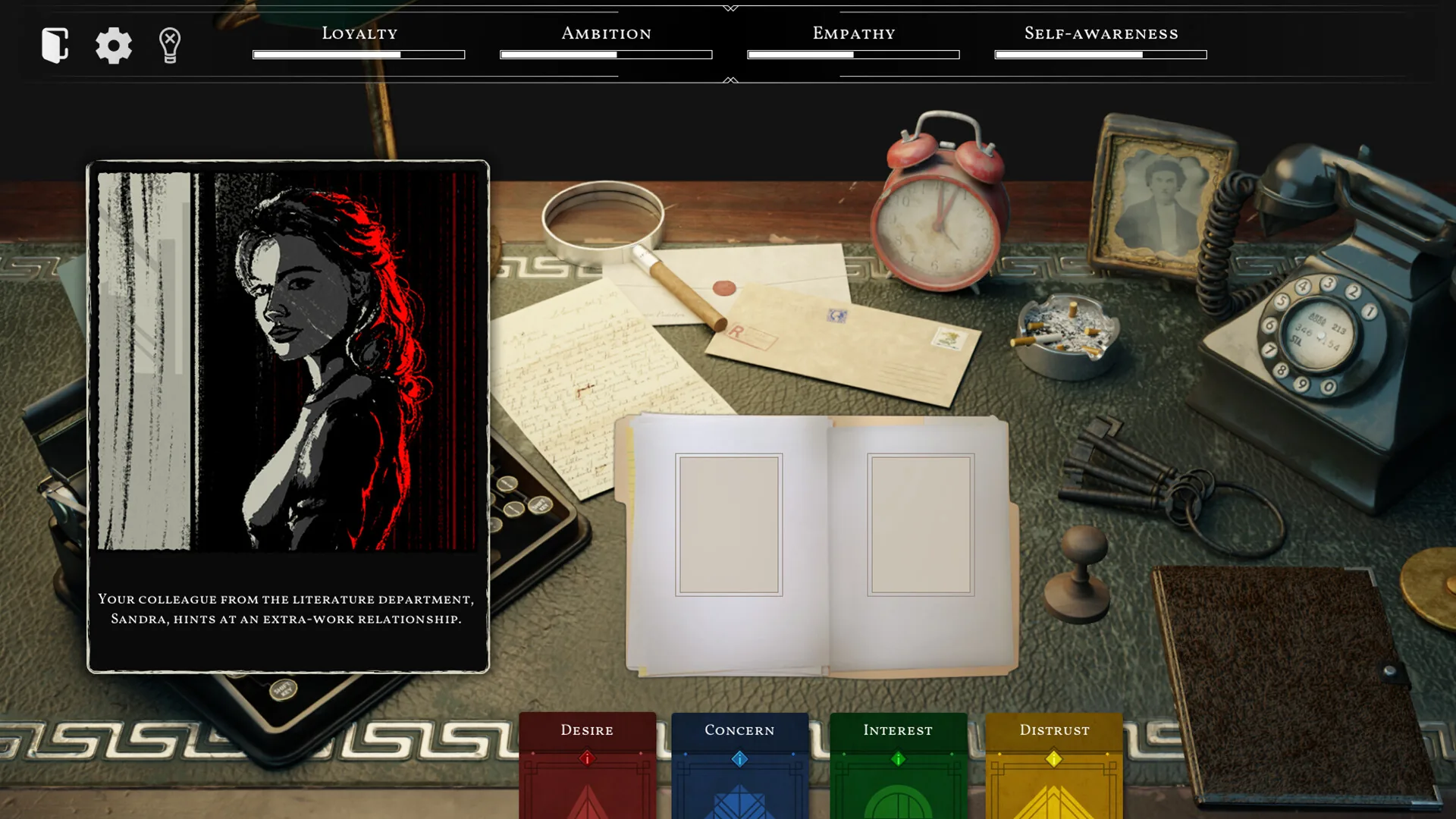
Keeping your mind pure. You have to suppress your doubts, govern your emotions, obey. Any weakness, any rebellious thought threatens you as much as it threatens the State, and your mind is under constant scrutiny.
That third pillar is what separates this from its cousins. In most oppressive-bureaucracy games the threat comes from outside: a superior, an inspection, a penalty. Here part of the pressure comes from what you think, and the game asks you to manage it as a resource.
The game announces both paths from the outset: stay loyal to the regime, or try to resist the system. Every misstep is punished, every doubt recorded.
That is the genre's classic structure and it works, provided resistance genuinely costs something. On that front the setup is coherent: since your doubts are tallied, choosing to resist is not a button pressed at the end, it is an accumulation that catches up with you.
The real test of a game like this lies elsewhere, and it fits in one question: is obedience tempting? A failed propaganda game is one where the right side is obvious and comfortable. A successful one is where giving in is simpler, faster, better rewarded, and where you catch yourself doing it out of convenience before you notice.
That is exactly the ground on which it will have to be judged over time.
The game launches today, 19 August 2026. It is developed by IKKOSAMA and False Memory Dept., and published by Two Cakes Studio.
It is a Ukrainian production, and the studio was taking part this week in the Ukrainian Games Festival. It can be noted, without building a thesis on it, that a game about rewriting history and manufacturing official truth does not carry the same resonance depending on where it is written.
One technical detail confirms it: Ukrainian and English are the only two fully voiced languages, on a list running past twenty.
And good news for this site: the game is available in French, which is not nothing for a title resting entirely on text to be read and falsified.
There is also a demo, a soundtrack sold separately and a supporter pack, and the game went through a public playtest in February.
It rewards an intelligent transposition rather than an illustrative one, with a hate ritual turned into a gameplay routine and an inner conformity gauge that moves surveillance inside the player. The atmosphere holds, the writing does not reach for subtlety where the subject has none, and the localisation is generous for a production this size.
It accounts for well-occupied ground, where Papers, Please set a reference that is hard to beat, and for a short format that lives or dies on holding its argument rather than on volume of content.
It also factors in the usual unknown with a choice-driven game: the real value of the second path, resistance, only measures itself across several playthroughs.
For anyone who likes games that make you uncomfortable for the right reasons, this is an honest and well-executed proposition.
A closing question: in a game that asks you to obey, are you playing the character or playing yourself?
We discuss it on the InsertCoins Discord, where nobody records your doubts.
Community
Your rating
Advertisement
Loading comments...
You might also like
Thirty-nine patches in two months, 64 international sides, facilities to maintain and a match engine that understands swing.
A hundred and fifty talent nodes, a smart ban system, and rocks that stayed white spheres.
Your railcars are your health and your skills at the same time. Assuming the game gets past the loading screen.