7
Test
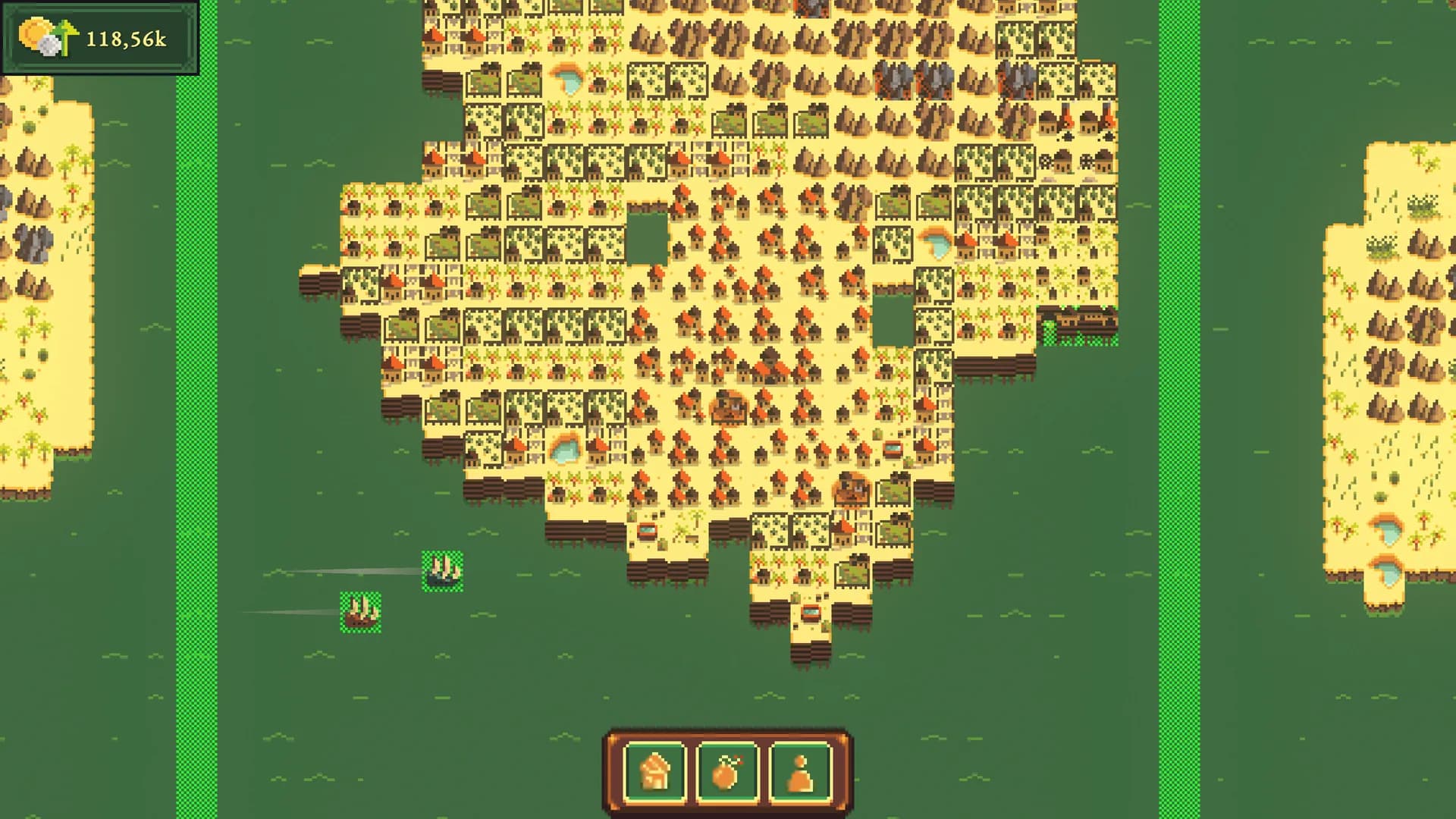
Archipeo: thousands of islands, ships running a shuttle service, and me not sleeping
A procedural Anno where haulage is the real game. Every badly assigned freighter takes its revenge forty minutes later.
Alexandrosse
8 min
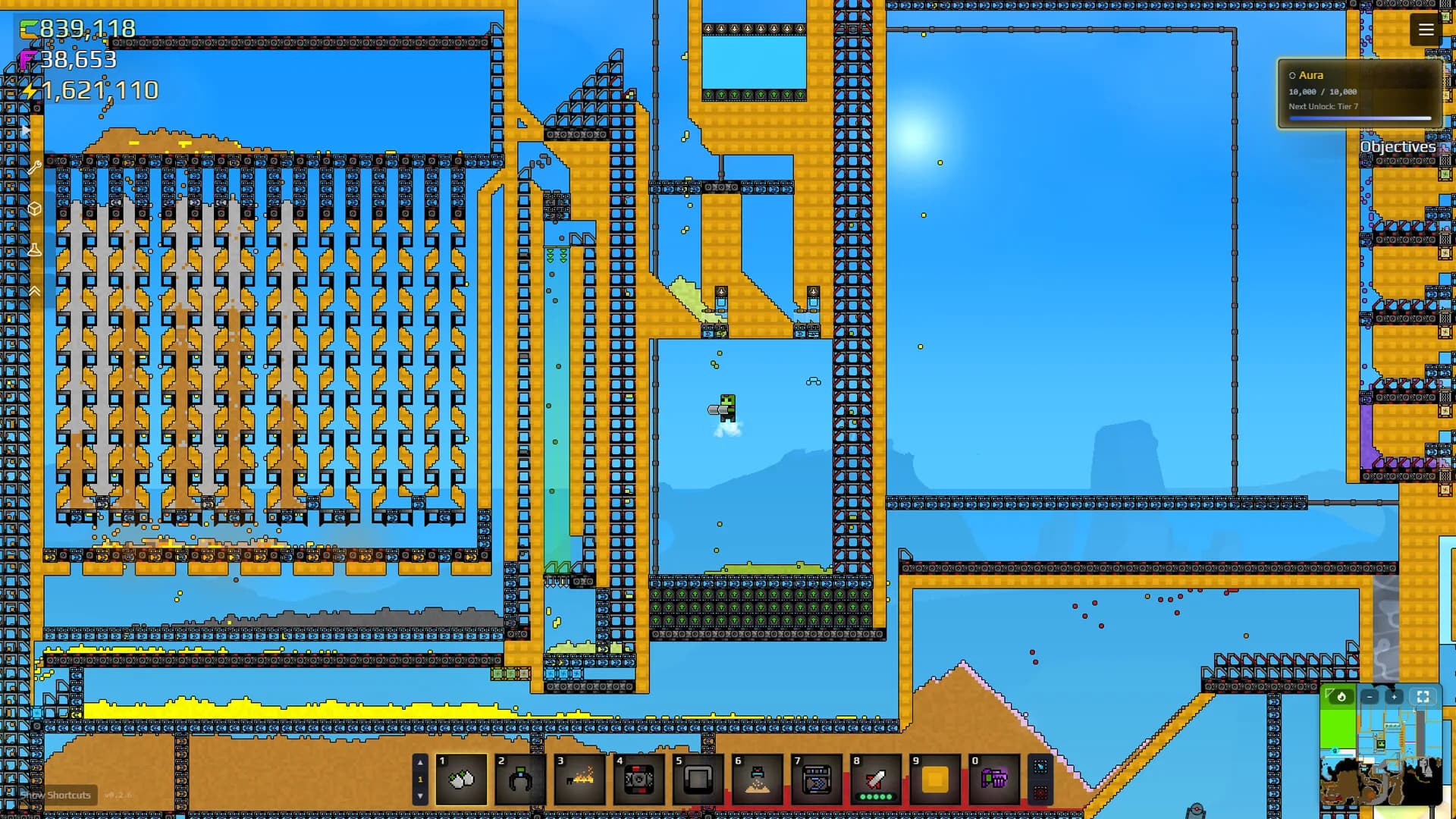
A factory game built on sand physics where every pixel counts. Fiercely addictive, and unfairly suspected of having been written by an AI.
Alexandrosse
InsertCoins.press Score
8/10
Verdict
Recommended
We have already confessed our weakness for tunnel games, the ones you launch for twenty minutes and put down when the sky changes colour. Sandustry belongs to that category, and it did not take long to confirm. Twenty minutes announced, very little sleep delivered.
That is in itself the best recommendation you can give a factory game. But there is a second subject around this game, and it deserves setting straight.
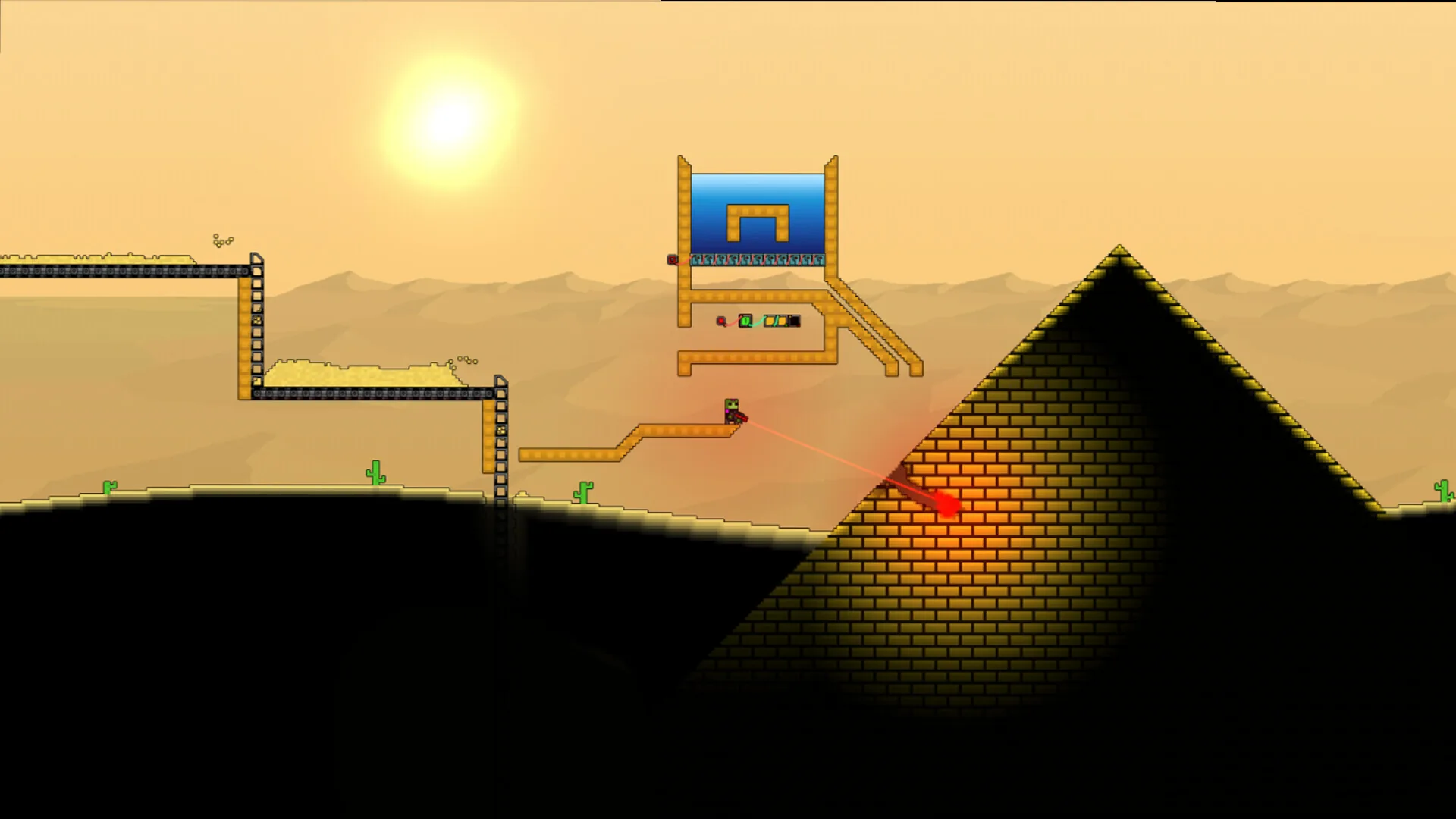
Sandustry is an automation game developed by Lantto Games and published by Hooded Horse, in which every pixel is a resource to mine, mix, process or destroy. You arrive on an unexplored, fully destructible planet, and you start from almost nothing: sifting gold out of sand.
What makes the loop so absorbing is that the physics is not scenery. Every grain of sand, every snowflake, seed, spore or chip of ice is a physical entity with its own properties, and you discover chemical and physical reactions that you then exploit in your production chains. In other words, the classic factory game, where you lay belts between two machines, is here grafted onto a materials simulator.
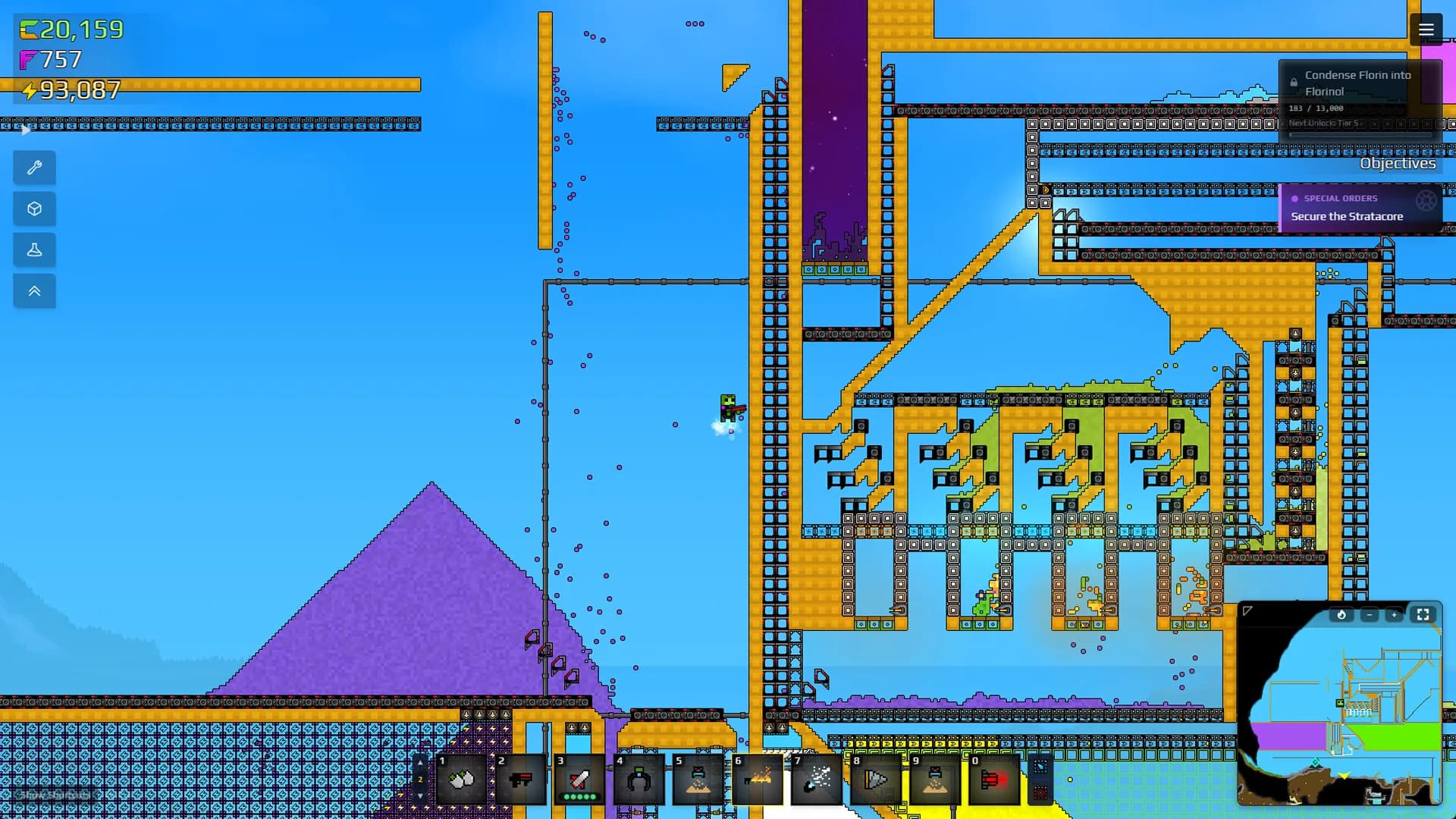
The consequence is that optimisation becomes tactile. You do not merely route resources, you channel fluids, manage states, build factories to the pixel or embrace chaotic tangles of conveyors. Add filters, drones, pipes, pumps, local wildlife to exploit, ancient artifacts to hunt down, and a rocket launcher which, it must be admitted, remains the fastest way to mine.
For anyone susceptible to the tunnel, it is a perfectly built trap: every problem solved opens two more, and matter behaves oddly enough to make you constantly want to try one more thing.
This needs addressing, because the rumour circulated and its premise is false.
A player published a long, very detailed critique of the game, listing inconsistent mechanics, objects with implicit behaviours, separate physics systems, poorly signposted progression and a narrative that runs out quickly. He concluded that all of this was characteristic of a game written by an artificial intelligence.
The publisher intervened directly. Hooded Horse's community director explained that Sandustry was not coded with the help of generative AI, and above all he traced the origin of the misunderstanding. The claim came from a comment by a community moderator who explained that he had used an assistant to build SandustryVault, an unofficial community site for sharing blueprints, precisely because he cannot code. That moderator is not the developer, and he was not talking about the game.
The same moderator added the missing context: the developer has been working on this project since before the mainstream language models launched, he is a professional developer, all of the artwork is his own, and the vocabulary quirks people object to are explained simply by the fact that he is Swedish.
We checked one last point ourselves: the game's Steam page carries no artificial intelligence disclosure. On a platform that requires such a declaration, and when we have noted several on other titles in recent days, its absence here is consistent with the denial.
The publisher's position deserves quoting because it is correct: criticising a mechanic as inconsistent, badly explained or simply poor is entirely legitimate, but interpreting those flaws as proof of automated authorship establishes nothing. A bad system remains a bad system, whatever its origin.
That is a useful lesson at the moment. Suspicion of AI has become a critical reflex, and it ends up serving as shorthand for saying a game is clumsy. That is not the same accusation, and it does not carry the same consequences for a solo developer.
It is available in French.
The criticisms listed above are not all unfounded, and it would be dishonest to sweep them aside because their conclusion was. Poorly signposted progression, objects with unclear behaviours and physics systems that coexist without answering one another are classic complaints for a game of this type, and Early Access exists precisely to address them. We will also watch the narrative structure, which appears to run dry faster than the factory loop.
But the essential thing is in our shortened night. An automation game is judged first on its ability to make you lose track of time, and this one manages it effortlessly. If you are the sort to say one more machine and look up at dawn, warn the people around you.
It rewards a fiercely addictive automation loop built on a genuine materials simulation, while accounting for the legibility and progression complaints noted above.
The real question: how long before you say one more machine and the sun comes up?
Disagree with the score? Come and tell us on the InsertCoins Discord, where we defend our verdicts live.
Community
Your rating
Advertisement
Loading comments...
You might also like
A procedural Anno where haulage is the real game. Every badly assigned freighter takes its revenge forty minutes later.
Towers, troops, a single pool for both. Every coin spent on defence is a coin you will not be sending the other way.

Crossing finally matters and defending responds. Then the screen goes black. 57 per cent positive on Steam, at 69.99 euros.