7
Test
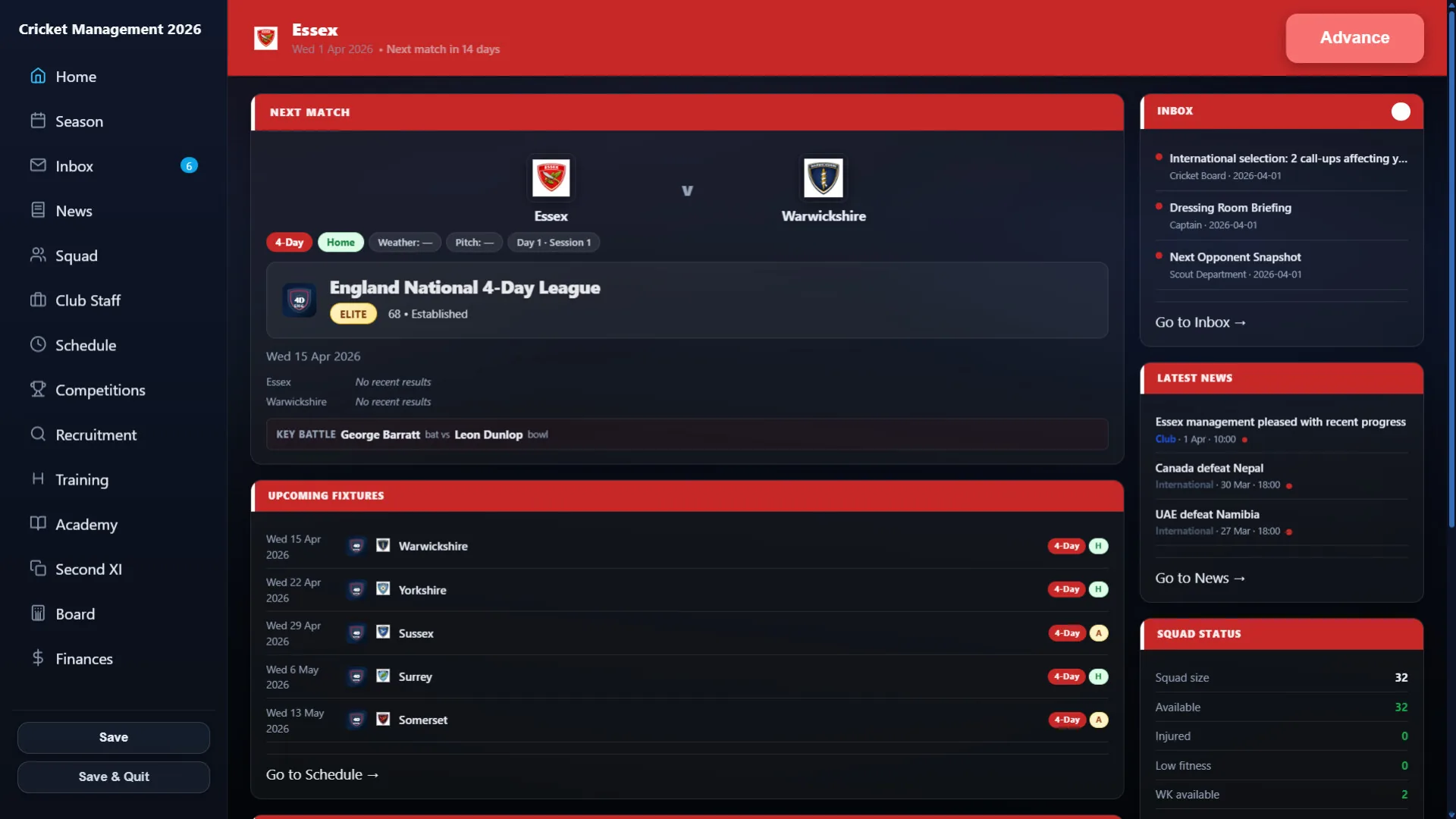
Cricket Management 26: one person built the Football Manager of cricket
Thirty-nine patches in two months, 64 international sides, facilities to maintain and a match engine that understands swing.
Alexandrosse
12 min
Sixty parts to collect, a miniature PS1 city and bets on your own fights. A superb art direction, and an absent magic.
Alexandrosse
InsertCoins.press Score
7/10
Verdict
Recommended
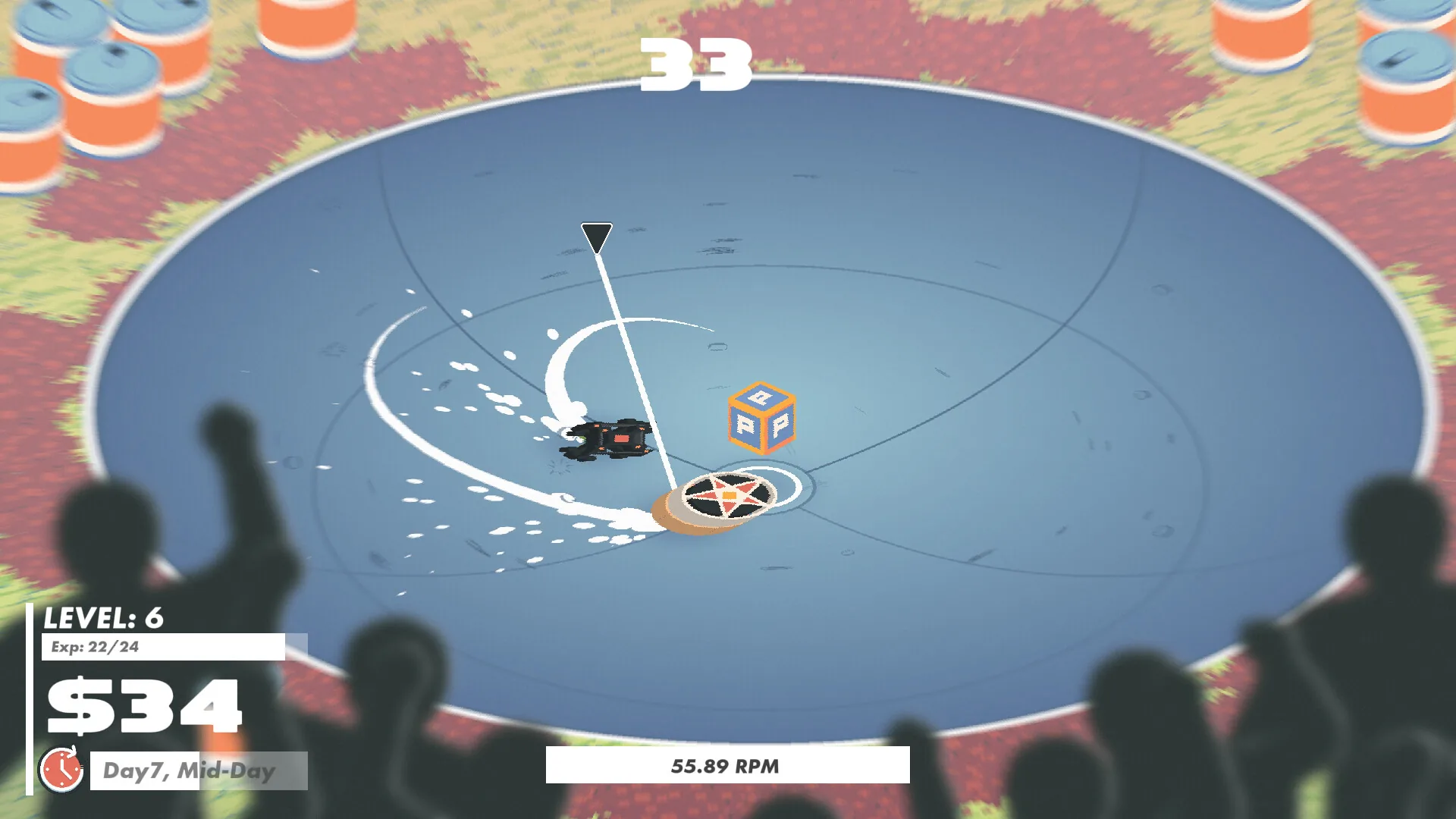
There was no avoiding the thought. Tops launched into an arena, parts you strip and rebuild, fights won on equipment as much as on the throw: Slayblade summons a very precise memory for anyone who had a plastic arena on the living room table.
It takes the mechanics seriously. It also leaves behind what made them sing.
There are no spirits inside the tops. No dragons, no creatures, no caged beasts erupting at the decisive moment.
That was precisely the other half of the formula. The tops were the sport, the creatures were the myth. Without them, what remains is objects that spin, very well simulated, but objects.
The game owns that choice, and it deserves credit for consistency: its fantasy is not the anime's, it is the street corner's. You bet your pocket money, you face strangers on the pavement, you strip your top to rebuild it better. It is the memory of the ground rather than the screen.
That stands up, and it still leaves a gap. A game that had layered glowing creatures onto the same mechanics would have reached two audiences instead of one.
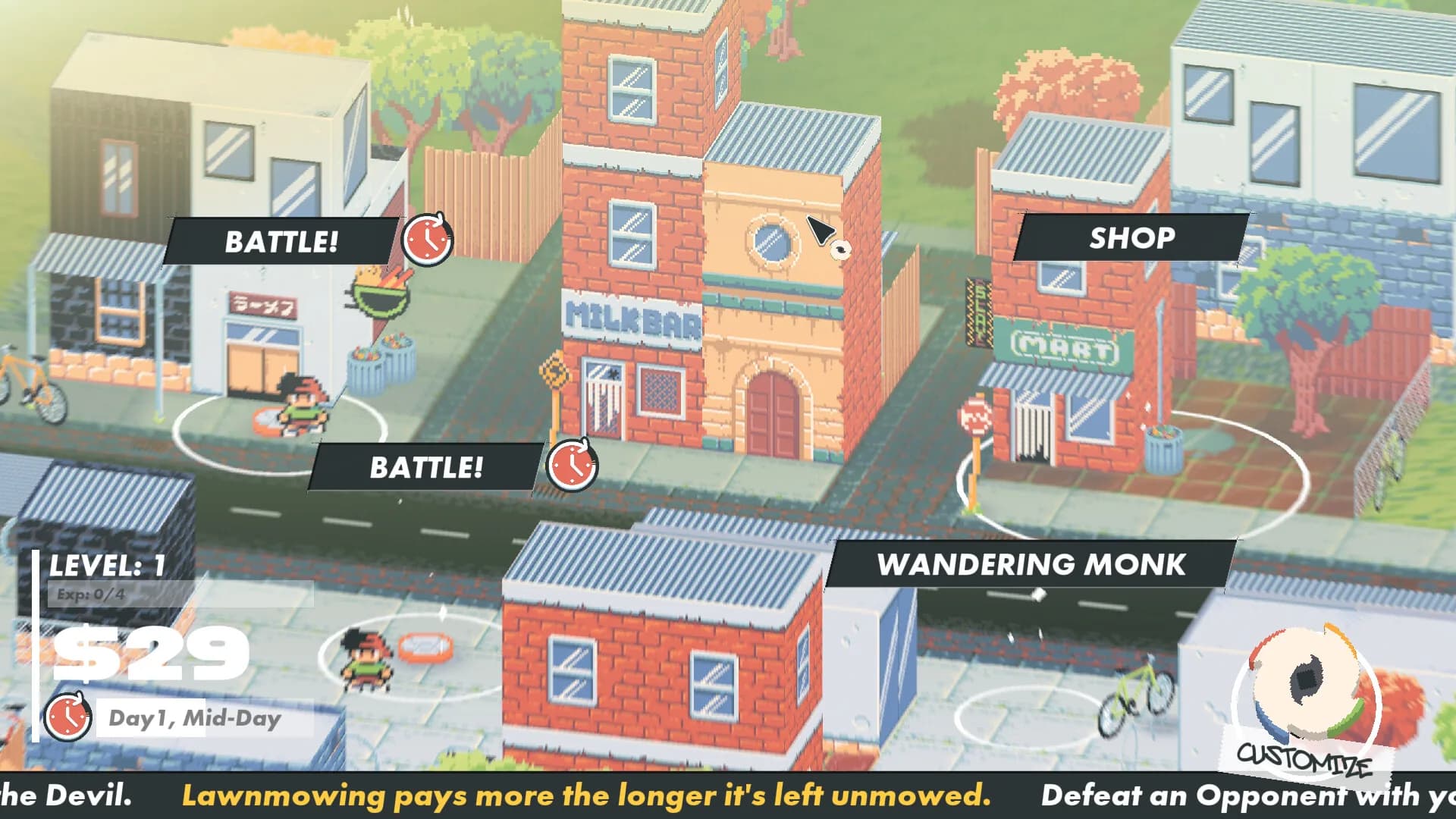
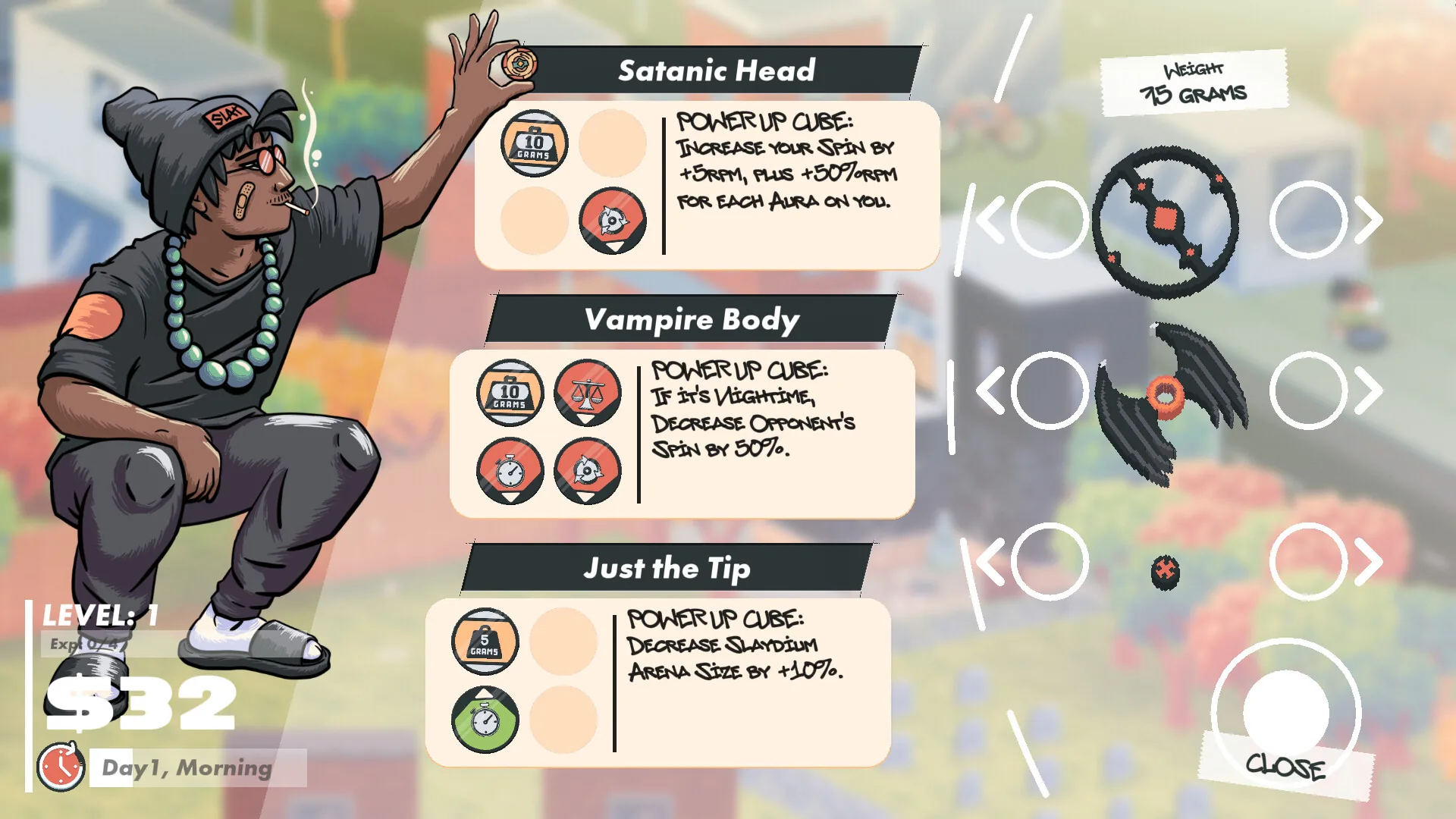
The art direction is superb. Colourful lo-fi visuals, hand-drawn character art, a miniature PS1 city to visit between fights. It has a strong, owned identity, and it is the first thing that lands.
The collecting works. Over sixty top parts to unlock, with the promise of ludicrous combinations once you have enough to experiment. That is the central loop and it is properly paced: you win, you buy parts, you hunt the build that breaks everything.
It is immediately playable. The whole game runs on a mouse and left click, a radical design choice that works. You do not spend three fights learning controls.
The arenas have ideas. The one whose grass is mown by passing tops is the kind of detail that adds nothing mechanically but raises a smile every run, and those details count.
The studio states plainly what its game is not, which is rare enough to salute.
There is no story mode, only a brief opening and closing cutscene. So there is no league, no championship, no ladder of arenas to climb in the Pokémon sense. Anyone hoping for a tournament structure with opponents to beat in order will be disappointed.
There is no multiplayer. This is a solo experience, entirely.
What the game offers instead is a run-based structure: you chain fights, earn money, buy parts, start again hunting for better. It is roguelite logic applied to spinning tops, and it carries replay value in place of scripted progression.
The narrative thread fits in one line: you save the city from a rich loser. And you break the law along the way, which sets the tone.
Slayblade is by Henry's House and Oscar Brittain, a name worth knowing: the creator of Desert Child, Kardboard Kings and Nanomon Virtual Pet.
That explains a lot. Desert Child already had this heavily worked lo-fi aesthetic and a taste for small worlds you inhabit rather than traverse. Kardboard Kings already revolved around card collecting and running a shop. Slayblade sits in direct continuity with that body of work, and anyone who liked the earlier games knows what to expect.
It rewards an art direction with real personality, a collecting and building loop that hooks, immediate playability and a handful of arenas with ideas rather than interchangeable bowls.
It accounts for the absence of a competitive structure, league or championship, which would have given progression a spine, the absence of multiplayer in a game about confrontation, and narrative content pared to the minimum.
It also factors in that missing magic. Technically it is not a flaw, it is a choice. But when you summon a memory this precise, you summon what came with it.
Which top did you have, and did it have a dragon in it? Tell us on the InsertCoins Discord.
Community
Your rating
Advertisement
Loading comments...
You might also like
Thirty-nine patches in two months, 64 international sides, facilities to maintain and a match engine that understands swing.
A hundred and fifty talent nodes, a smart ban system, and rocks that stayed white spheres.
Your railcars are your health and your skills at the same time. Assuming the game gets past the loading screen.