Preview
DinoBones: nine skeletons in pieces, a museum to put right, and a cat
A sorting game where every bone starts out unknown and you learn to recognise it. No date yet.
Alexandrosse
6 min
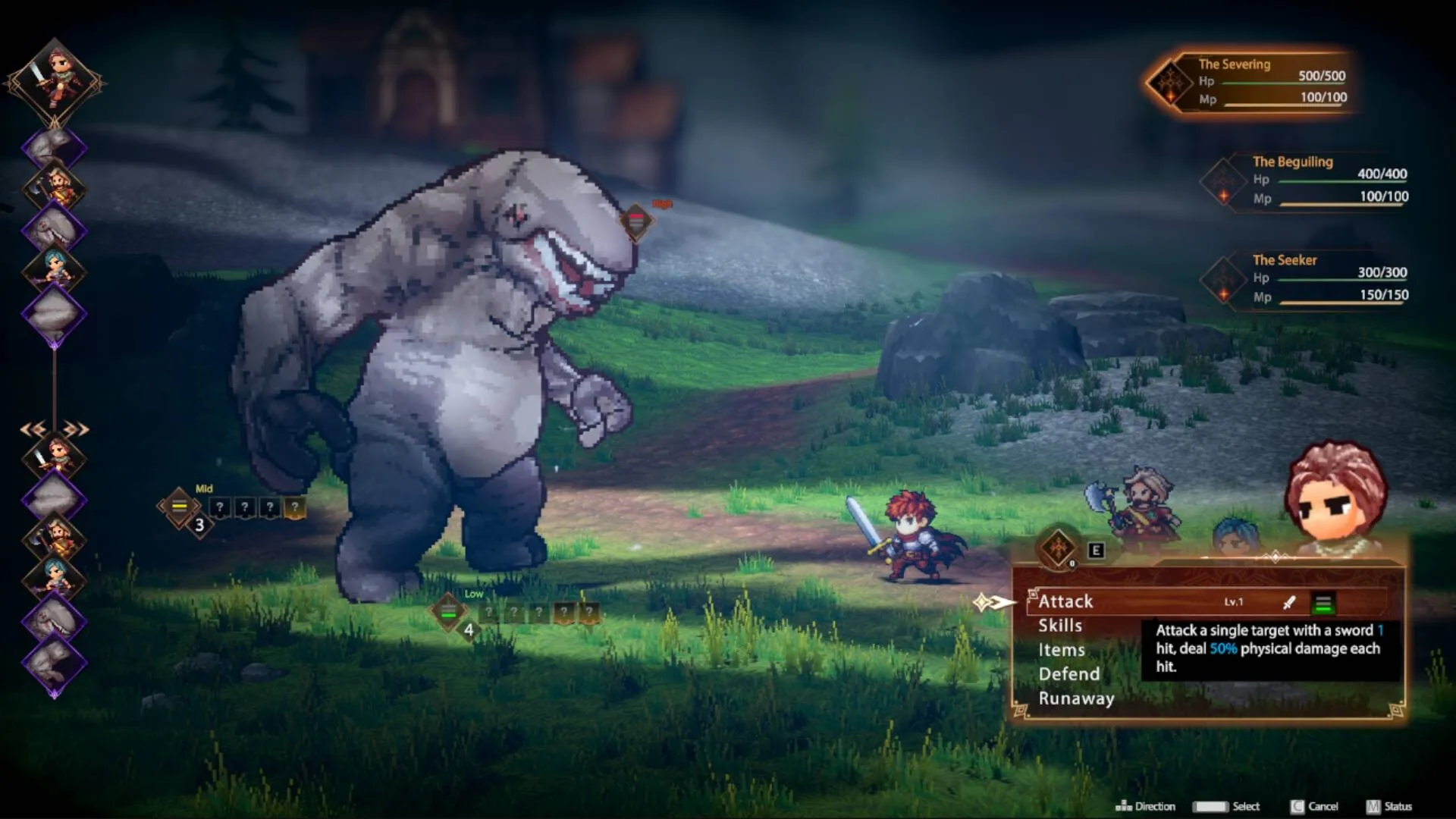
Height-based combat, limbs to sever on Titans, a karma system. Genuinely new mechanics, in a shell that still has to find its own identity.
Alexandrosse
Let us start with the point everyone agrees on, including the harshest critics: it looks good. The 2.5D style, with cut-out sprites over three-dimensional sets and carefully worked lighting, still works beautifully, and The Severed Gods comes through the visual test with honours.
Now your two questions, which are exactly the right ones: are there new mechanics, and how is the story? Separate answers, because they are not worth the same.
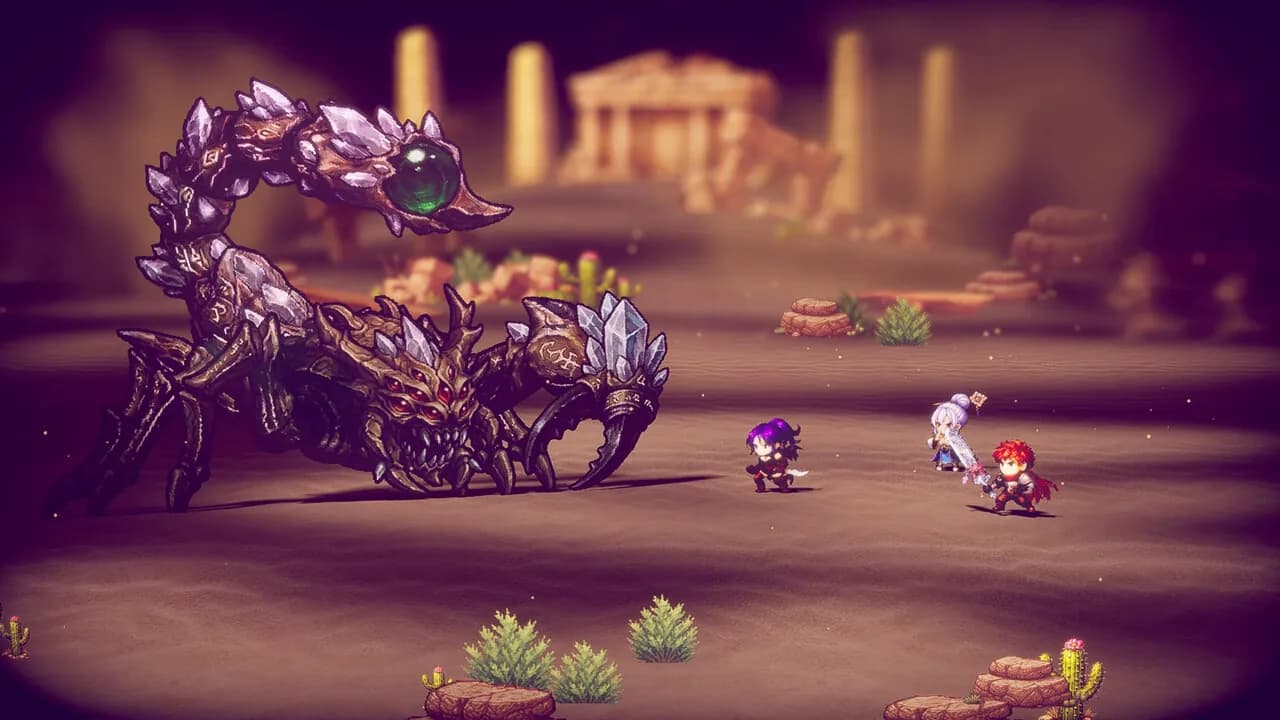
Impossible not to start there, because everyone said it before us. When the Vietnamese studio Topebox showed its game, the comparison with Octopath Traveler landed immediately, and not only on the art style. Developers pointed out, very precisely, the near-identical combat interface, the boost system, the elemental weaknesses hidden behind question marks until you reveal them, the scale and animation of the monster sprites, the positioning of the parties, right down to the fonts and the camera movements. One even noted that the class names had not been changed.
Two qualifications are needed, in fairness.
The first is technical, and it comes from a player who took the time to look closely: the objects here are low-poly 3D run through a pixel filter, with pixels that jitter instead of sitting perfectly aligned, puppet animations for the bosses, far simpler terrain, no background blur, and a Unity engine where Octopath runs on Unreal. It is not the same construction, even if the aesthetic intent is related.
The second is legal and worth knowing: Square Enix trademarked the term HD-2D, not the style itself. Nobody holds a monopoly on sprites over 3D sets, which is precisely why the term 2.5D spread. A genre is always born this way, by imitating a model, exactly as the soulslikes were.
Still, the studio acknowledged the problem and announced a full interface overhaul, which was the right response.
Here is the answer to your first question, and it is more positive than the controversy suggested.
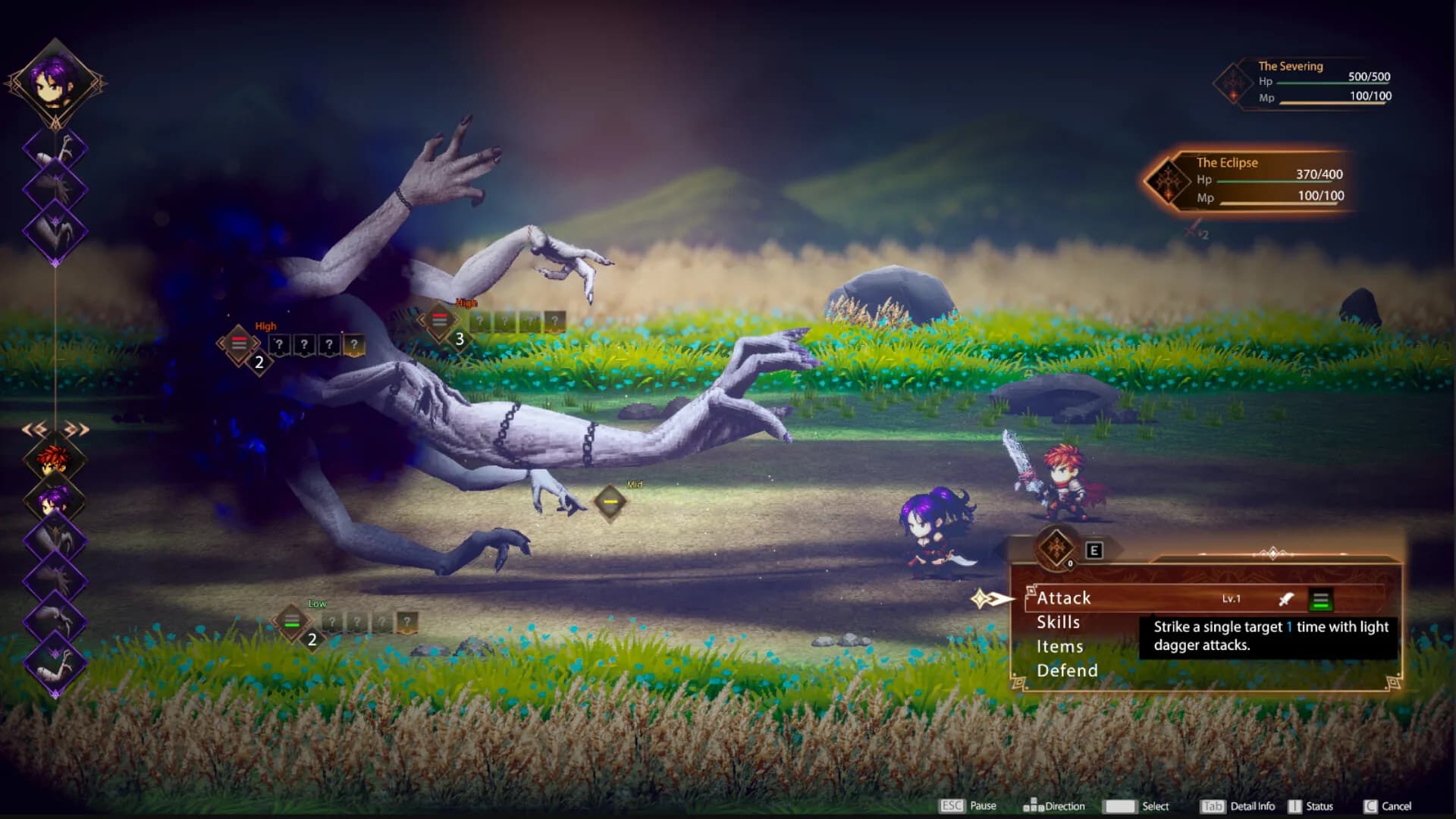
The central idea is height-based combat, and it is genuinely clever. The battlefield is no longer a single plane: every enemy has Low, Mid and High body parts, each with its own shield and its own weakness. You are no longer breaking a single guard gauge, you are dismantling a creature zone by zone.
The logical follow-up is better still: you can sever limbs to permanently disable abilities and reduce the number of attacks an enemy has available. On the colossal Titans that serve as major opponents, that means taking them apart piece by piece, from legs to torso to head. That is a real difference from Octopath's break system, where you attack a single block.
The rest fills in properly. The game is a roguelite: every death starts a new cycle of reincarnation, with heroes, skills and relics unlocked permanently. A karma system separates Virtue from Sin through concrete choices, such as taking supplies from a dying soldier or escorting them to safety, with Virtue earning the respect of allies while Sin unlocks forbidden powers. Each hero carries a Hero Mark that also works outside combat: the thief steals items from characters, the scholar uncovers enemy weaknesses, the merchant recruits followers. And heroes can inherit abilities from the characters they meet, while relics transform how skills function.
One point of caution, though, raised by a player of the Next Fest demo: he gave up because of the hit randomness. Striking a part his character was supposedly able to reach produced too many misses, and combined with the generous health pools of tougher enemies, the feeling was of fighting the dice rather than the game. He was careful to say he loved the idea and found the move effects very good. The studio replied that it was taking note, but this is the kind of tuning that decides everything in a tactical game.
Second question, less flattering answer.
The setting is a dark fantasy world overrun by colossal Titans, where a band of heroes marked by fate walk an endless path of death and rebirth to slay the gods. You travel through ruined villages, towering strongholds, barren deserts and cursed lands, and you must uncover the truth behind the Titans, the Umbra and the mark you bear.
On paper, that is fine. In practice it also describes a great many other games, and the announced mode of storytelling invites caution: the story reassembles itself through scattered fragments and interactions with characters. That is the standard roguelite procedure, and it has a known flaw: when the structure forces you to restart everything, the narrative becomes an atmospheric puzzle rather than a plot that holds you. It is hard to grow attached to eight heroes when the game reshuffles them every cycle.
Worth noting too, the store page has shifted since the first presentations: the pitch then was eight heroes reincarnated to stop a mysterious dragon named Umbra, and today it speaks of Titans and a vaguer Umbra. The narrative is visibly still settling.
The game launches today in Early Access, developed and published by Topebox, a small Vietnamese team working in Unity. No user reviews exist yet, which is why we are not giving it a score. And this needs flagging immediately: the game is available in English and Chinese only, with no French version.
The bet is clear. Visually, it will have to prove it is something other than a very good Octopath student, and the announced interface overhaul will be the first test. Mechanically, on the other hand, height-based combat and severing limbs from Titans are real ideas, solid enough to justify the game's existence. What remains is fixing that sense of fighting the dice, and proving the story holds over time.
A demo exists, and for an Early Access at this stage, that is clearly where to go before paying.
We watch the release calendar together on our Discord, come and watch with us.
Community
Your rating
Loading comments...
You might also like
A sorting game where every bone starts out unknown and you learn to recognise it. No date yet.
Announced for 25 September. What the store page describes, what it does not say, and why we will wait to play it before judging.
A magical sorting game where you unlock spells to work faster. No date yet, so no score yet.