7
Test
Barfender: my idiotic friend drank all the beers
A co-op bar that collapses while you serve. 98 per cent positive, and one of the rare times chaos is the actual subject.
Alexandrosse
7 min

Three and a half years of early access, a final version today. An empire to build across New York, on foot, behind the wheel, and in parking spaces.
Alexandrosse
InsertCoins.press Score
8/10
Verdict
Recommended
Thirty-six years old, and I spent the first hour not knowing what I was playing.
I was walking down a New York street, getting into a car, entering a building. Then I was buying a sofa, checking whether I had slept enough, and consulting a payroll sheet. Three different games, in the same session, with no transition.
The camera does not help you decide. You play from a high, tilted view over the city, the way the early GTA games worked, and you move around a little person with needs and furniture, the way The Sims worked. Two references with nothing in common, and a game that summons both without warning.
It took me a while to understand that this was the point, not a flaw.
Big Ambitions launched into early access on 10 March 2023. It leaves it today, with its 1.0, after three and a half years of public development.
This is not a quiet launch: the game carries over thirteen thousand reviews, 93 per cent of them positive. It is made by Hovgaard Games, the Danish studio behind Startup Company, and it sells for twenty-six euros.
In other words, this review is not discovering an unknown. It is looking at a game plenty of people have played for years, at the moment its author declares it finished.
The starting point is modest: an uncle hands you an apartment and a first job, and your bank balance is pitiful.
Setting up a business follows a sequence you then repeat dozens of times. You take a loan, rent a unit, design your logo, renovate the shop, buy stock, hire staff. Then you do it again somewhere else.
The available businesses cover plenty of ground: gift shop, supermarket, coffee shop, law firm, clothing store, liquor store, florist, and enough to run a fast-food chain or a website development outfit.
None of that is original in itself. What is original is how the game makes you do it.
Here is the real subject of this game, and it explains my initial confusion between two genres.
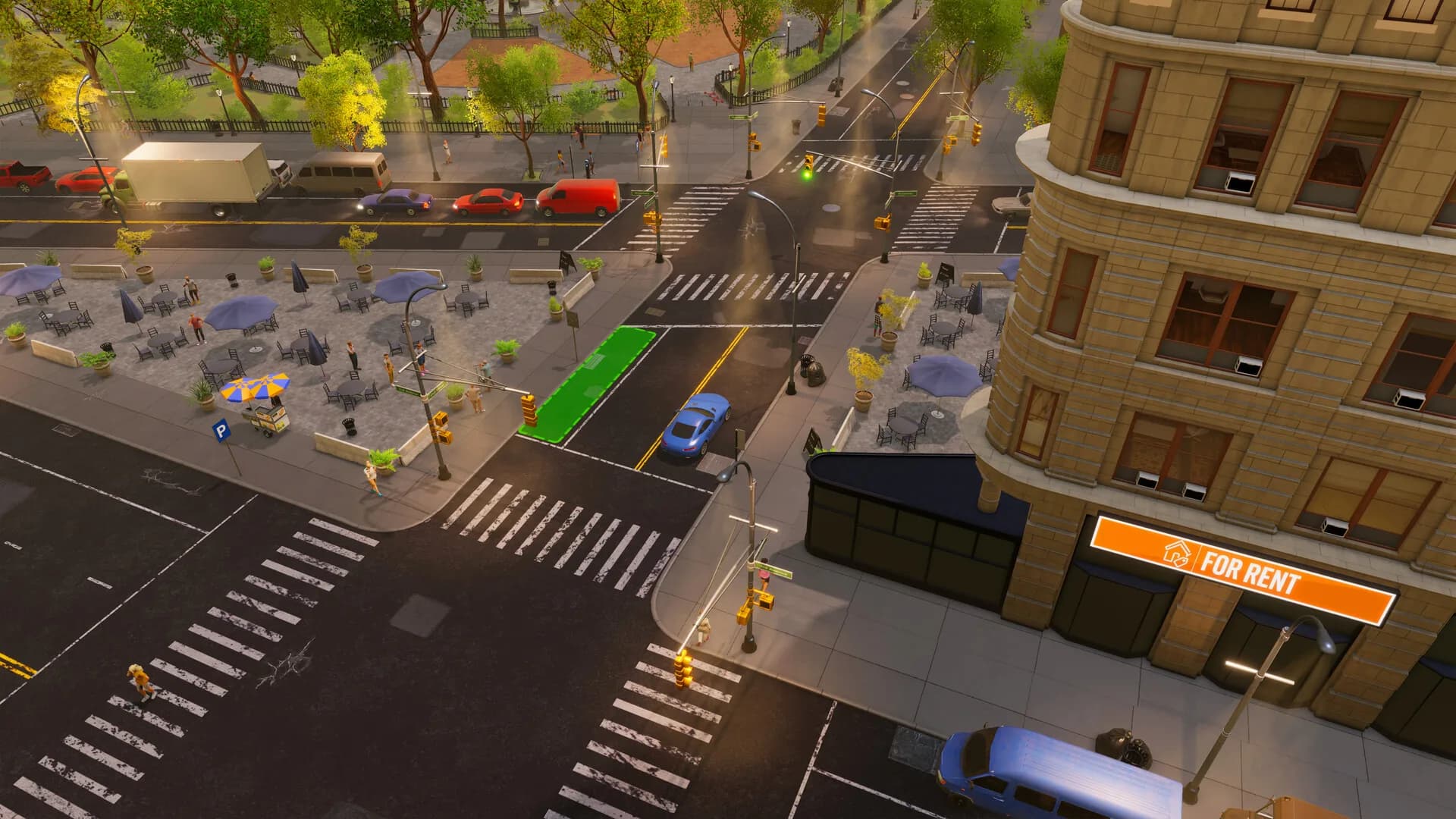
There is no button for buying a truck. You have to go to the dealership, in New York, physically. There is no button for eating either: you go to the supermarket, and you had better have thought about buying a fridge so you can bring something home. The studio sums it up in a line that is the key to the whole thing: your character has to interact physically with the world to survive and succeed.
That sounds incidental. It is structural.
In a conventional management game, a decision costs money and a click. Here, a decision costs money and a journey. Opening a second shop at the other end of the island means committing to a round trip on every restock until you build the logistics that avoid it.
The result is that geography becomes an economic constraint. You no longer choose a location because the rent is low, but because it is on the way to the others. That is exactly the question a real shopkeeper asks, and I do not know many games that impose it this naturally.
The flip side is immediate and players joke about it among themselves: you spend a considerable amount of time driving, and a non-trivial share of that time parking. One review puts it better than I can by claiming half its hours went on parallel parking. It is true, and it is the price of the system.
The game transforms once you outgrow the single shop, and that is where it gets genuinely interesting.
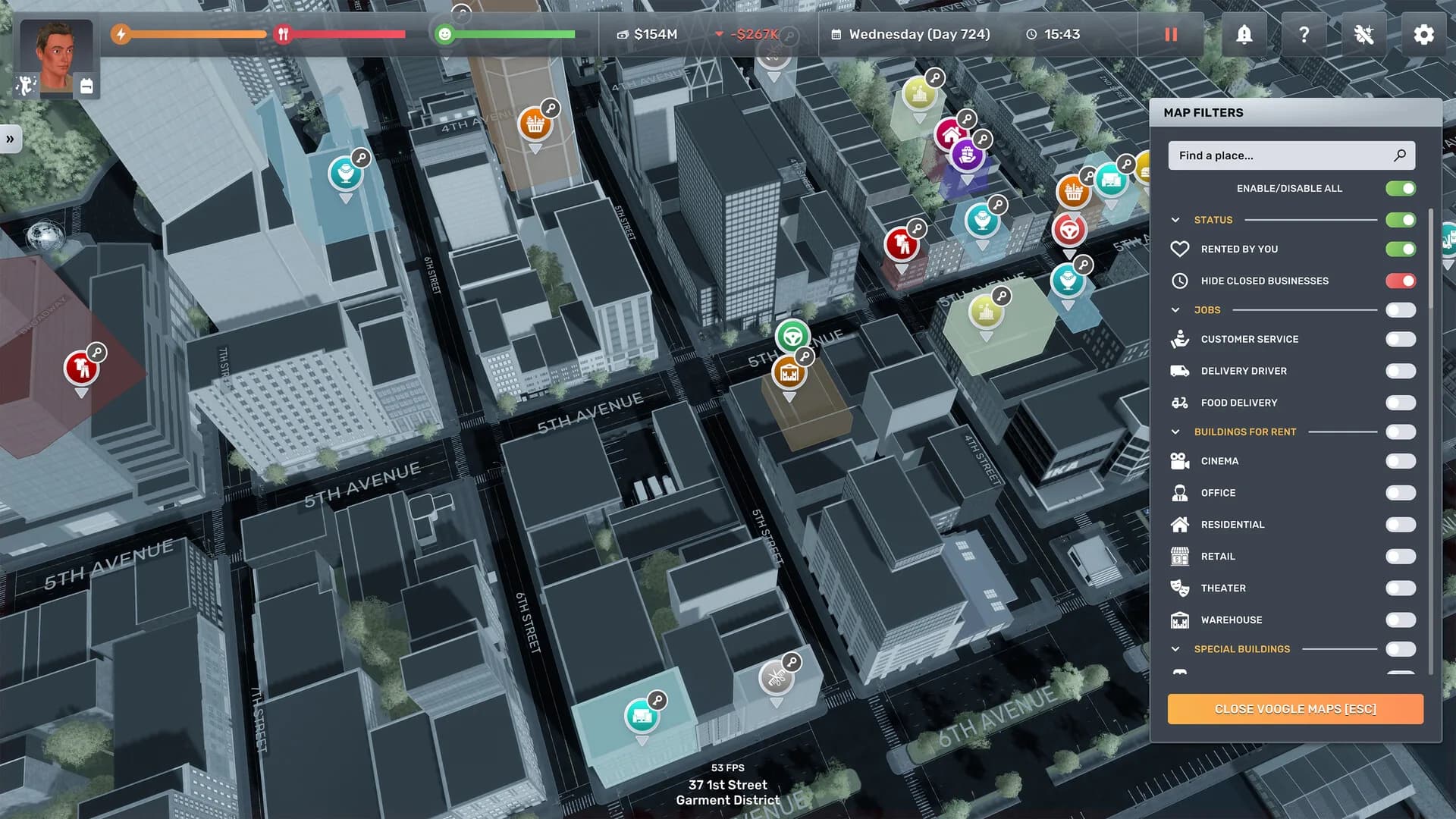
You need supply, so you import through the harbour, so you build a network of warehouses to distribute to the stores. Logistics stops being a word and becomes a map.
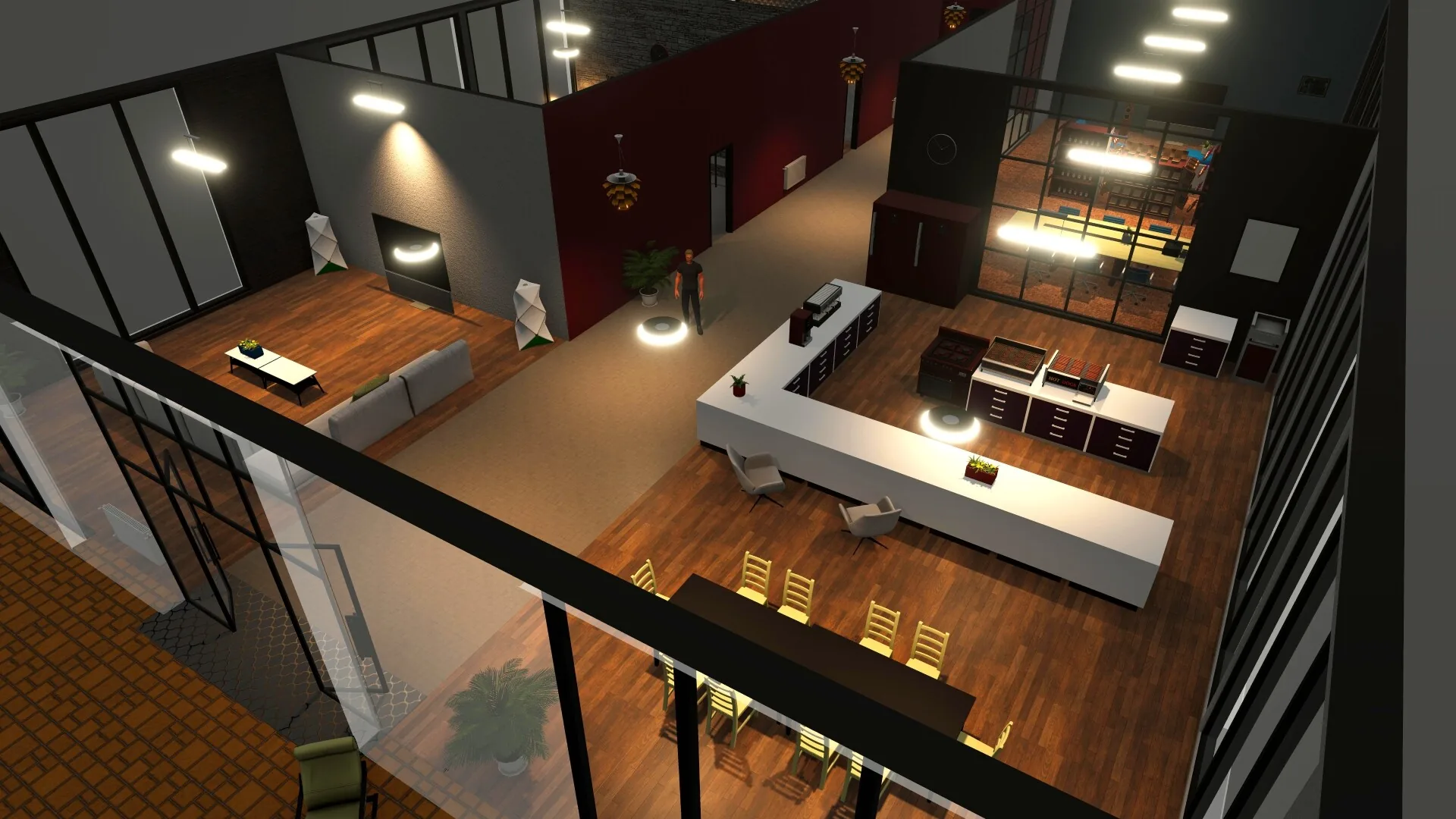
And you need people to run all that. You hire HR managers, logistics managers and purchasing agents. With a detail I love: these people need desks and computers. So you need a headquarters. So you rent it, fit it out, furnish it.
The org chart has an address. Your administrative structure occupies space in the city and costs rent. That is an elegant design shortcut to a truth management games usually dodge: growing is not only earning more, it is becoming heavy.
Because alongside all this, there is a life to lead.
You have to sleep, stay healthy, stay in a good mood. You move from a studio to a midtown penthouse, or a townhouse in Hell's Kitchen, and you furnish each place according to your means and your taste.
You buy cars, from the big family vehicle to the sports model. You can put money into investment funds or go and lose it at the casino. Property is an investment in its own right: any building in the city can be bought.
It is that half which gives the impression of playing something else. It is not decorative: your condition governs your ability to work, and the comfort of your home governs your condition. An exhausted boss manages badly.
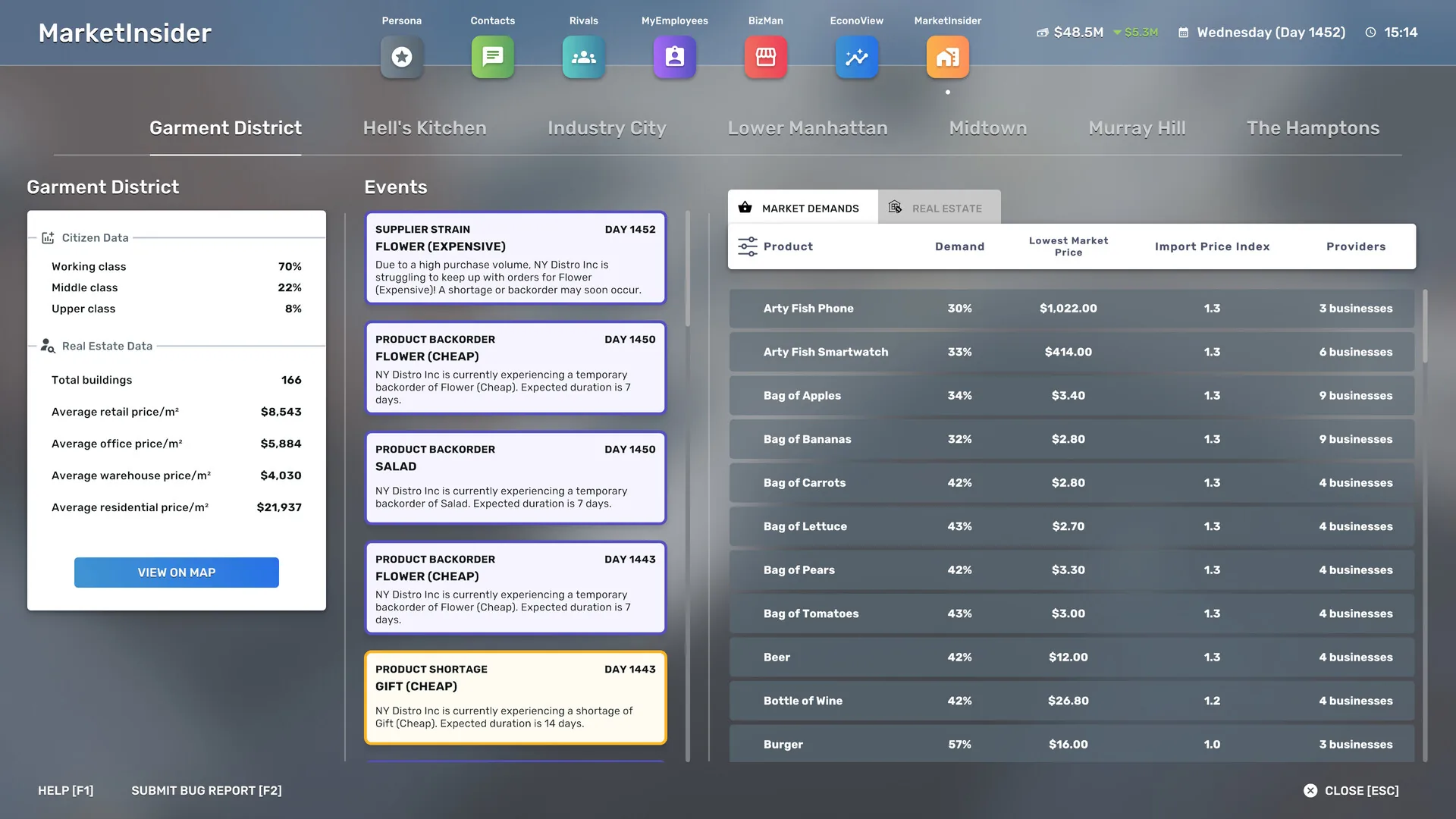
There is one screen that sums up the seriousness of this simulation better than anything else, and it is the market panel.
The city is divided into real districts, from the Garment District to Hell's Kitchen by way of Industry City, Lower Manhattan, Midtown, Murray Hill and now the Hamptons. And each is described by data you have to learn to read.
Social composition first, with the split between working, middle and upper class. A district that is 70 per cent working class does not consume what an affluent one buys, and putting the wrong shop in the wrong place is paid for in unsold stock.
Property prices per square metre, separated between retail, office, warehouse and residential. On the same street, the gap between warehouse space and housing can be fivefold.
And above all, a demand list by product, with the percentage of unmet need, the lowest market price, an import price index and the number of competitors already selling the thing. That is a market study, precisely.
Add events that disrupt supply chains: an overstretched supplier warning of a coming shortage, a backorder lasting a week, a shortage running a fortnight. Your plans depend on people you do not control.
This is where the game stops being a genre curiosity and becomes a genuine economic simulation. You do not choose a business because it looks nice, you choose it because a table says demand sits at 57 per cent and only three competitors are sharing the market.
The 1.0 is not a label change, and its contents are worth detailing.
The Hamptons, a new neighbourhood. Largely residential, though it does have a retail strip and luxury stores. There are mansions costing several million, and even gated communities with a private dock. An amusing detail: some houses already belong to people you know. Uncle Fred has one, so does his golf nemesis Richard, and so do your own rivals, provided you have not already driven them out of the city.
The private driver, long requested, arrives via Onyx Luxury Chauffeurs. The design is well judged: you supply the vehicle, from your uncle's cheap runabout to a limousine, you sign a contract, you leave the car in their garage, and you summon the driver whenever you need one. It is the official answer to the parking problem, and it lands at the right point in progression.
Food delivery through Speedy Bites, brought to your home or your office. And which you can also carry out yourself for quick money, which is a nice loop for the early game.
And a banking overhaul worth examining. Negative interest disappears, the studio judging that it exists in reality but remains too rare to justify the friction. Loans get stricter, with higher income requirements, heavier rates and minimum daily payments, but the borrowing ceiling rises and partial repayment becomes possible. Investments gain daily auto-investing and partial withdrawal without closing the account.
Those banking changes say something about the studio's seriousness. Making loans harder while raising the ceiling is a refusal to take the easy road in either direction.
Three things, and the last is the one not to get wrong.
The step up is steep. This is not a management game you understand in ten minutes. Players say so freely, including the ones recommending it. Budget a first run sacrificed to learning.
The endgame thins out. Once the machine is running and money is plentiful, repetition sets in. That is the genre's chronic ailment and this game does not entirely escape it, though the support promised after 1.0, with further updates and a first piece of additional content, leaves room.
And there is no multiplayer. I am saying it plainly because the question comes up constantly: the game is single-player. A community mod exists that allows several people to play, and the studio has announced no official mode. If you are buying this to build an empire with somebody, you are depending on an unofficial modification.
Worth noting all the same, since June, Steam Workshop support, which opened the door to mods and should keep the game alive well beyond the studio's own additions.
My early confusion was not an accident, it was an accurate description of the game. Big Ambitions layers three things: a city you genuinely cross, an existence to maintain, and a company to run.
And it stands up because those three layers pay for each other. The spreadsheet becomes concrete because you have to drive to its consequences. Personal life becomes an economic variable because a badly rested boss works badly. The city becomes a logistics problem because it has distances.
There is one last thing, and it is what struck me most. Your character ages. The game warns you along the way, with slightly cruel elegance, that money does not buy time.
At thirty-six you do not necessarily want a management game reminding you of that. But it may explain why I kept playing long after I had finished taking notes.
Which business do you start with? Come and defend your first unit on the InsertCoins Discord.
Community
Your rating
Advertisement
Loading comments...
You might also like
A co-op bar that collapses while you serve. 98 per cent positive, and one of the rare times chaos is the actual subject.
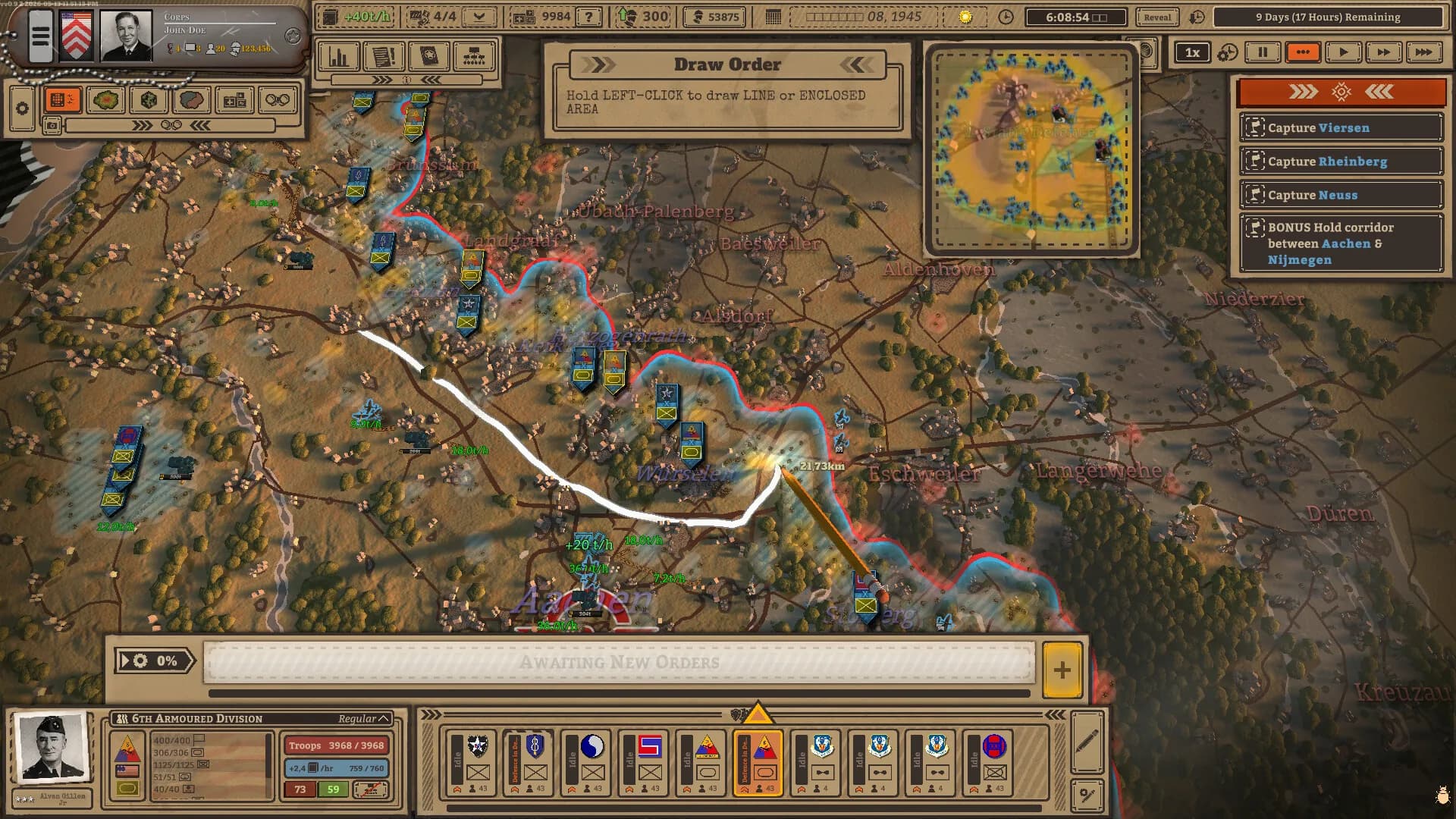
You draw a plan on the map and officers execute it alone. Except the game crashes every other planning phase.
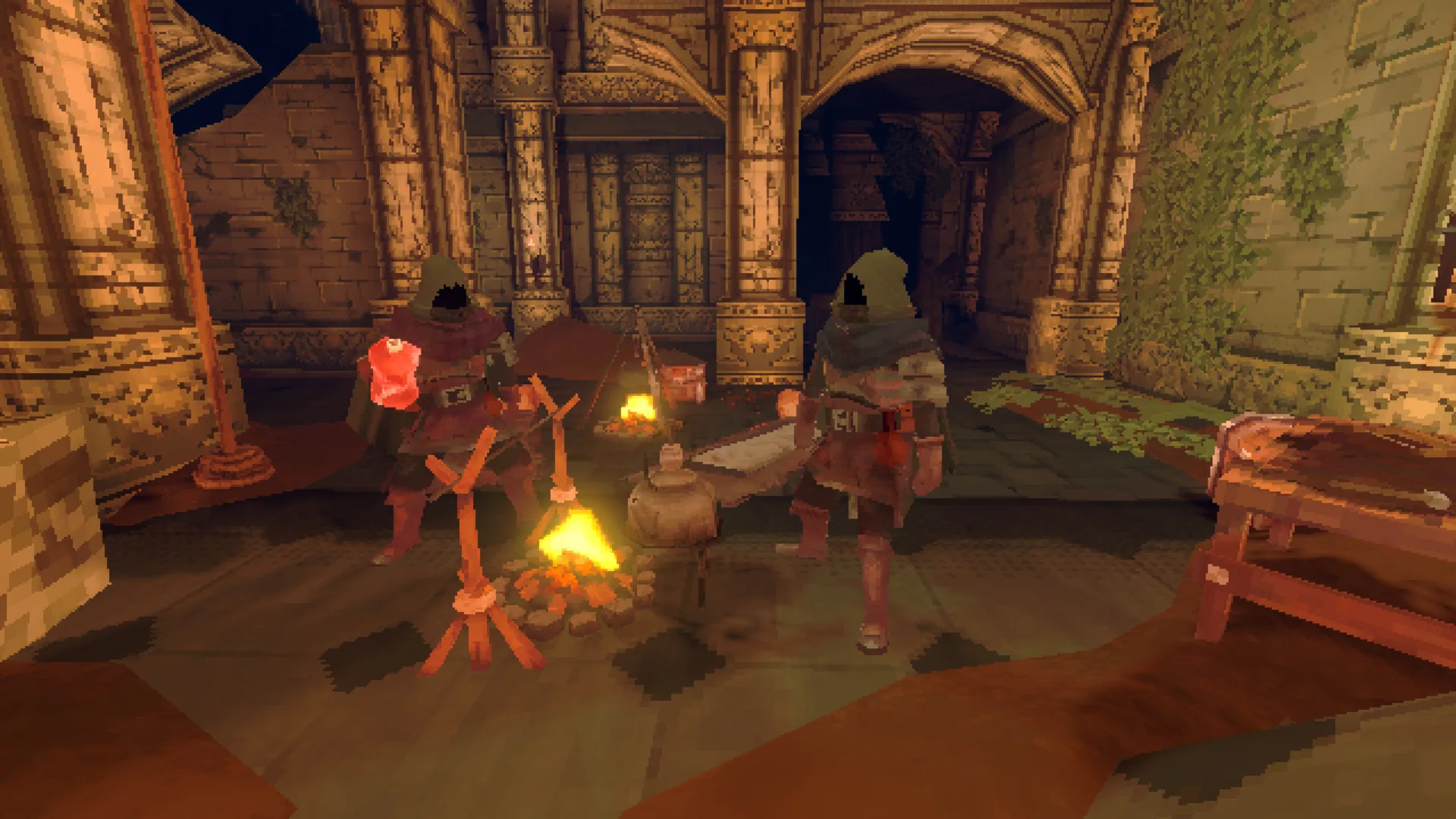
The Knights of Pen & Paper team return with a dungeon where you come back to camp, cook, and unlock recipes that change your stats.