7
Test
Dungeon Inn: running an inn while keeping two rival guilds from meeting
You struck a deal with a dragon. All that is left is serving both sides without either finding out. The 1.0 lands on 23 October.
Alexandrosse
7 min
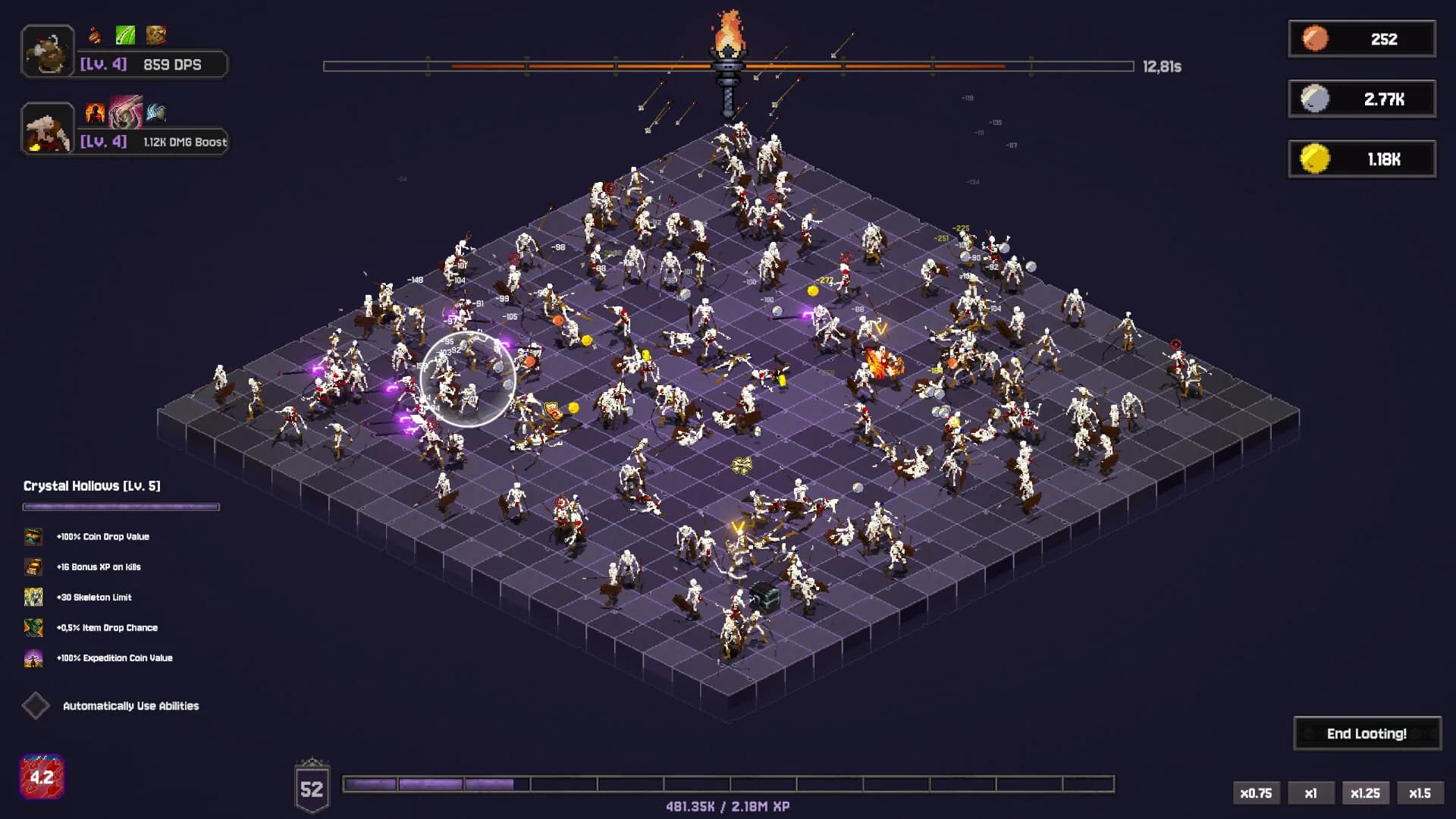
A hundred skeletons on screen, numbers climbing on their own, and one real question: which party collects the most.
Alexandrosse
InsertCoins.press Score
7/10
Verdict
Recommended
There is a tickbox at the bottom left of the screen labelled "automatically use abilities".
That is the moment you understand exactly what you have bought. Bones and Coins does not ask you to play well during the fight. It asks you to have prepared the fight well, then to watch.
Depending on your mood that is either a restful revelation or a disappointment. For me it was both, three hours apart.
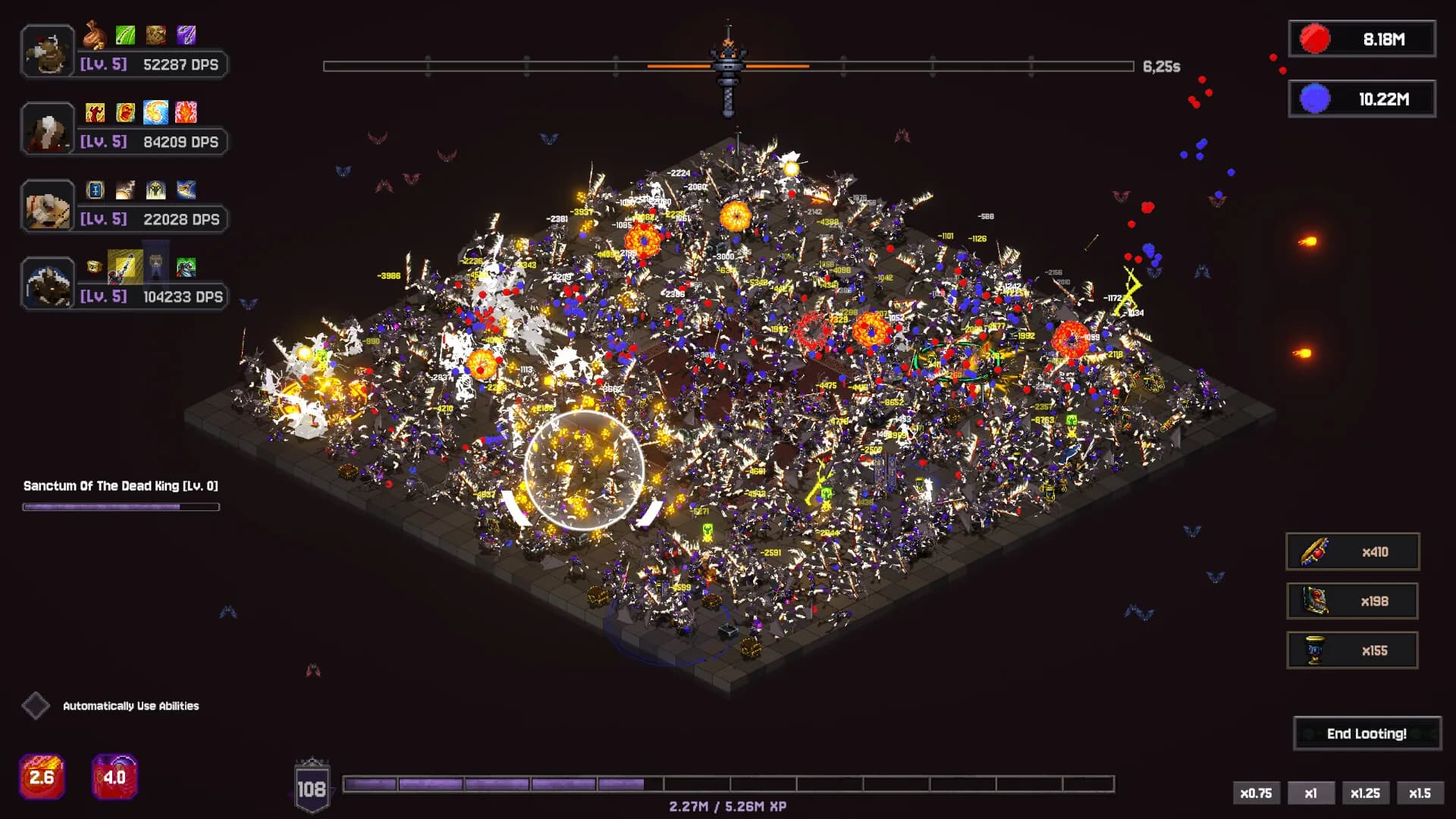
An isometric pixel-art platform, a torch at the far end, and several dozen skeletons throwing themselves at your small party while damage numbers rain down.
Top left, your heroes, with their level and their contribution: this one does 859 damage per second, that one adds a 1.12K bonus. On the right, three currencies climbing. At the bottom, an experience bar reading 481 thousand out of 2.18 million, which tells you everything about the curve.
And a speed setting, from 0.75x to 1.5x, because the game knows perfectly well you will want to hurry it along.
It is legible, it is dense, and it is frankly satisfying to watch. The pixel art is nothing exceptional, but it handles overload well: even with a hundred enemies on screen, you can pick out your heroes.
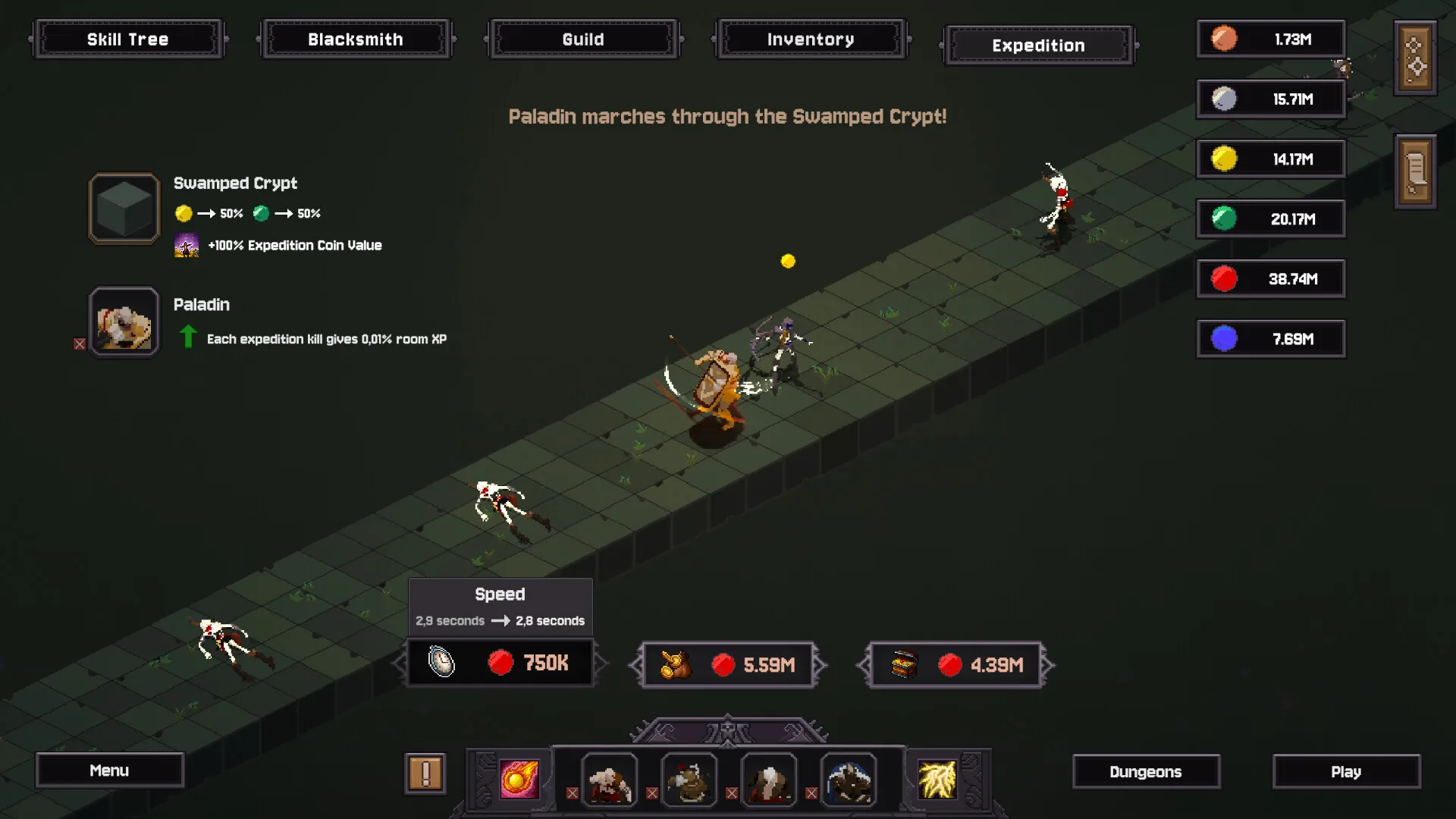
Three places, three decisions.
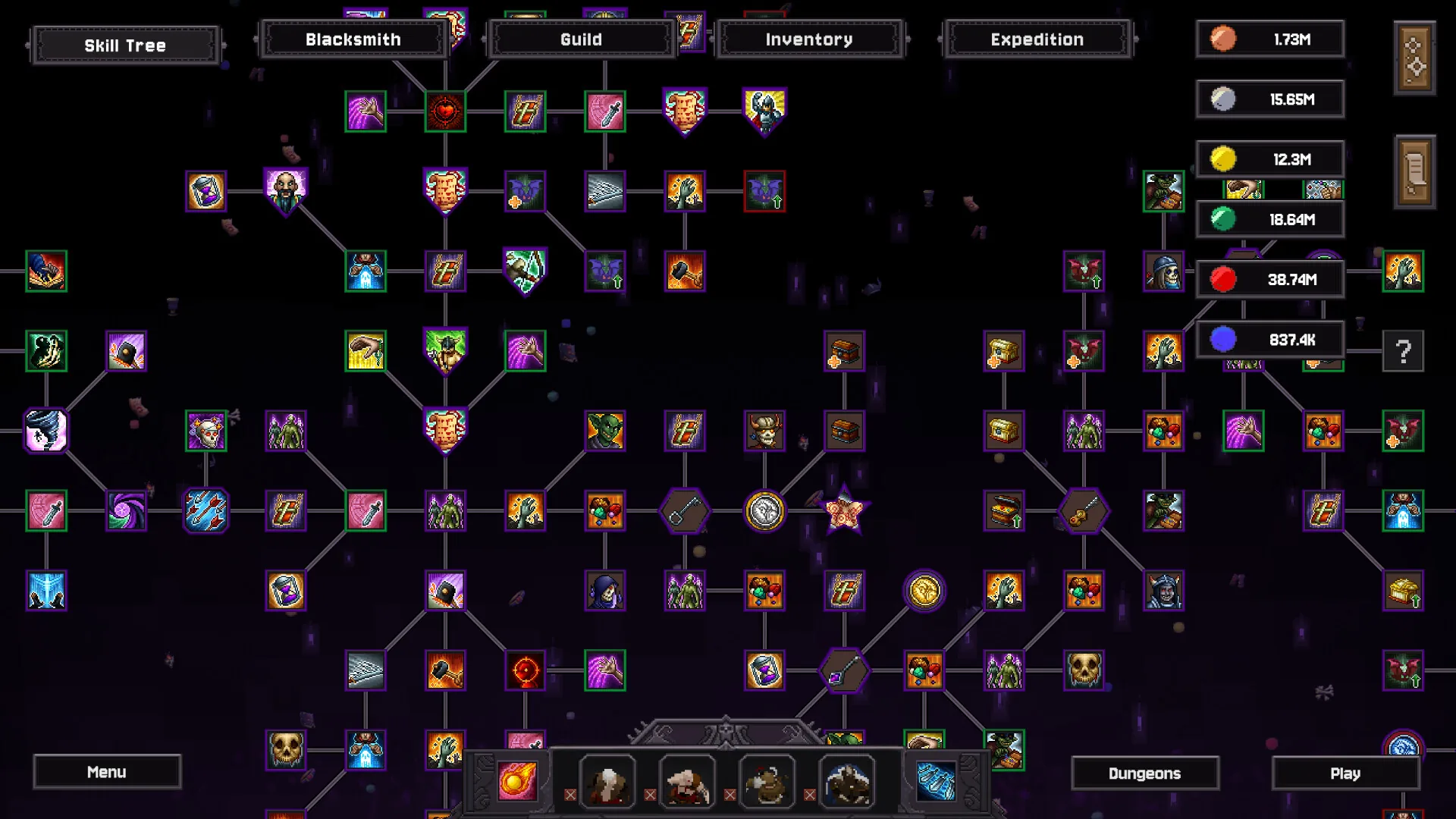
The Guild recruits and upgrades heroes. The game promises six, each with their own upgrade paths and abilities. The demo ran with the Barbarian (soaks damage, hits on the front line), the Archer (steady ranged damage) and the Shaman (support), then the Wizard arrived along the way.
The Blacksmith forges weapons. Sixteen in total, and the studio stresses a point that matters more than it sounds: each has its own attack animation. In a game where you spend your time watching, that is what stops everything blurring together.
The skill tree holds over one hundred and sixty upgrades. That is where most of your coins go, and it is the spine of the progression.
On top of that come blessings, applied to heroes at the Guild. The full game plans five slots per hero, which is the real ground for party building: that is where you decide whether the Shaman heals, amplifies or drives the economy.
This is the detail that kept me longer than planned.
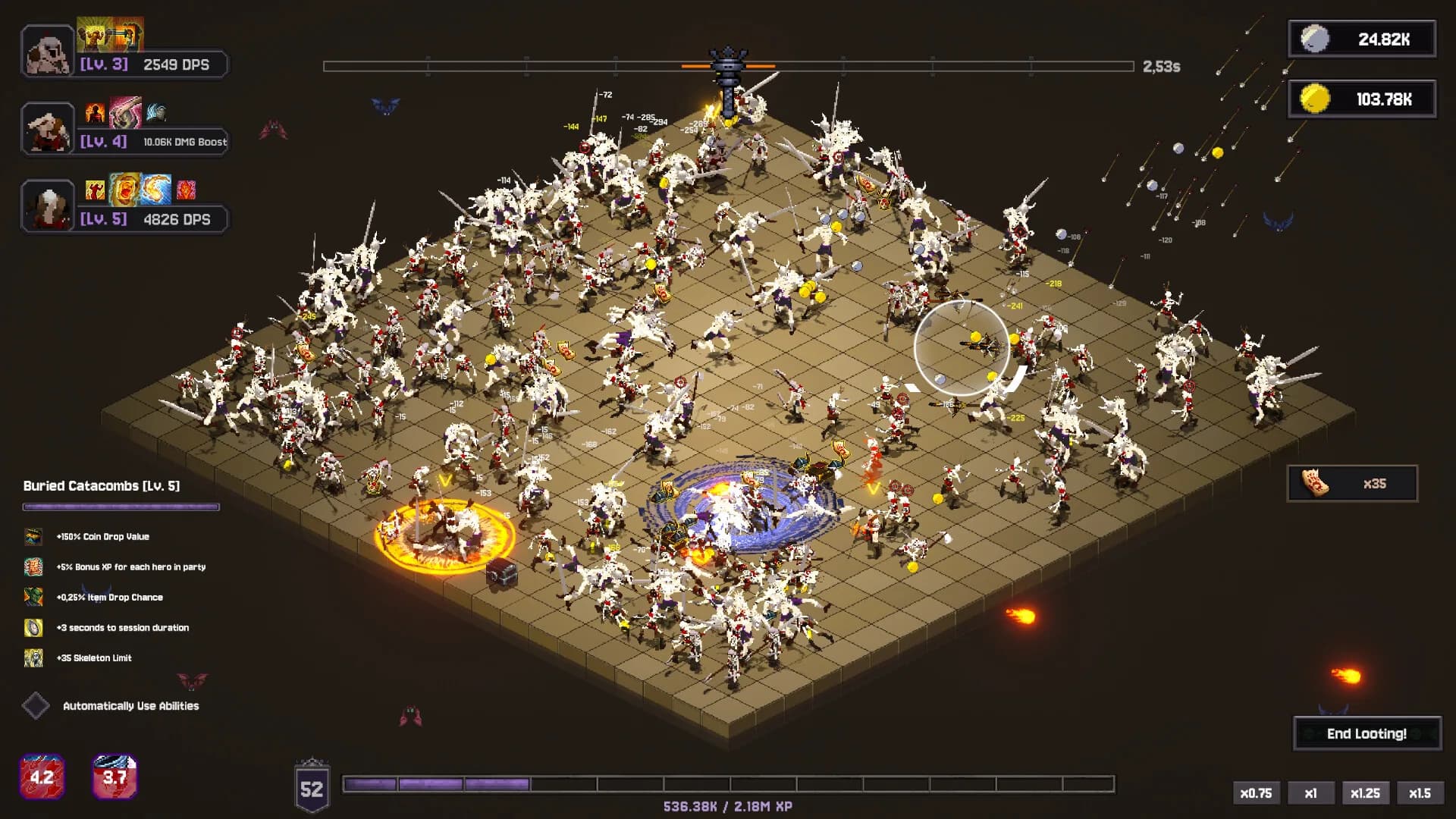
Every dungeon room has its own level and its own bonuses, spelled out on screen. In the Crystal Hollows, for instance: one hundred per cent more coin value, sixteen bonus experience per kill, thirty more skeletons allowed at once, half a point of item drop chance, and one hundred per cent expedition coin value.
That skeleton limit is the game's most interesting figure. It is tied to room size, and it determines how many enemies can exist simultaneously, and therefore your rate of income. Levelling a room is not just earning more per enemy, it is raising the number of enemies the room can hold.
In other words you are not optimising your party in the abstract, you are optimising it for one specific room. The eight announced rooms each have their own drop rates and exclusive enemies, whose items feed the Blacksmith or get sold.
The developer, working alone at Troyd Games, spent the year in public: a playtest in January, a Next Fest demo in February, updates through to June.
What was added since is not cosmetic: an expedition system, hero abilities, new playable heroes, the complete blessing system, new rooms, a substantially expanded skill tree.
And the patch notes show somebody listening. Room size no longer grows endlessly in the same way, a skeleton limit was introduced to stop the screen turning to soup, combat readability was reworked, the economy rebalanced.
For a one-person game published by Rogue Duck Interactive and Gamersky Games, that is a clean record.
It is an incremental, with everything that implies. Gains climb, numbers turn absurd, and the pleasure comes from the curve rather than from the action. If watching a party fight on its own bores you on principle, no system here will change your mind.
Combat expects nothing from you. You tick the ability automation and become a spectator. The game lets you trigger them by hand, but let us be honest, nobody will do that for long.
It is single-player. There is Remote Play Together, which lets you share a pad remotely, but it is not a co-op mode.
The entry barrier, though, is nil: one gigabyte of disk, four gigabytes of memory, integrated graphics, and mouse-only play. This is exactly the game you install on the work laptop.
I went in with a preconception, the number game that plays itself, and it is not entirely wrong.
But one design decision saves the whole thing: by tying bonuses, enemy limits and loot to the room rather than to the character, the game forces you to rebuild your party for each destination. That replaces the soft question of "how do I get stronger" with a sharp one: "which setup for this room".
It is not a great game, and it does not claim to be. It is a good incremental, honest about its contract, made by one person, and it does exactly what its store page promises.
How many skeletons can you hold on screen at once? The record is being contested on the InsertCoins Discord.
Community
Your rating
Advertisement
Loading comments...
You might also like
You struck a deal with a dragon. All that is left is serving both sides without either finding out. The 1.0 lands on 23 October.
A co-op horror fishing game at nine euros. You must sacrifice fish every day, and the beast is not the worst thing out there.
Scrapheap robots sent to exterminate a planetary fungus. The 1.0 lands tomorrow, and the upgrade grid is the genre's best idea.