6
Test
Backrooms: Code Yellow: you explore infinity with six people, then head home to bill the day
A co-op game where exploring the yellow hallways is paid work. And you may not be alone.
Alexandrosse
7 min
A post-apocalyptic factory game where machines move nothing: automatons follow the instructions you write.
Alexandrosse
InsertCoins.press Score
7/10
Verdict
Recommended
There is a line on Brave New Wonders' store page that raised an eyebrow: no conveyor belts and no coding, it is just you and your army of automatons.
Removing the conveyor from a factory game is like removing the pickaxe from a mining game. You then have to explain what replaces it.
Intelligent automatons move the materials, following the instructions you give them.
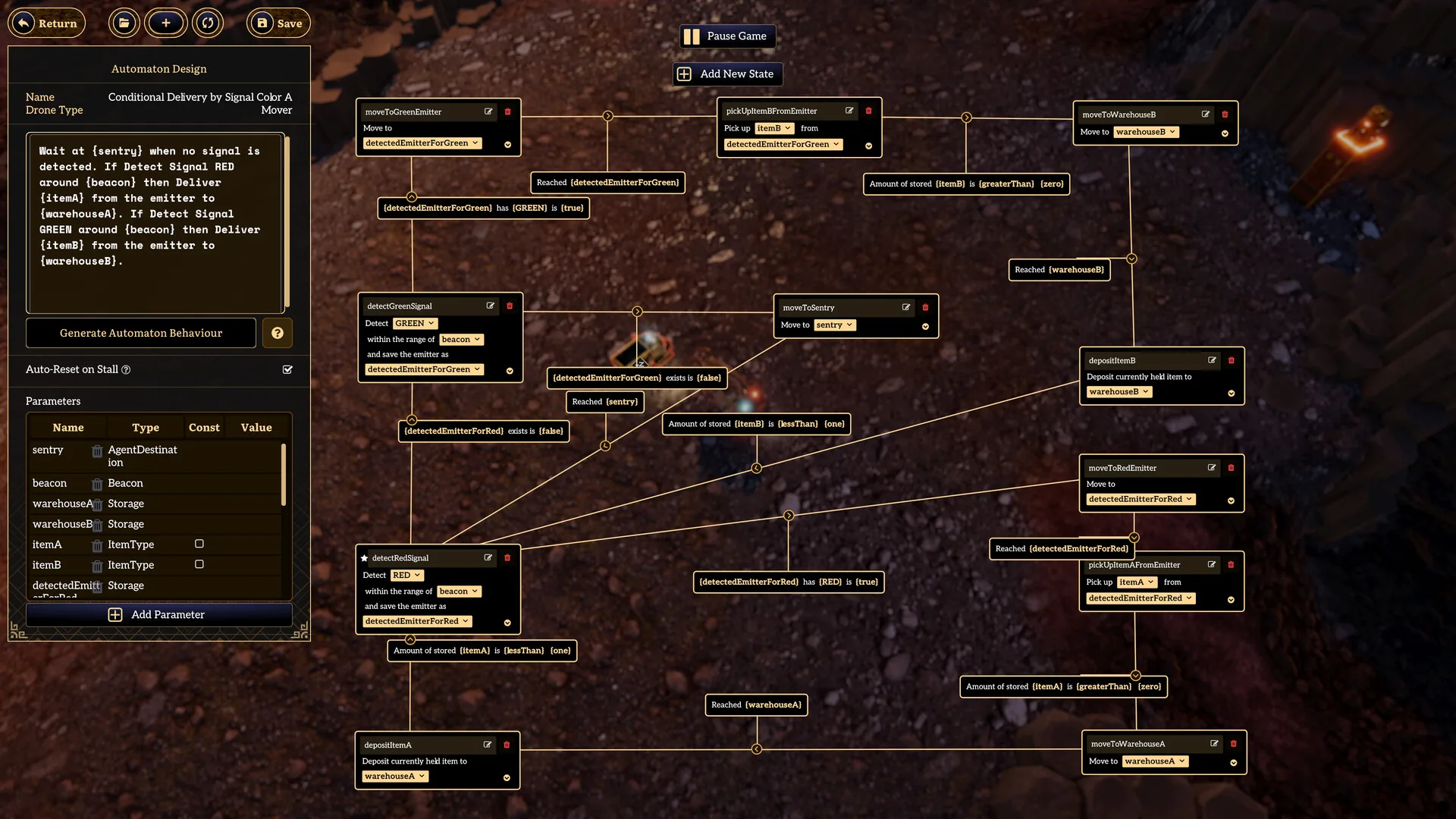
You start with simple presets, then write behaviours in plain language, in any language, without a line of code. A behaviour editor guides you as you write.
The studio's examples are clear. You can tell an automaton to move between A, B and C in order. Or set a condition: when a red signal is detected at the warehouse, pick up crystal compound from the general factory and deposit it at the warehouse.
And it goes further: buildings and factories broadcast coloured signals and react to each other, letting you wire programmable systems across your whole base.
In other words, the game replaces physical logistics with logic. You no longer draw a path, you describe a rule.
It is more than a cosmetic variation, and it produces two effects.
The factory becomes legible differently. In a conveyor game you understand an installation by following the lines with your eyes. Here you have to read behaviours. It is less immediate visually, and closer to what modern warehouses actually do.
And debugging changes nature. A blocked conveyor is visible. An automaton following a badly written rule does exactly what you asked, which is infinitely more galling and, let us admit, funnier.
The studio adds blueprints to copy and paste whole layouts in seconds, and cloned automatons keep their tasks, which avoids rewriting everything at each expansion. That is precisely the comfort feature needed to keep the system practical.
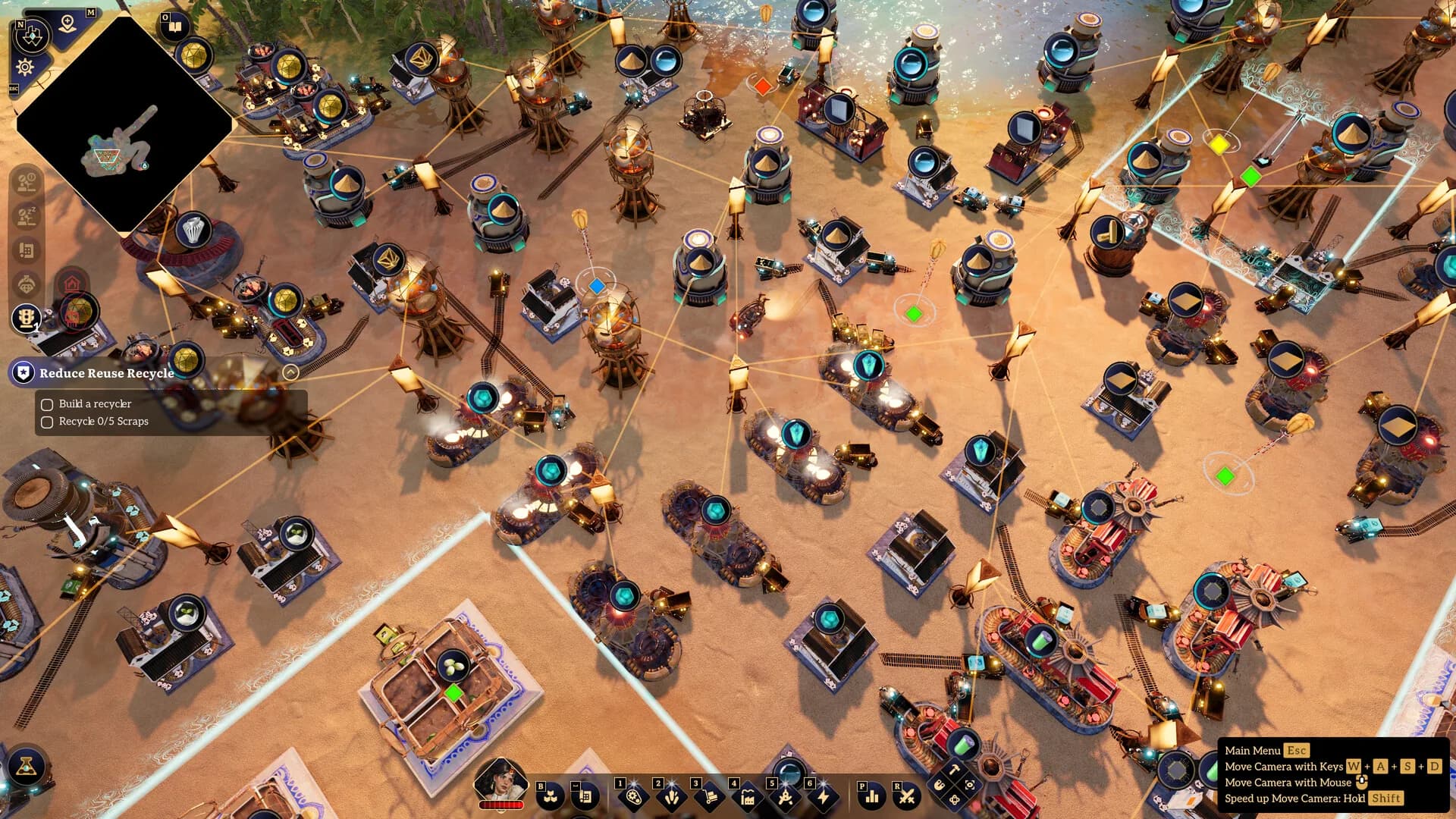
An automation and base-building simulation set in a post-apocalyptic far future.
You mine ore and crystal, smelt them into refined materials, craft increasingly complex components along branching production lines, powered by an expanding energy network.
And you link factories, warehouses and logistics routes, because one factory is never enough.
The studio describes its game as part factory builder, part city builder rising from the ruins, which is a clear ambition.
The game launched yesterday at 21.66 euros, developed by City From Naught and co-published with LoongGate, and it has just two reviews as I write.
Which is to say no usable information, and I would rather say so than pretend.
My main reservation concerns the comprehension of the order system. Writing instructions in plain language is an appealing promise, and also the sort of promise that is hard to keep: it only takes slightly rigid or slightly vague interpretation for the player to spend their time rephrasing rather than building.
That is precisely the point I would watch in early feedback, and it is also what will decide whether this game is a curiosity or a genuine alternative to the conveyor.
Your first conditional rule that went wrong? We collect misunderstandings on the InsertCoins Discord.
Community
Your rating
Advertisement
Loading comments...
You might also like
A co-op game where exploring the yellow hallways is paid work. And you may not be alone.
A tactical roguelite where every relic slot grants a bonus and a drawback. Five months of early access, and a 1.0 today.
A survival sandbox where you can spend a hundred hours farming, or risk everything underground. Eight online, four in split screen.