7
Test
Barfender: my idiotic friend drank all the beers
A co-op bar that collapses while you serve. 98 per cent positive, and one of the rare times chaos is the actual subject.
Alexandrosse
7 min
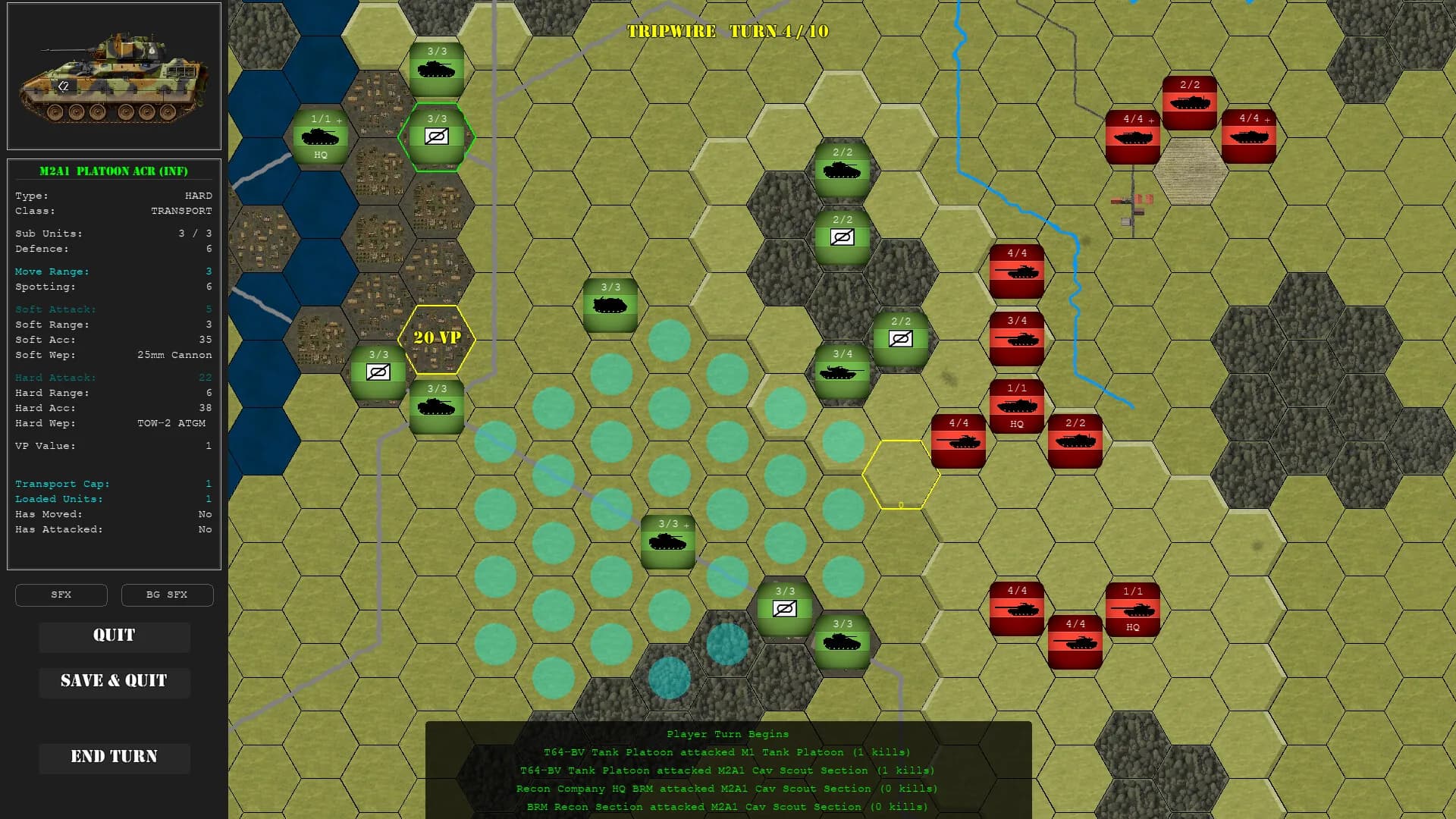
Forty scenarios from 1945 to 1990, five-hundred-metre hexes and platoon counters. No spreadsheets, no logistics, and that is deliberate.
Alexandrosse
InsertCoins.press Score
7.5/10
Verdict
Recommended
There is a line in this game's pitch that, for a genre this conservative, borders on blasphemy: easy to learn, hard to master, without complex logistics or spreadsheets of obscure data to wade through.
A hex wargame proudly announcing that it has deleted the paperwork. That is the idea, and it is what makes this game interesting.
Before the scenarios, look at two numbers, because they explain every choice that follows.
A hex is five hundred metres. A counter is a platoon.
That is not a presentation detail, it is the definition of the game. At that scale you are not commanding an army manoeuvring over weeks, you are commanding a company or a battlegroup over a morning. Logistics has no place because at that distance fuel and rations are not the problem: the problem is who can see whom.
Hence the feature list, which follows logically from the scale. Terrain and cover condition every move. Smoke exists to cut lines of sight. You have to decide when and above all where to unload your transports, which is the real tactical question of mechanised warfare. And artillery is called for, not placed.
In other words, this game did not lighten a staff-level wargame. It chose a scale at which lightening costs nothing.
This is where the content impresses, and by some distance.
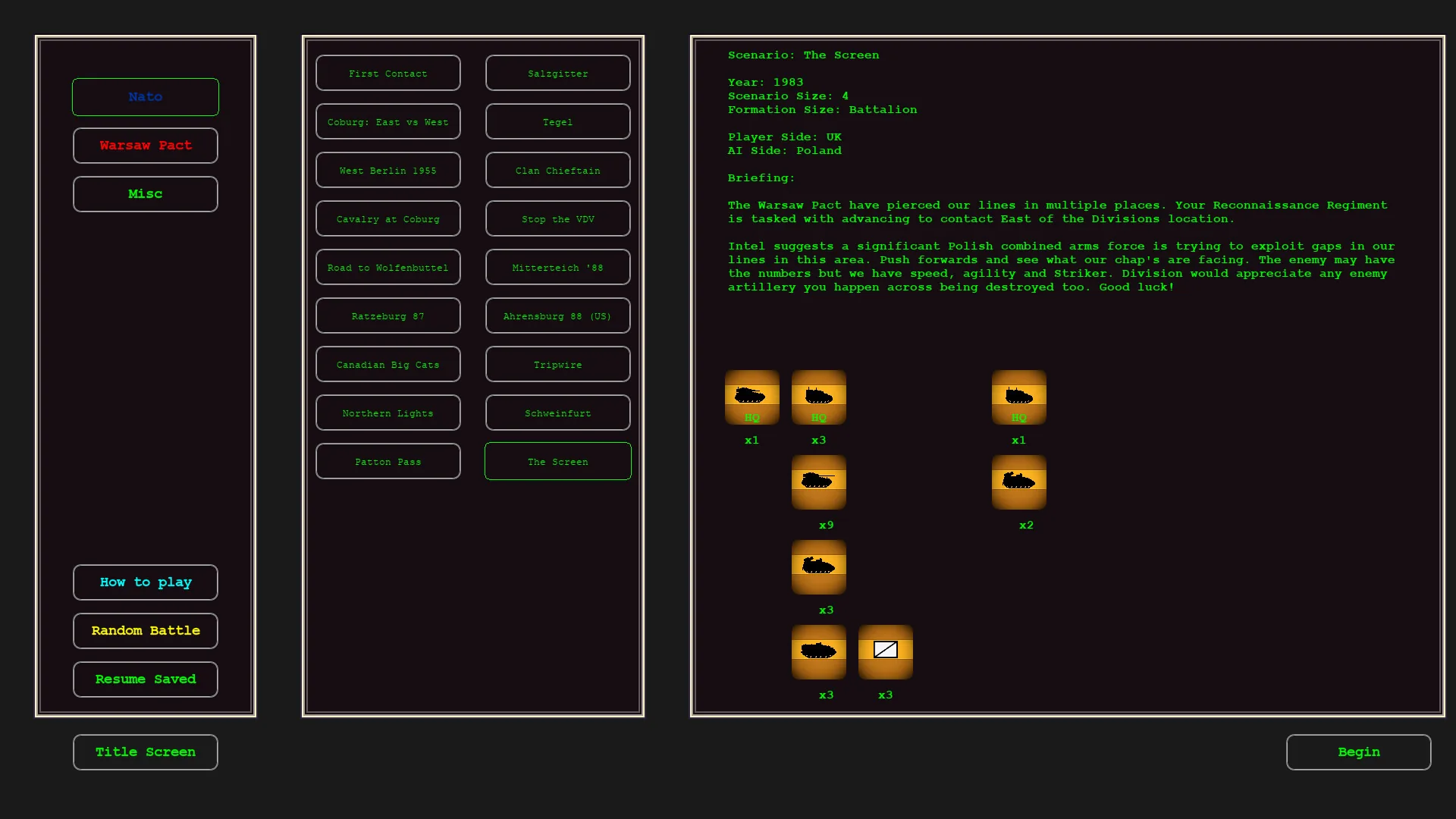
Over four hundred real units and formations, drawn from more than fifteen nations and factions. Forty handcrafted scenarios, plus twenty missions across four mini-campaigns, plus a random battle generator for when you have worked through the rest.
The main frame is the hypothesis that has haunted this genre forever: the Cold War turning hot between NATO and the Warsaw Pact, from 1945 to 1990. The classic Third World War in Germany is present, naturally.
But it is the margins that caught me, and they are worth naming. You play the northern tip of Norway in the early eighties. The Golan Heights in 1973. Vietnam in the sixties. And above all, two theatres computer wargames essentially never model: Angola and Grenada.
That is a real argument. The Cold War seen from central Europe has been done a hundred times. The Cold War seen from southern Africa, almost never, even though that is where the two blocs actually fought each other by proxy for years. Choosing those theatres is an authorial decision, not list-filling.
Missions split between attack, defence and meeting engagements, which is the right trio: a wargame offering only assaults eventually reduces to a ratio calculation.
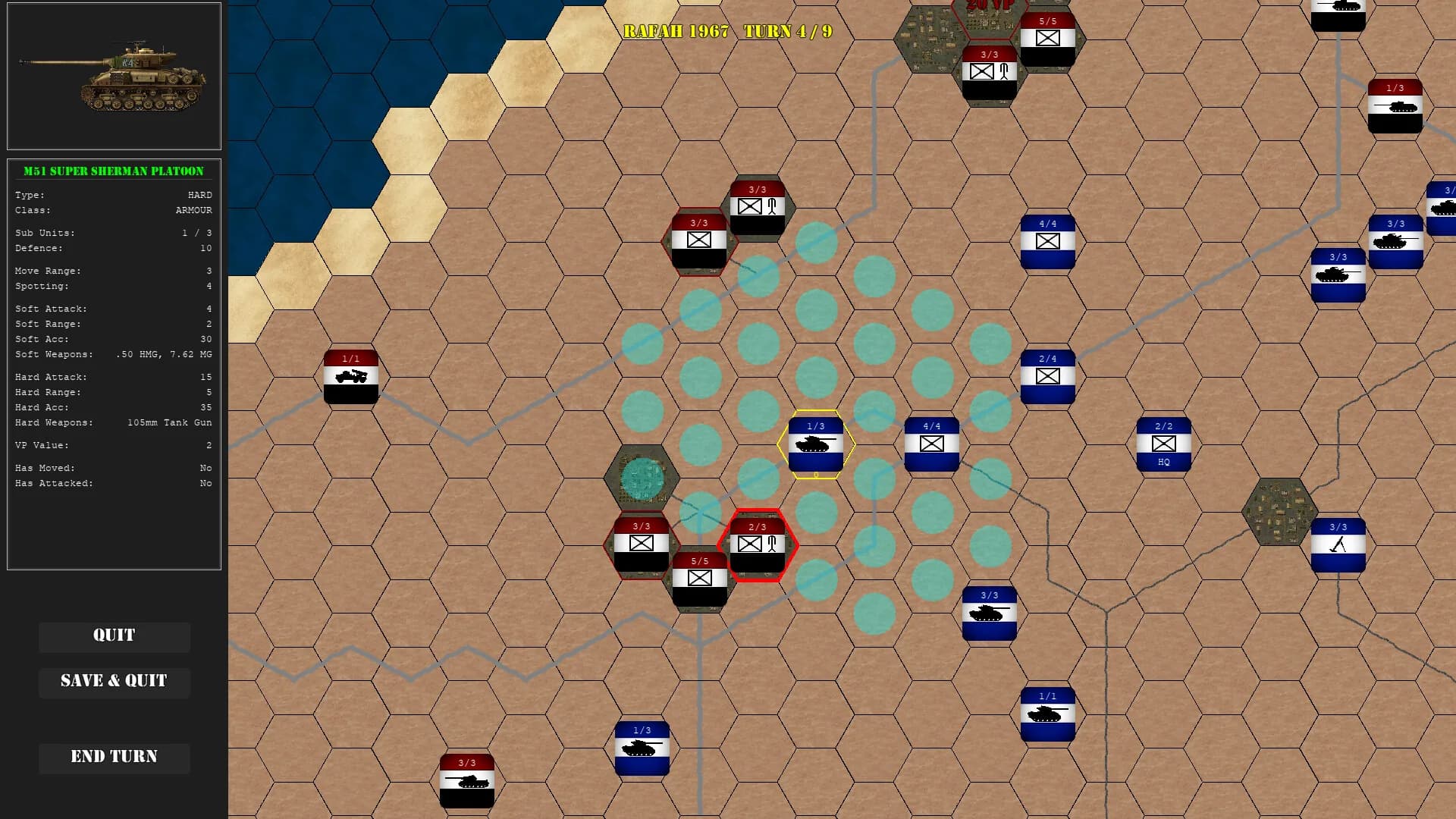
The studio highlights something worth taking seriously, because it is the genre's historic weak point: a machine opponent as competent attacking as defending, and multiple battle plans for each scenario.
The second promise is the more important of the two. A solo wargame dies the day you know what the enemy is going to do. When a scenario runs one script, the second playthrough is a memory exercise and the third is a formality. Having several plans per map is what turns a library of forty scenarios into a great deal more than forty games.
It is also the harder promise to keep, and the one to verify over time. An AI that can defend, you meet occasionally. One that can attack cleanly, coordinating support and dismounts, is considerably rarer.
Let us talk about the graphics, because it has to be addressed and it also should not be blown out of proportion.
It is austere. Functional, legible, and without the slightest attempt at seduction.
For a long time that was the genre's accepted excuse: a lone developer or a very small team cannot afford art direction, and anyway you play these things for the rules. The argument held.
It holds less well today. Between asset libraries, procedural terrain tools and free engines, the entry cost of decent presentation has collapsed. A board that looks like a board, with clean icons and a map that is pleasant to read, is no longer a luxury reserved for funded studios. When a game stays at this level of plainness in 2026, that is a priority, not a fate.
That said, let us be fair about what it actually costs. In this specific genre, legibility beats beauty: you spend your time assessing lines of sight and cover, and a clear board is worth more than a pretty one. The complaint is legitimate, it is not disqualifying.
It is single-player only. No multiplayer, no play-by-email. In a genre where the pleasure of facing a human bluffing with a smoke screen is considerable, that absence is noticeable. The random battle generator compensates in part, not entirely.
And the content is dated "so far". The studio writes "so far" beside its scenario and unit counts, implying the list will grow. Good news in principle, provided the support materialises.
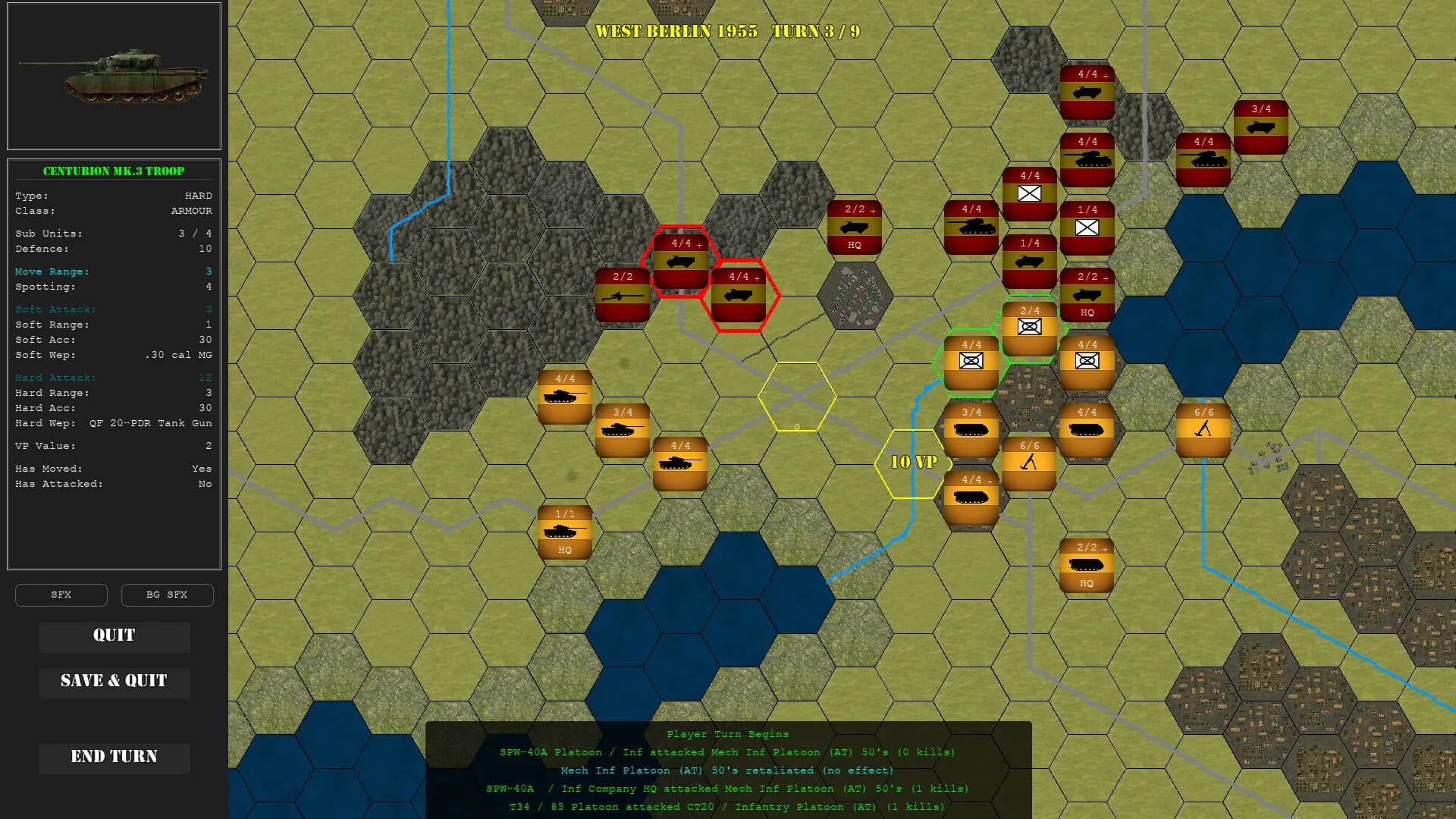
The question this game asks, and answers well, is what you keep when you modernise a board wargame.
The usual answer is to keep everything and add menus, which produces those magnificent, unplayable monsters three hundred people finish. Kudos Games did the opposite: it kept what produces decisions, the hex, the counter, the line of sight, the cover, and threw out what produces bookkeeping.
The result is a game where you decide quickly and get it completely wrong, which is exactly what you want. Laying a smoke screen to push transports up to a treeline, dismounting the infantry at the right moment and discovering a tank was waiting behind the ridge does not need a spreadsheet to be gripping.
And Angola in a computer wargame, frankly, has been a long time coming.
Which theatre are you starting with? Come and say so on the InsertCoins Discord, we hold strong opinions about Norway.
Community
Your rating
Advertisement
Loading comments...
You might also like
A co-op bar that collapses while you serve. 98 per cent positive, and one of the rare times chaos is the actual subject.
You draw a plan on the map and officers execute it alone. Except the game crashes every other planning phase.
The Knights of Pen & Paper team return with a dungeon where you come back to camp, cook, and unlock recipes that change your stats.