7
Test
Barfender: my idiotic friend drank all the beers
A co-op bar that collapses while you serve. 98 per cent positive, and one of the rare times chaos is the actual subject.
Alexandrosse
7 min
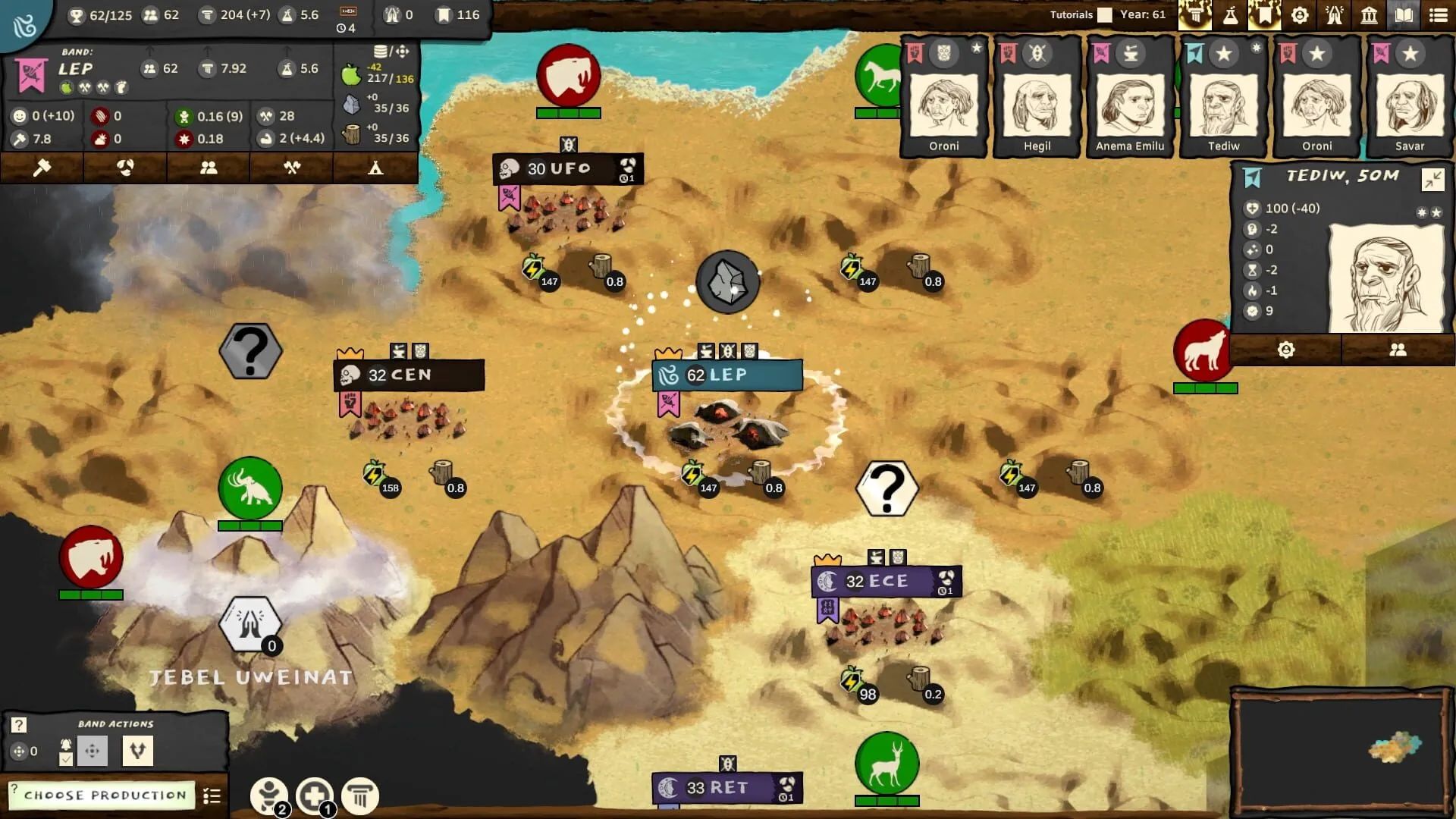
A palaeolithic 4X where every fallen warrior was also a hunter, a father and a memory. Beautiful, cruel, and far harder than it looks.
Alexandrosse
InsertCoins.press Score
8/10
Verdict
Recommended
The developer signs his announcements Enkidu. That is the name of the wild man from the Epic of Gilgamesh, the one who lived with the beasts before being civilised. For a game that stops at the exact moment humanity settles down, it is the best possible handle, and it already says something about the care that went into the rest.
Rock Paper Shotgun summed it up in a line I will not improve on: this is a 4X about prehistoric nomads that ends where Civilization begins.
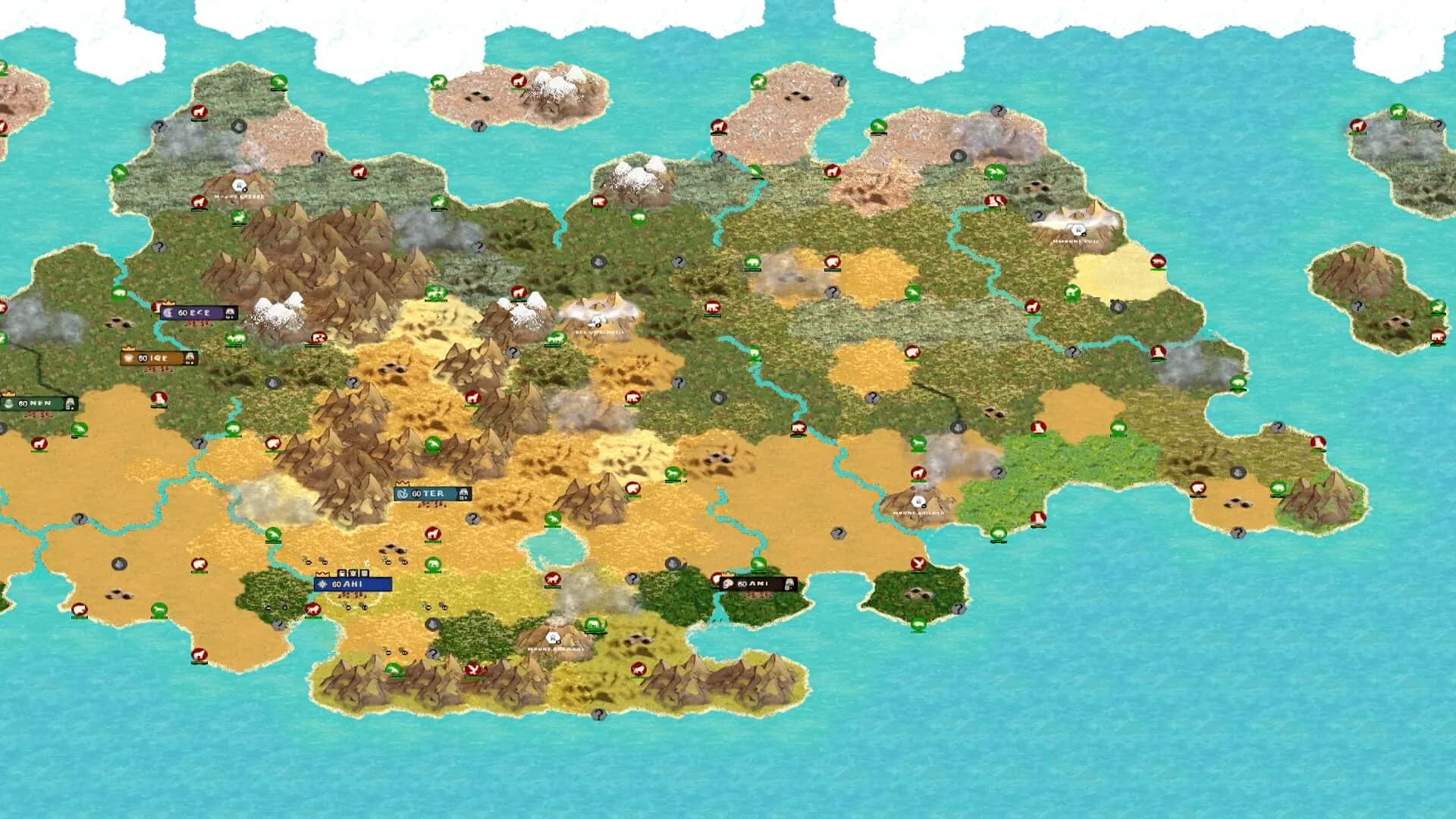
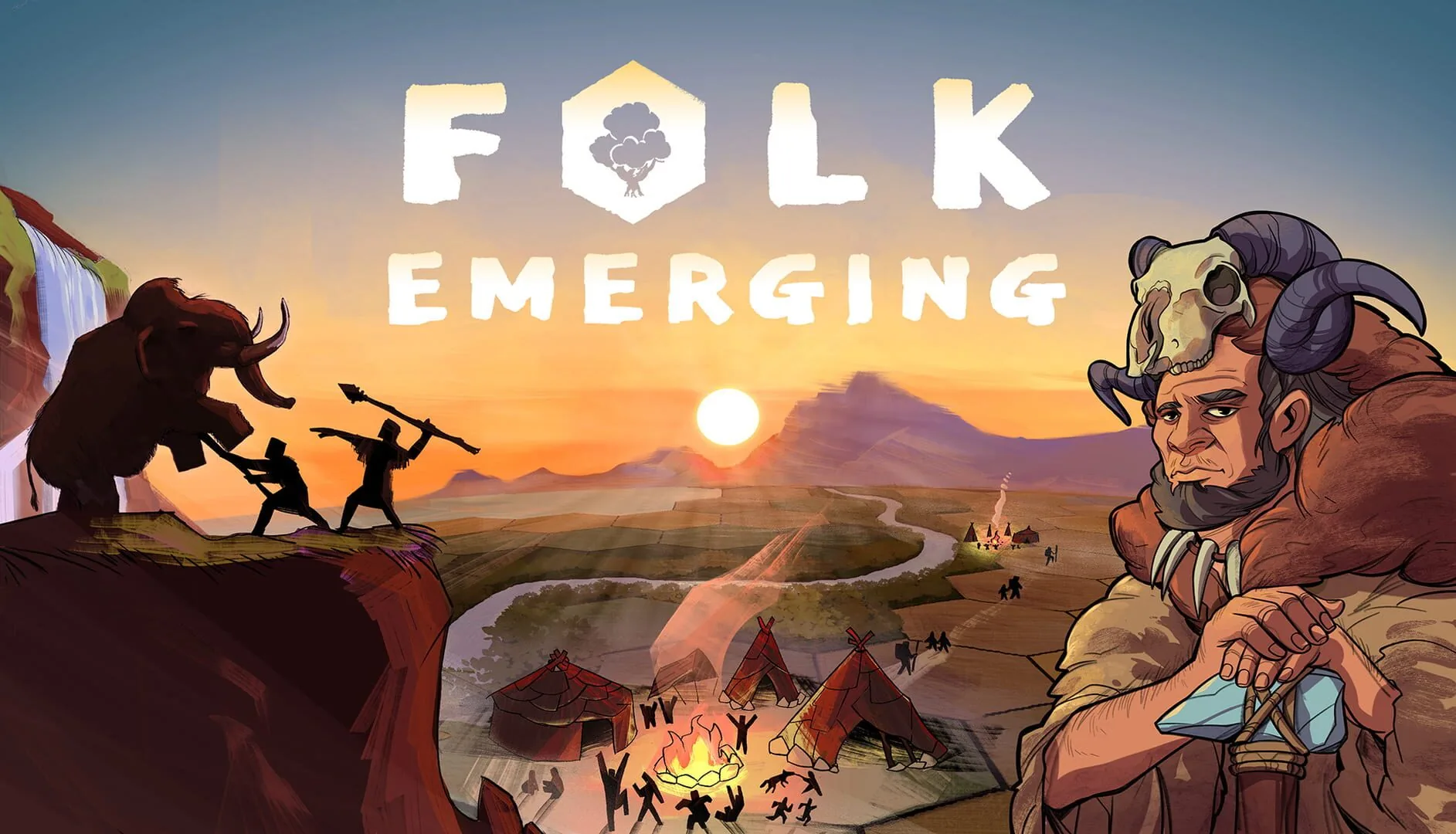
Start with what hits you, because it is true: it is beautiful, and more importantly it is accurate.
The palaeolithic in cinema and games is usually brown mud and shaggy men. Here the palette belongs to real latitudes: the ochres of the steppe, the muted greens of temperate forest, the dirty white of cold periods. You can tell somebody looked at what a Pleistocene ecosystem actually looked like before choosing the colours.
And the rendering serves legibility, which matters more than beauty in a game like this. You see at a glance where the food is, where it no longer is, and where the terrain will kill you.
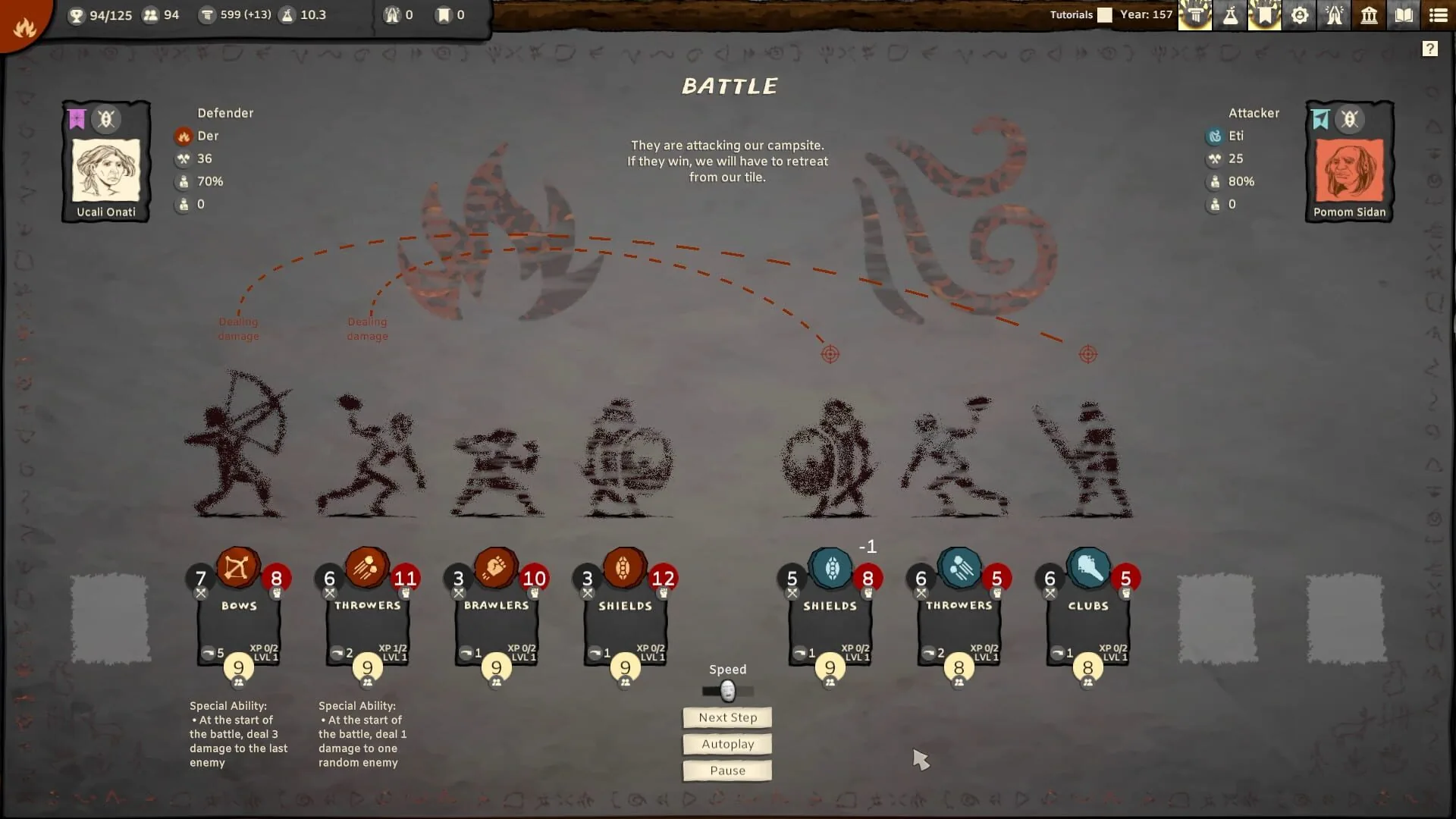
It is an autobattler, and the word needs qualifying here, because it frightens people for the wrong reasons.
You do not drive the battle. You prepare it. Before the engagement you distribute your available fighters into units, you equip them with items that only affect the unit they sit in, and you let the resolution play out. The whole game is in the composition, not the clicking.
Several systems make that preparation interesting.
Reinforcements. A band about to fight can pull reinforcements from adjacent bands to swell the number of assignable fighters. The direct consequence on the map is that small bands become far less vulnerable if they stay clustered. But the bands sending reinforcements also go on attack cooldown, so you cannot draw from everywhere with impunity.
Critical hits. Some units have a chance to deal double damage. Obsidian grants a twenty percentage point bonus to that probability, and the Sages clan adds five more. In other words a specific geological resource becomes a military stake, which is exactly what happened in reality.
Morale, and it is defensive. Watchtowers only give morale when defending. Caves and standing guard only give it when defending the campsite, not structures. The game rewards whoever prepares to be attacked, not whoever squats on conquered ground.
And Glory. Total damage dealt in battle is tracked and accumulates as tribe-level Glory. Every hundred points triggers a beneficial event with bonuses for everyone, and certain factions and cultural norms have bonuses that scale with Glory. It is the mechanic that makes a warlike tribe genuinely playable instead of a punishment.
But the real stroke is elsewhere, and the studio states it plainly: a warrior is never only a warrior. When one falls, the tribe does not lose a unit, it loses a skilled hunter, a member of a family, and a carrier of wisdom accumulated across generations. Individuals are deeply simulated, with heritable traits feeding the other systems.
The result is that winning an expensive battle can cost you the hunting season. I have rarely seen a game make war this unappealing, and that is a compliment.
A small design detail I like a great deal: after every battle a trade embargo applies automatically between the two factions for five turns. Violence cuts commerce, mechanically.
This is the part I found most original, and it has nothing to do with what you expect from a 4X.
Each of the nine climates has its own food web, a complete and dynamic food chain. You do not tick a "hunt" box on a terrain tile: you select a species within the web and decide to harvest it.
And the consequence lands. Organism populations recover twice as slowly once they are already very low. Emptying a game species is therefore not a decision for this turn, it is a decision for the next several decades. Species in ecoregions where no band lives drift gently back towards their equilibrium population, which means the world keeps living without you and that leaving a territory to rest is a viable strategy.
Three subsistence paths coexist, and that is what stops the game reducing to the mammoth.
Megafauna hunting, the most profitable and the most dangerous.
Gathering, which the developer has explicitly placed on the same level as hunting as a complete subsistence strategy. It is not the coward's fallback, it is a design choice.
And scavenging, one of the main ways to interact with predators. Robbing a big cat rather than fighting it: exactly what our ancestors did, and almost no game offers it.
On top, domestication is paid for in dedicated points, obtained through technology, through the Agriculture and Pastoralism cultural norms, and through a climate adaptation. And cordage technology unlocks nets that passively produce food along rivers and coasts.
You are right to find it hard, and there is a design reason behind it.
Global climate changes were reworked to have ramp-up and wind-down periods, with a deliberately less predictable schedule. You can no longer prepare to the exact turn.
Above all, the two catastrophes work nothing alike, and that is what makes the game devious.
The ice age imposes harsher baseline conditions but produces fewer disruptive phenomena. It is slow, continuous pressure that strangles your yields across dozens of turns. You will not die suddenly, you will grow poor.
The heat wave does the opposite: less violent baseline conditions, but far more disruptive phenomena. Wildfires, burned terrain, floods, river flooding. It is chaos rather than strangulation, with one consolation, since floods leave fertile soil behind them.
And there is a cruel multiplier: the food penalties from food web stability, from the ice age and from the heat wave are second-order modifiers, applied together with local population size. Which means an ice age arriving while you have overhunted your game does not add to your problem, it multiplies it.
The counter exists and it is elegant. Every turn your tribe has a band in a climate, it gains an experience point for that climate. At certain thresholds, events trigger climate adaptations, permanent tribe states that allow real specialisation. Your people learn the cold by living in it, not by ticking a technology.
This is the point I want to be precise about, because it is easy to misread.
There is no list of prefabricated tribes with numeric bonuses beside them. Your people is defined by the combination of several layers, and that is what makes the range so wide.
Clans first, which structure internal society and compete for influence. The Sages, for instance, unlock a production focus dedicated to studying nature and improve critical hits. Each clan pulls the tribe in a direction.
Cultural norms next, which are the real rudder. The Council turns the weakest clan's influence into collective happiness, rewarding societies that do not crush their minorities. Agriculture and Pastoralism open up domestication. Some norms give extra influence to certain clan types, creating coherent pairings. And you can switch norms, at three times the normal cost: your society can reform itself, expensively.
Climate adaptations last, which come from wherever you have lived.
Add the three together and you get a tribe that is not chosen but become. Two runs in the same starting climate produce two different peoples depending on which clans rose and which norms were adopted. It is closer to an anthropological simulation than a faction pick, and it is infinitely more interesting.
The technology tree follows the same arc, from the Pleistocene to the threshold of the Bronze Age: controlled fire, cooking, hideworking, hafting, cordage, domestication, agriculture, all the way to megalithic construction and the first cities.
This is a solo developer's first game, and you can read it in the update log: months of fixes on balance, AI movement, diplomacy. That is not a flaw, it is rather reassuring, but the AI remains the thing to watch on a game this complex.
There is a demo on Steam, and it served as a laboratory for months. It is the best way to find out whether the pace suits you.
And you have to accept the proposition: this game will never hand you an empire. It stops at the precise moment other 4X games start being generous. What it offers instead is the only period of human history in which surviving the winter was the political project.
What I take away above all is the coherence. Obsidian scarcity changes your battles, a lost battle deprives you of hunters, a shortage of hunters forces you to gather, gathering exhausts a species, the exhausted species stops recovering, and the ice age arrives right then. Nothing is isolated. That is the highest compliment you can pay a strategy game.
How long do you last before your first ice age? Come and compare on the InsertCoins Discord, we have humiliating numbers to trade.
Community
Your rating
Advertisement
Loading comments...
You might also like
A co-op bar that collapses while you serve. 98 per cent positive, and one of the rare times chaos is the actual subject.
You draw a plan on the map and officers execute it alone. Except the game crashes every other planning phase.
The Knights of Pen & Paper team return with a dungeon where you come back to camp, cook, and unlock recipes that change your stats.