7
Test
Barfender: my idiotic friend drank all the beers
A co-op bar that collapses while you serve. 98 per cent positive, and one of the rare times chaos is the actual subject.
Alexandrosse
7 min
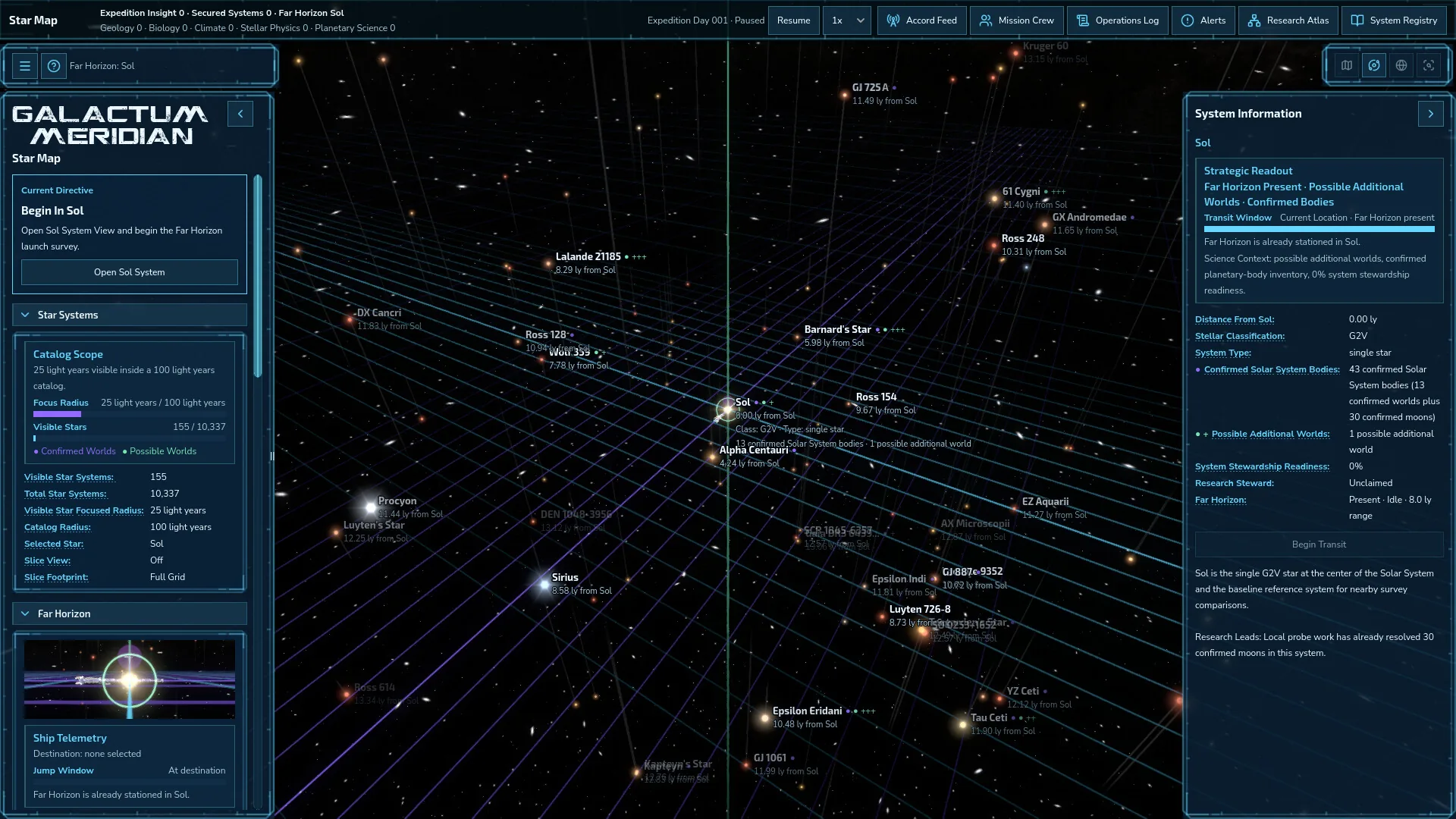
Ten thousand real stars drawn from NASA catalogues, a 3D map, and a tech tree replaced by a research atlas.
Alexandrosse
InsertCoins.press Score
7/10
Verdict
Recommended
The 4X carries four verbs in its name, and the industry has only ever kept one. You explore quickly, expand a little, exploit in the background, and spend three quarters of the run exterminating.
Galactum Meridian removes the fourth and looks at what is left.
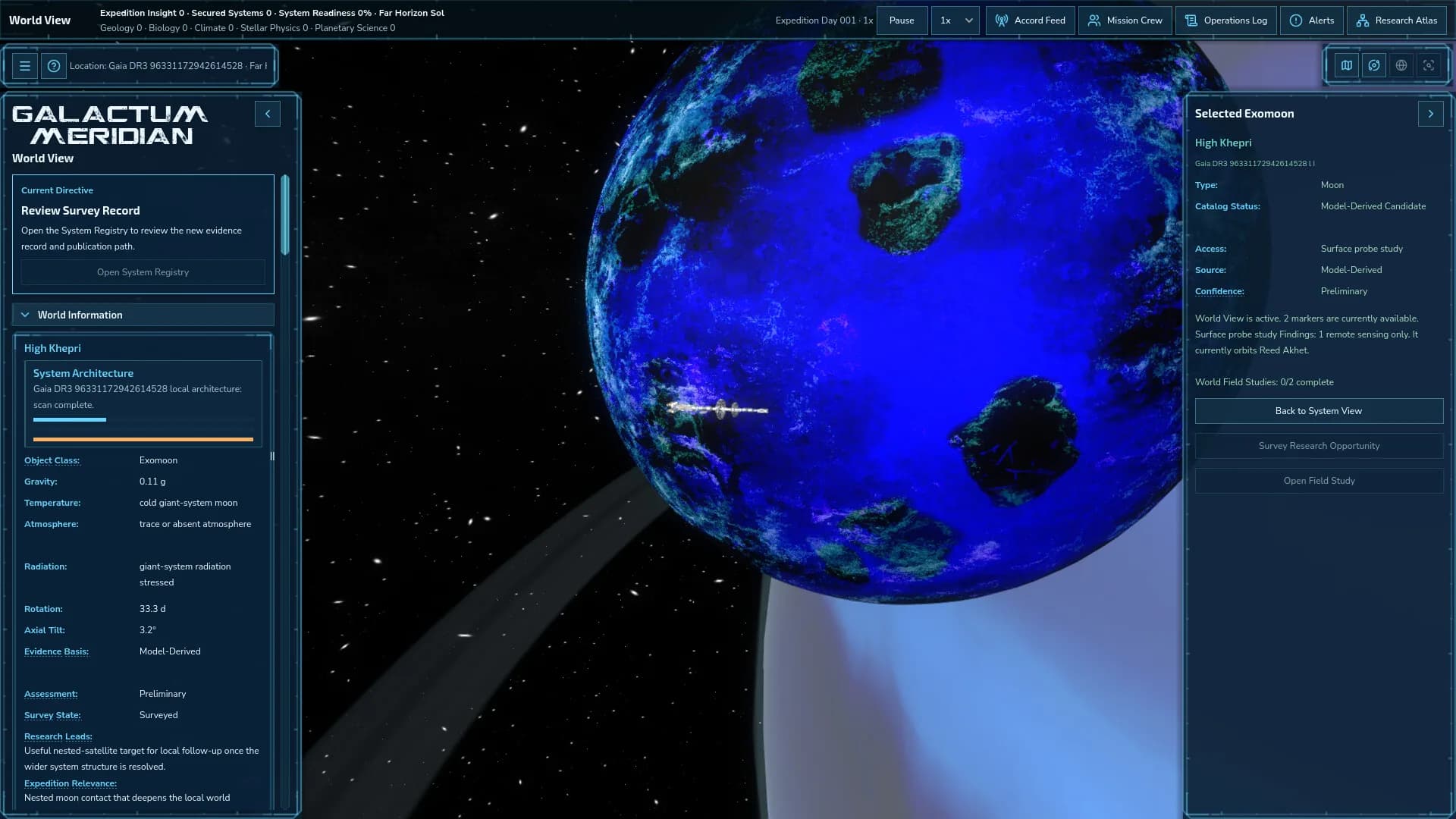
You command the ISA Far Horizon, a deep-survey cruiser sent towards neighbouring star systems where the map is incomplete and the data uncertain.
The studio's phrasing states the programme without ambiguity: you are not here to paint borders across space with fleets, you are here to build the first working picture of humanity's interstellar future.
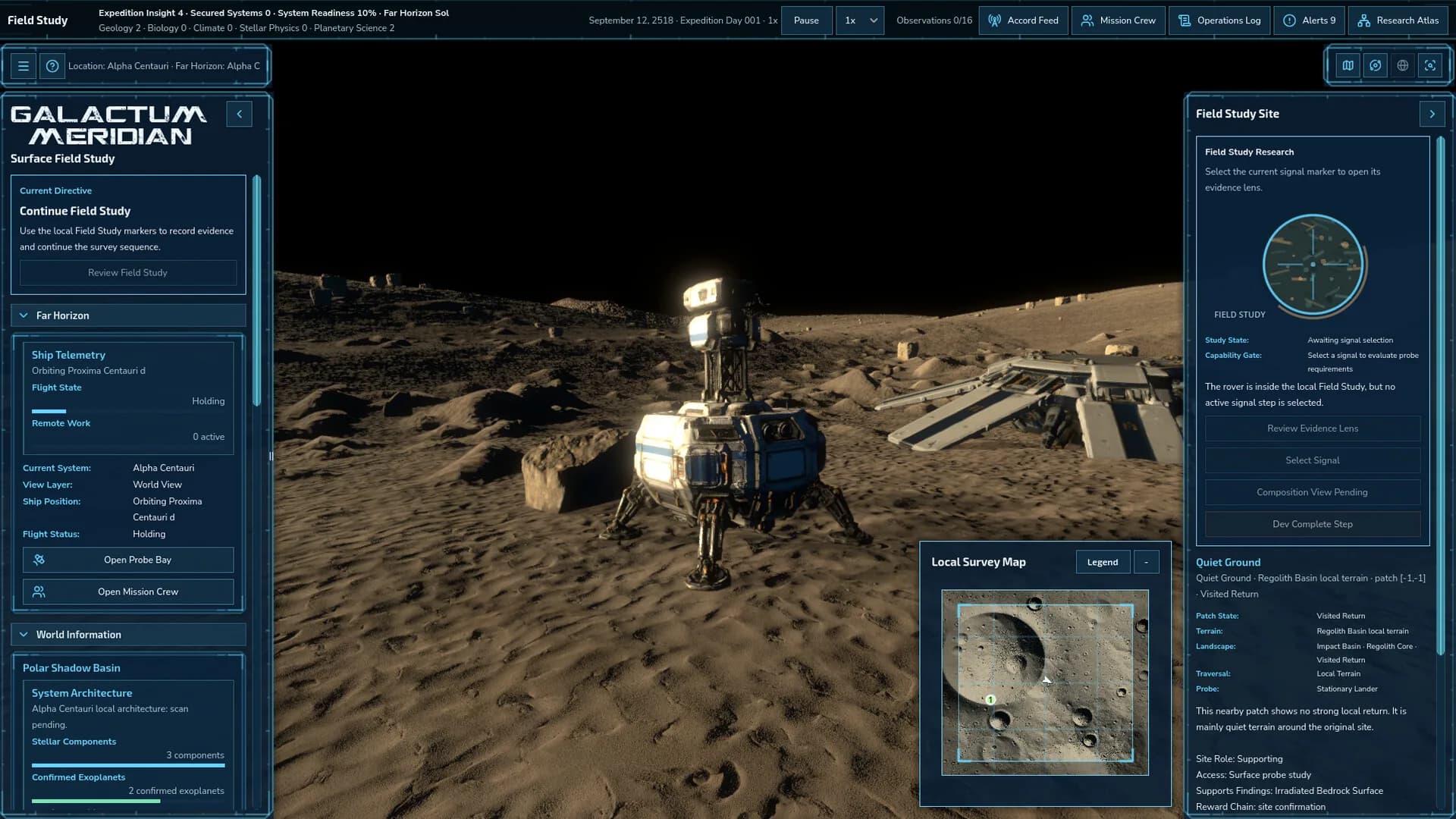
In practice you survey systems, inspect planets and moons from orbit, deploy probes, orbiters, landers, rovers and specialised field packages. You follow up anomalous readings. And you turn raw evidence into research, mission priorities and strategic authority.
The Far Horizon is not a marker on a map. It is your mobile observatory, your laboratory, your probe carrier, your mission hub and your lifeline.
That is the game's main argument, and it is more than dressing.
The map rests on genuine astronomical data: nearby stars, confirmed exoplanet data where it exists, system information drawn from sources such as the NASA Exoplanet Archive. The studio advertises over ten thousand real stars from current catalogues, updated as new data appears.
And the map is three-dimensional, which has become rare. Most games in the genre flatten the galaxy into a plane with lines between points, because it reads more easily. Here the volume is accepted, with the early disorientation and the later satisfaction that implies.
The developer tells a story that captures the project's colour well. Integrating real orbital data, he found systems behaving in ways no game normally models. Alpha Centauri, a triple system. 61 Cygni. Frankly bizarre configurations, and real ones. His conclusion is worth quoting: science is more fascinating than the things we invent.
What is not known is filled in with modelled and inferred discoveries, plus a measure of fiction. Some things are observed, some deduced from what we know, some invented and mysterious.
Progression runs through the Research Atlas, a three-dimensional branching map of knowledge.
Instead of unlocking generic upgrades from a flat menu, you spend the insight earned from discoveries to improve probes, extend survey reach, strengthen the Far Horizon's support systems and open new strategic options.
And the game specifies that disciplines matter: geology, biology, climate science, stellar physics, comparative planetology. The better you understand the universe, the more capable your expedition becomes.
That is coherent with everything else. In a conventional 4X, technology exists to kill better. Here it exists to see better, and seeing better is the precondition for all the rest.
Here is the part I find most interesting, because it answers a question the genre has always dodged: how do you own space without invading it?
The game's answer is one word, stewardship. You earn stewardship points that let you take control of systems, and territory is represented as a three-dimensional strategic layer: not merely who owns a patch of space, but where your expedition has reach, credibility and recognised scientific authority.
And you are not alone. The agency has sent several expeditions to the frontier. Other crews are racing to publish first, secure stewardship authority and shape the official record of what humanity finds beyond Sol.
A publication race as the engine of a 4X is, frankly, something somebody had to think of. It is absurd and perfectly accurate: that is exactly how real science works, where arriving second on a discovery amounts to not having made it.
The studio makes no secret of it, and even announces a multi-game project of which this would be the first chapter.
Some readings do not fit the models. Some worlds preserve evidence that should not be there. And somewhere beyond the catalogue data, the Far Horizon may make a discovery large enough to change what humanity thinks it knows about life, intelligence, and its place in the galaxy.
Worth noting for anyone here hoping for contact: there are no playable alien civilisations in this entry, and the developer confirmed it publicly. The operating radius is limited to a hundred light years around Earth, and he says that will change.
Two serious reservations, and the first is the one the community raised immediately.
Information density. The genre has a tradition of unreadable tables, and a game resting entirely on reading data starts with a handicap. Players pointed at the screenshots saying there was too much text permanently displayed, and the developer acknowledged the problem, announcing a reduction and moving part of the information into hover tooltips. That is the work that will decide whether the game is playable or merely admirable.
Filling the galaxy. That is the question everyone asks an exploration game, and it is fair: how do you make ten thousand stars contain ten thousand interesting things? The developer is aware of it. It will need checking over time whether a discovery stays strategically meaningful or becomes another line in an archive.
And this is early access, made by a very small outfit, Hedra Games. The game launches today in English, with Simplified Chinese planned for the launch-day update and other languages including German announced afterwards. No French at this stage.
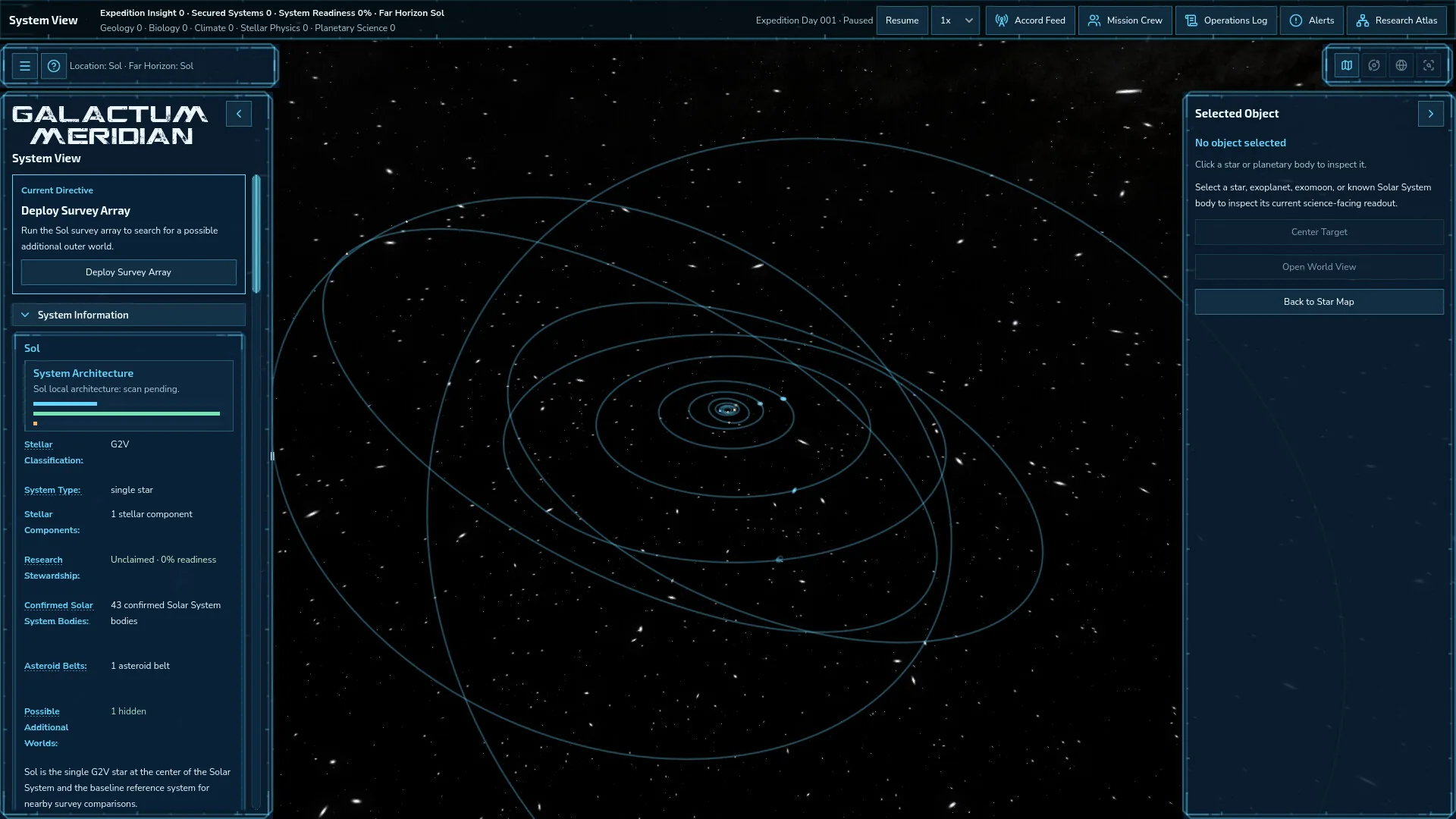
This game will never let you win by force, and that is the whole point.
Space 4X has spent thirty years replaying the same run: explore a little, then build fleets, then erase the neighbours. Removing extermination forces an answer to a question the genre never needed to ask: what makes a player powerful if they cannot hit anything?
The answer proposed here is credibility. You are powerful because you saw first, understood first, and published first. Territory is not what you hold, it is what others acknowledge you know.
That is a strong idea, and it rests entirely on the game's ability to make discovery exciting rather than administrative. On that precise point, we will need to come back in a few months.
But the idea of looking at a star on a map knowing it genuinely exists, with its real orbital eccentricities, and going out to put a probe there, is a promise few games keep.
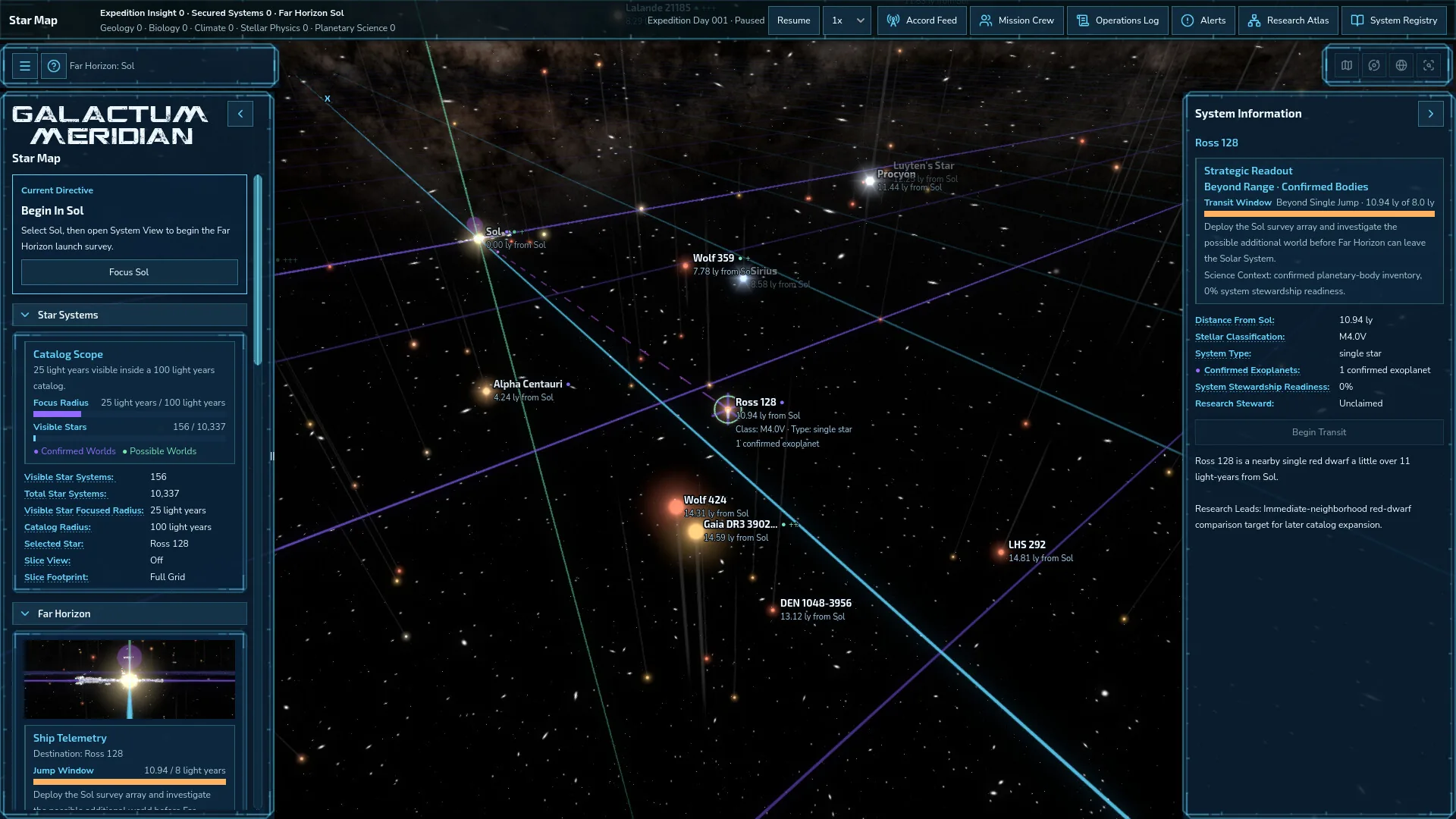
Do you prefer conquering or understanding? Come and settle it on the InsertCoins Discord.
Community
Your rating
Advertisement
Loading comments...
You might also like
A co-op bar that collapses while you serve. 98 per cent positive, and one of the rare times chaos is the actual subject.
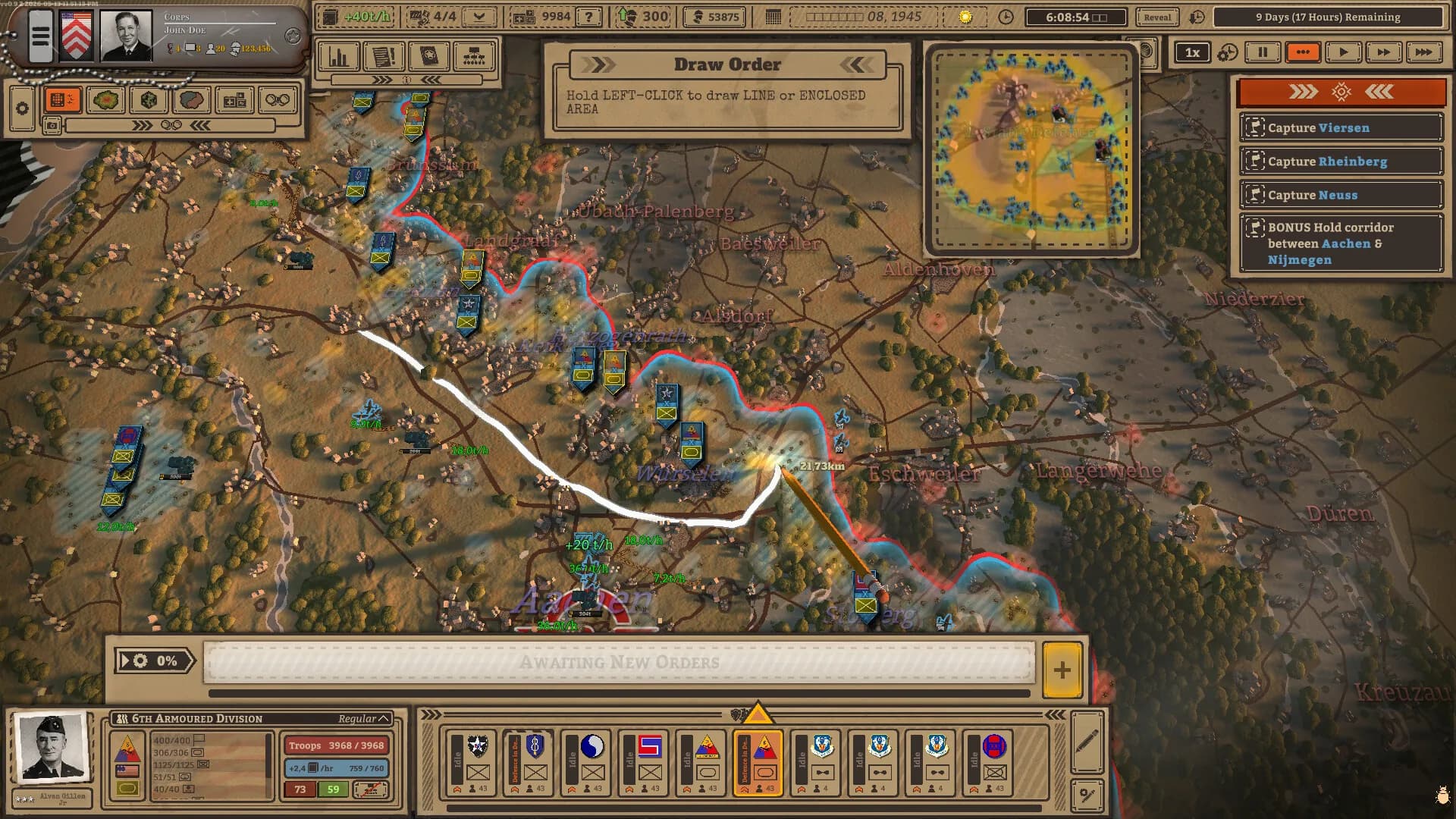
You draw a plan on the map and officers execute it alone. Except the game crashes every other planning phase.
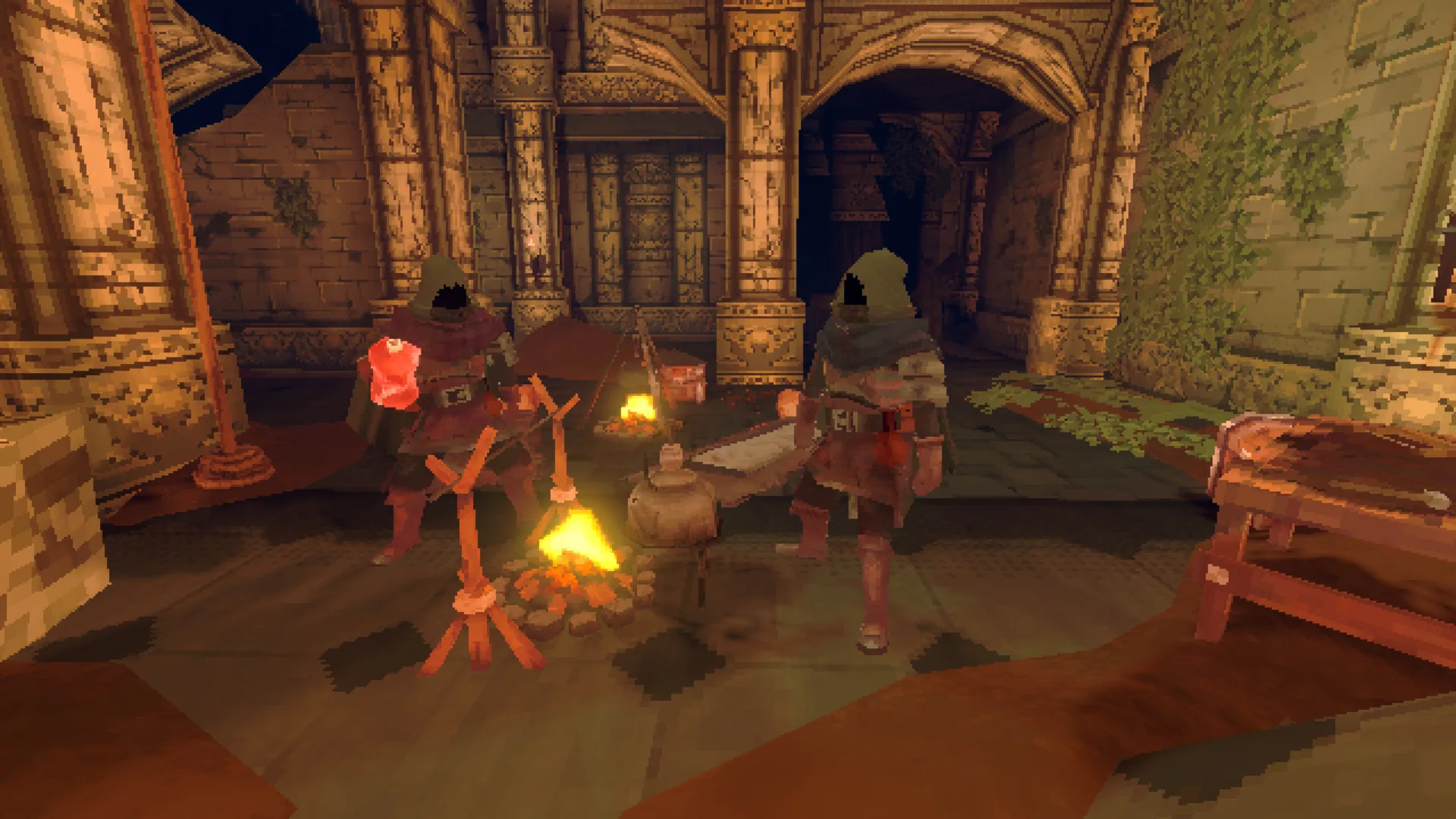
The Knights of Pen & Paper team return with a dungeon where you come back to camp, cook, and unlock recipes that change your stats.