7
Test
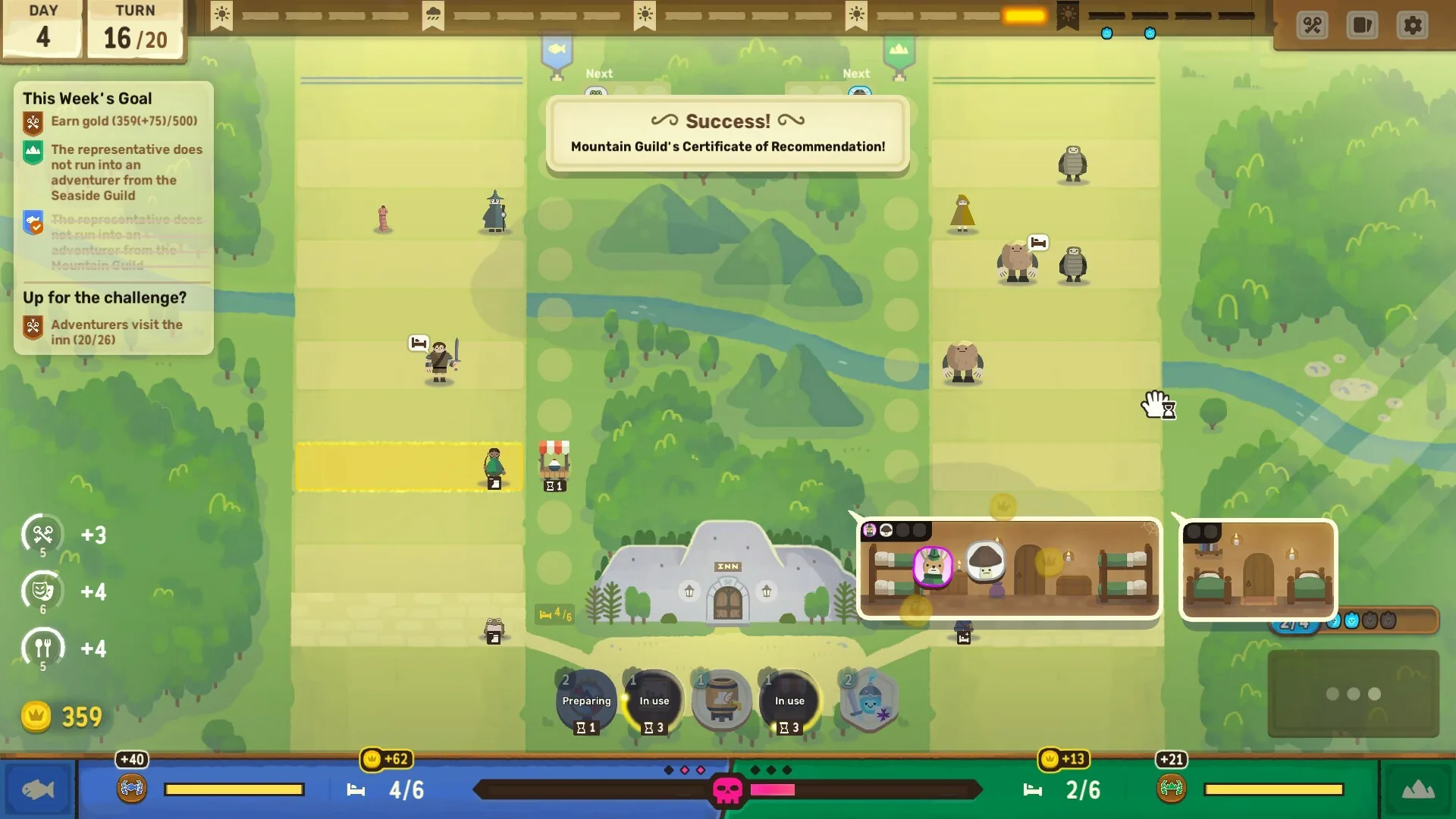
Dungeon Inn: running an inn while keeping two rival guilds from meeting
You struck a deal with a dragon. All that is left is serving both sides without either finding out. The 1.0 lands on 23 October.
Alexandrosse
7 min
Hexagons are having a moment. TownsFolk doesn't reinvent the formula, but it inhabits it with a warmth and generosity that make all the difference.
Alexandrosse
InsertCoins.press Score
7/10
Verdict
Recommended
Hexagons are having a moment. Ever since Dorfromantik proved that a six-sided tile could become addictive at an almost biological level, indie developers have cracked the code. Towns, forests, rivers that slot together, a soft and satisfying spatial logic, and a player who finds themselves an hour deeper without having decided to be. The hexagon formula has practically become its own genre.
TownsFolk arrives in this already well-populated landscape. And the first question you ask yourself is the obvious one: does it bring anything new, or is this just Dorfromantik but worse?
The answer sits somewhere between the two, but it leans firmly toward the good.
What sets TownsFolk apart from its contemporaries is the human layer it places over the placement mechanic. You're not just building a territory, you're building a community. Each tile houses inhabitants, each inhabitant has needs, preferences, a small story. The village you're constructing isn't an abstract map, it's a place where people live.
It's a distinction that sounds minor on paper but completely changes your relationship with the game. When you place a farm next to the mill, it's not just for a production bonus, it's because the Lebrun family needs flour for the baker across the way. A fiction builds itself naturally, without the game needing to write it for you.
Mechanically, this narrative layer translates into chains of dependency between buildings and their occupants. A sawmill needs to be within range of a forest, a blacksmith needs the miner's ore, the miner needs to be fed. These relationships read quickly and create genuine spatial satisfaction: watching your village organize itself with coherence, seeing each hexagon find its place in a whole that holds together, that's the heart of the game and it knows it.
The loop is classic: place tiles, satisfy needs, unlock new residents and buildings, repeat. But the pacing is well-calibrated. You never feel overwhelmed, never behind. TownsFolk plays in the cozy category without apologising for it.
TownsFolk is built for a specific kind of player. Someone looking to unwind, to build something pretty and functional without time pressure, without enemies to defeat, without a timer threatening overhead. In that category, it ranks among the best of the year. The art direction is warm, the music understated, the interface readable. Everything works toward the cozy experience it promises.
For players looking for stronger systemic depth, a real challenge, a loop that keeps renewing itself beyond the first few hours, the verdict is more nuanced. This isn't the game for you. Not because it's poorly made, but because it wasn't made for you.
It's not a flawless game.
The strategic depth plateaus fairly quickly. Once you've understood the production chains and tile compatibilities, there are no more real surprises. Your first runs are captivating because you're discovering. Later ones are pleasant because they're comfortable. But the jump from "I'm learning" to "I've mastered it" is a little short, and players looking for genuine systemic complexity may hit the ceiling fast.
Replayability rests almost entirely on the procedural tile generation. It works, but it doesn't always sustain the surprise over time. You'd want more varied secondary objectives, events that shake up the routine, a little more benevolent friction so that each run feels distinct from the last.
TownsFolk is a well-made indie game, honest in its ambitions, generous in its execution. It doesn't claim to reinvent the hexagon genre. It settles into it with a smile and a cup of tea, and does its job with care.
In a market where small studios can sometimes aim too high and stumble on the basics, TownsFolk does something harder than it looks: it delivers a complete, clean experience that does exactly what it says. The narrative layer placed over the tile mechanic is a genuinely good idea, executed with consistency. That's rare. And in the cozy category, that kind of care is exactly what builds lasting loyalty.
Hexagons are having a moment. TownsFolk deserves to ride it.
Strengths:
Weaknesses:
Tested on PC.
Your verdict differs from ours? The Discord is the place to make your case.
Community
Your rating
Advertisement
Loading comments...
You might also like
You struck a deal with a dragon. All that is left is serving both sides without either finding out. The 1.0 lands on 23 October.
A co-op horror fishing game at nine euros. You must sacrifice fish every day, and the beast is not the worst thing out there.

Scrapheap robots sent to exterminate a planetary fungus. The 1.0 lands tomorrow, and the upgrade grid is the genre's best idea.