Warhammer 40,000 in 11th edition: I read all 88 pages of rules so you do not have to
A free 37-page PDF so you can play your first game without memorising anything. Plus a new section on the site.
Alexandrosse
There is a statistic nobody will ever publish: the number of people who walked into a Warhammer shop, watched a game table for three minutes, and walked back out without saying a word.
What stops those people is almost never the price. It is a very specific feeling, and it is wrong: the impression that you have to know everything before you are allowed to play a single game.
So I took the 88 pages of the 11th edition Core Rules, the updates that correct them, and wrote the thing I wish somebody had handed me that day. Thirty-seven pages, free, at the bottom of this article.
Also, a new section
InsertCoins is opening a Wargame section.
Not to fill a slot, but because a good share of the people who read strategy game reviews in the evening already have, somewhere in a cupboard, a box of miniatures they never assembled. The two audiences are the same audience, and there was no reason to keep them apart.
We will cover rules, entry boxes, painting, and what it genuinely costs. It starts here, with the biggest thing on the shelf.
The loop fits in one sentence
Here is all of Warhammer 40,000, mechanically.
You move, you shoot, you charge, you fight. Then it is your opponent's turn.
That is it. The 88 pages do nothing but specify how and when you are allowed to do those four things. A game usually runs five rounds, each round contains a full turn for each player, and each turn breaks into phases: command, movement, shooting, charge, fight.
Hold on to that and you can follow an entire game as a spectator without getting lost. The rest is vocabulary.
What costs money, and what does not
There is a stubborn misunderstanding here, and it deserves to be killed outright.
The Core Rules are free. The 88-page book is a free download on the Games Workshop site. The Combat Patrol rules, the short format built for small armies, are free too. Each faction's datasheets, the ones carrying the stat lines and the weapons, are free in the app.
In other words, Warhammer 40,000's barrier to entry is made of plastic, not paper. You can read every official rule, understand the game, follow a match and even referee one without spending a penny.
Which does not mean 88 pages read like a novel. That is precisely the problem this guide tries to solve.
What is inside
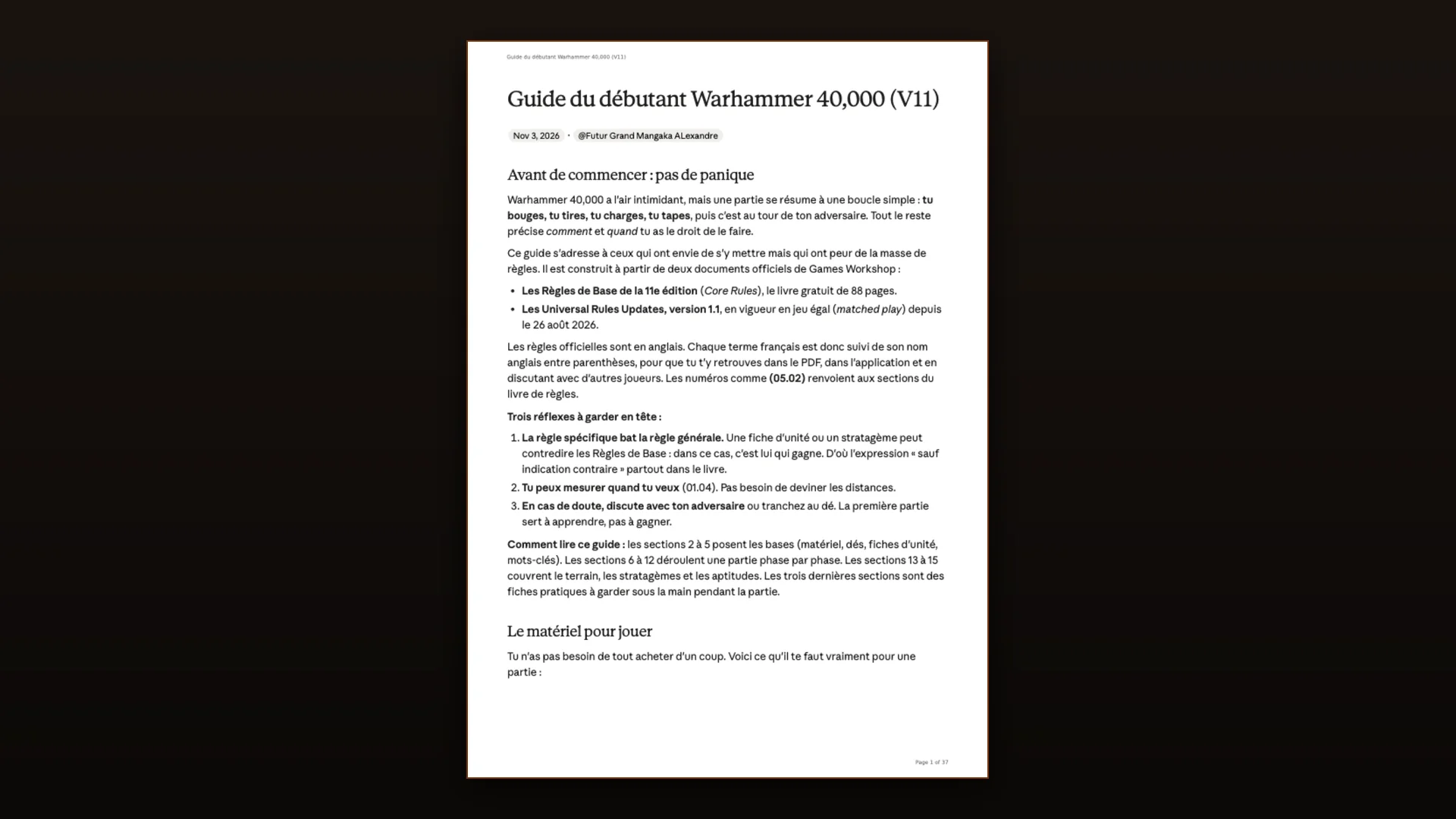
Thirty-seven pages, arranged to be read in order once, then raided at random during a game.
The first four sections lay the groundwork: the equipment you actually need, dice notation, how to read a datasheet, and keywords. The next seven walk through a game phase by phase, in the order they arrive on the table. The last ones cover terrain, stratagems and weapon abilities.
And crucially, the final three sections are reference sheets, the kind you keep open beside the board:
- A table of what your unit can still do based on what it has already done this turn. It advanced, so it cannot charge. It fell back, so it can do nothing. That is half of all beginner mistakes solved by one page.
- The list of distances that matter, from 1 to 24 inches, and what each one triggers.
- A French to English glossary. That one is not cosmetic: the official rules are in English, the app is in English, and the people you will play with say battle-shocked rather than any translation. Every term in the guide carries its English name in brackets.
References like (05.02) point at sections of the official book, so you can always trace a claim back to the source if somebody argues.
The three reflexes that prevent arguments
The guide opens on these because they are the only things worth holding before your first game.
The specific rule beats the general rule. A datasheet or a stratagem is allowed to contradict the Core Rules, and when it does, it wins. That is why the book is stuffed with "unless otherwise stated".
You can measure whenever you like. There is no eyeballing in this game. Before moving, before charging, before deciding anything: get the tape out.
When in doubt, roll for it and move on. A game stuck twenty minutes on a line of sight is a game ruined for everyone. Note the case, look it up afterwards, keep playing.
What 11th edition changed that actually affects you
The 11th edition landed in June 2026. It is not a rebuild, it is an evolution, and three changes matter to somebody starting today.
Coherency goes to 9 inches. Every model must be within 2 inches of at least one other, and within 9 inches of all the others. That second condition is new, and it kills an old habit: the twenty-model conga line snaking across the table to block an entire corridor. Your units have to look like groups, not snakes.
Objectives are no longer round markers, they are terrain areas. You no longer fight over a token sitting in open ground, you fight over a ruin. That single change turns scenery into the prize rather than the obstacle.
And infantry can hide. An infantry unit inside a dense terrain area, which has not shot this turn or last, is only visible at 15 inches or less. Beyond that, it cannot be shot at all.
Practical consequence, and it is the advice I repeat most: put plenty of terrain on the table. An empty board turns the game into a shooting match where the longest-ranged army wins and the melee players never get a turn. In 11th edition more than before, terrain is not decoration.
Which box to come in through
That is the real question, and there are three answers depending on your budget and your circle.
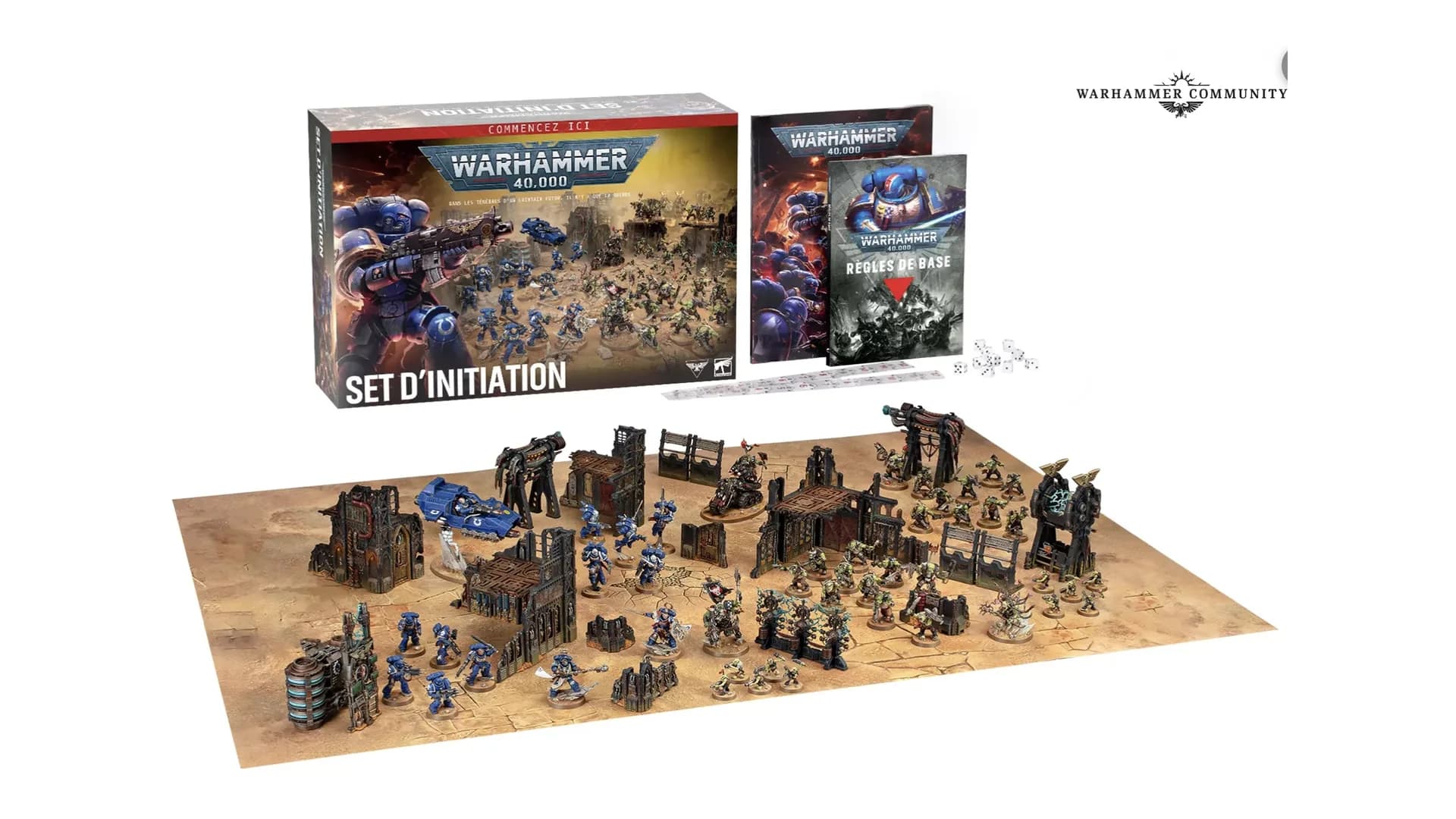
The Starter Set, released 25 July 2026, around 200 euros. Forty-six push-fit miniatures, thirteen Space Marines against thirty-three Orks, fifteen pieces of terrain, two double-sided boards, dice, rules and a booklet written for beginners. It is the most complete box for two people starting from nothing, because it contains the scenery. Given what I just wrote about terrain mattering, that is not a footnote.
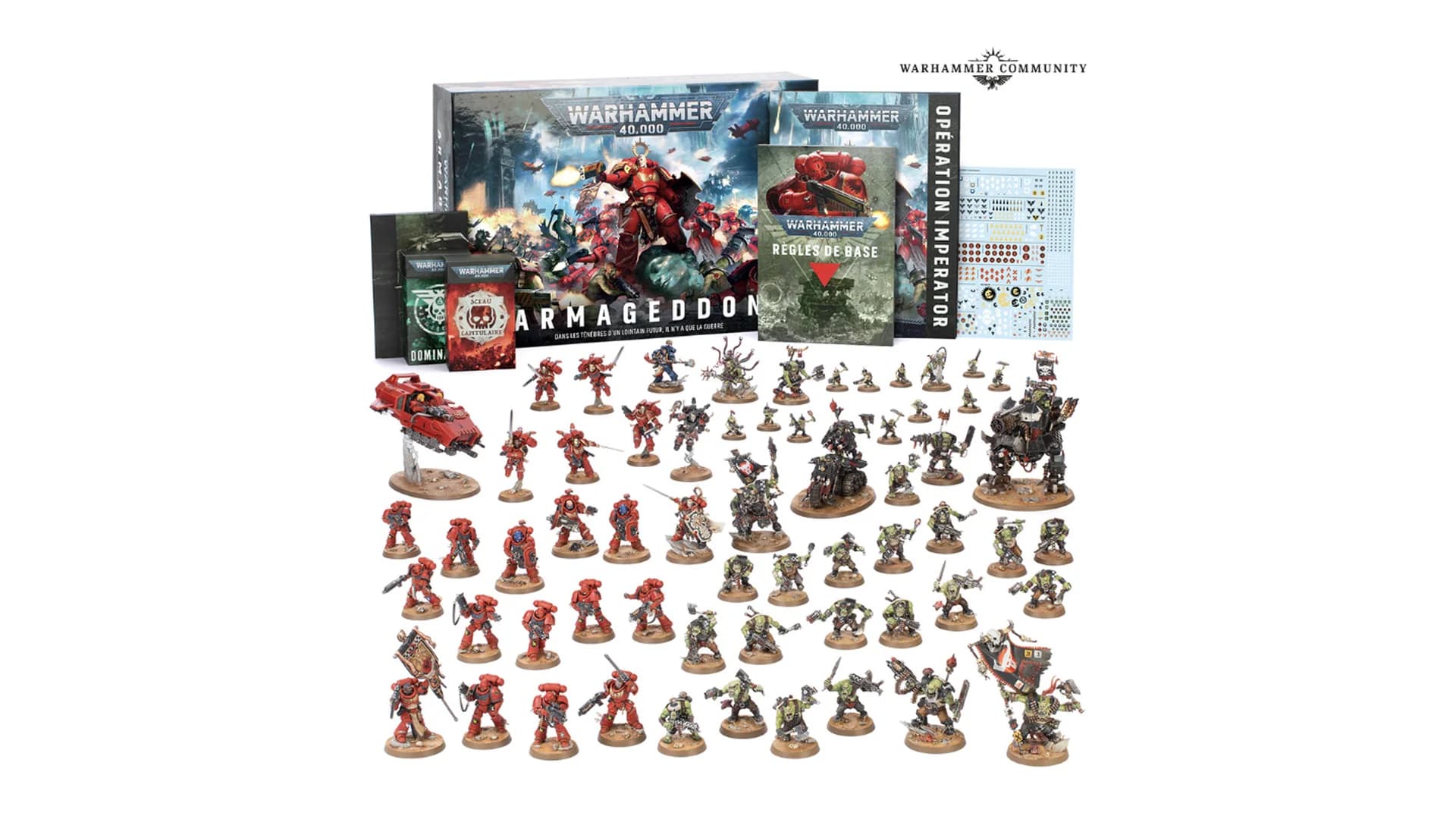
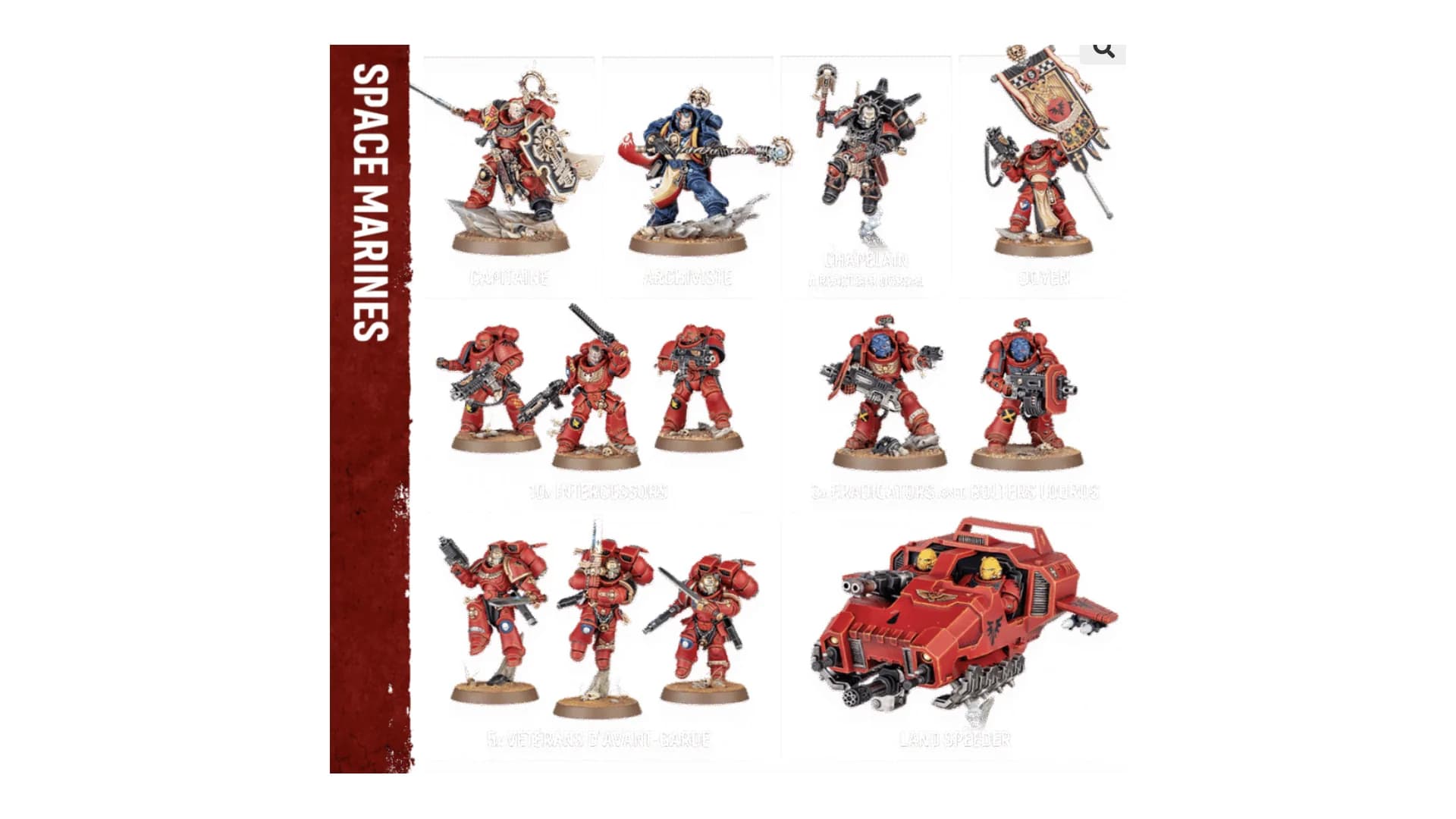
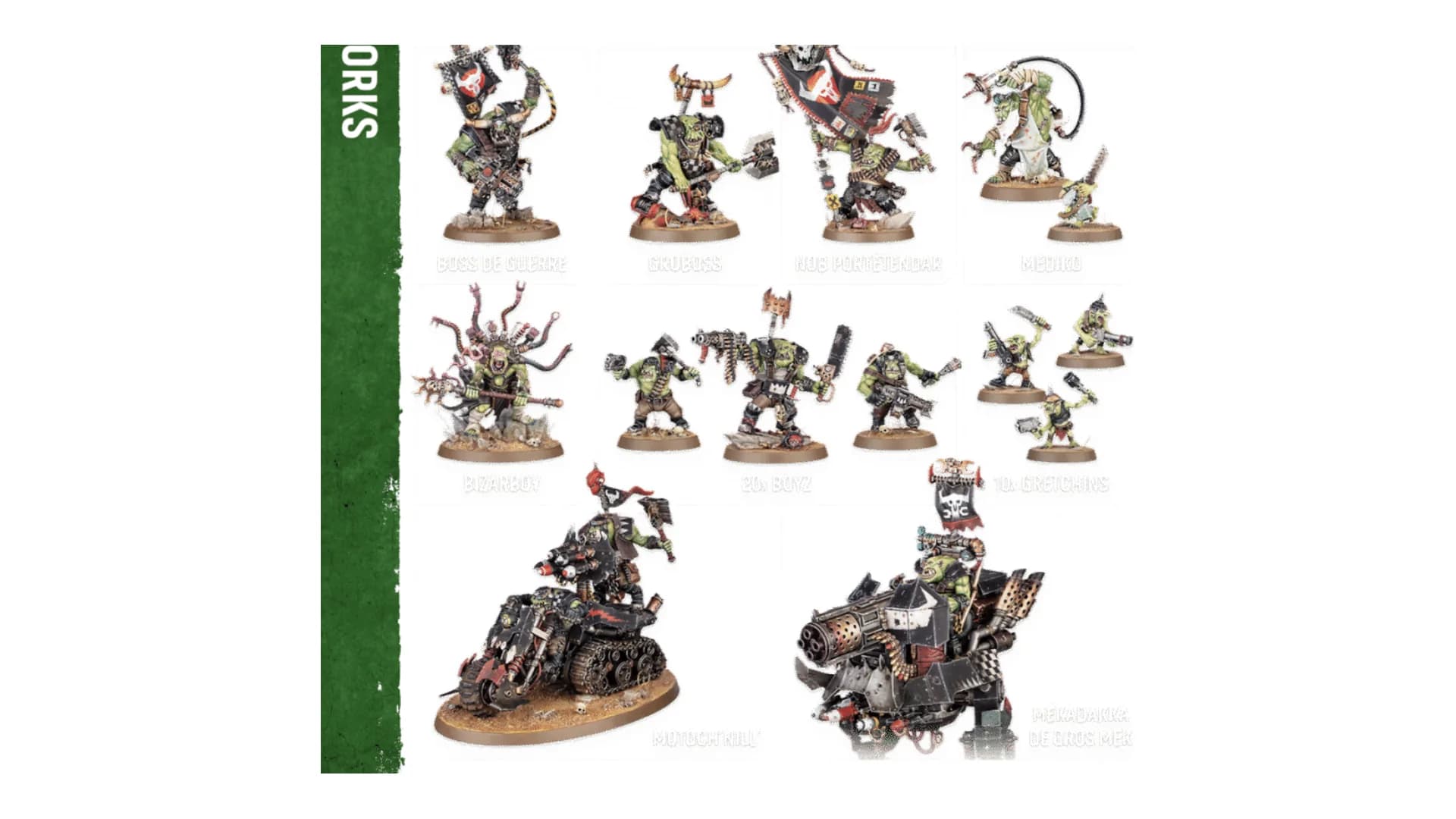
Armageddon, the edition's launch box, released 20 June 2026, around 240 euros. Sixty-one miniatures, twenty-three Space Marines in Blood Angels colours against thirty-eight Orks, the Core Rules, a lore book, datasheet cards and a transfer sheet. More plastic, more unit variety, and enough to start two armies properly. No terrain, though.
A Combat Patrol box, if you already play with somebody who is equipped. One army, one invoice, and the format's rules are free. It is the cheapest entry point that still gives you a playable force.
And there remains the zero-euro option, which is by far the best for a first time: find a club, or a shop with open tables, and ask. This hobby has plenty of faults, but it lends its miniatures to anybody who asks politely.
The mistakes that cost the most
The guide lists twelve. Here are the ones I see most often, and they all fall into the same category: things you cannot undo once done.
Advancing and then wanting to charge. Impossible. That decision belongs to the movement phase, not the charge phase, and it is too late by the time you notice.
Forgetting that your opponent also gains a command point in every command phase, including yours. Plenty of beginners count half the resources on the table.
Applying Armour Penetration to an invulnerable save. It ignores AP, that is the entire point of it.
Leaving a unit in reserve to the bitter end. Still in reserve at the close of round three and it is destroyed. No combat, no roll, nothing.
Shooting through a ruin because you can see the enemy through a window. A light or dense terrain area blocks the line between two models, even when your eyes insist otherwise.
Go on, then
If you have been putting it off, it is probably for the reason in the first paragraph. There is no entrance exam. Nobody knows the 88 pages by heart, including people who have played for fifteen years, and that is exactly why every table is covered in open booklets.
Take the PDF, read it once on a train, keep the last three pages handy, and go lose your first game. It is the only compulsory step.
Note that the guide itself is written in French, with every rules term carrying its official English name alongside, so it doubles as a translation key if you play in English.
Got a rules question blocking you, or an army in mind and no idea where to begin? There is a channel for that on the InsertCoins Discord now, and we talk painting there too.
Community
Your rating
Comments
Loading comments...