Dossier
Paris Games Week 2026: who is coming, what you can play, and the evening not to miss
22 to 25 October, fifteen years of the show, Game of Roles at the Dome de Paris, and 300 square metres for French studios.
Alexandrosse
10 min
A few years ago, you launched a game to have fun. Today, you launch a game to check boxes, fill a bar, keep your streak alive, collect your daily login reward, and finish the battle pass before it expires. When was the last time you played a game just for the fun of it?
Alexandrosse
Ask yourself this honestly: the last time you launched a game, was it to relax, or to avoid losing your progression?
If you hesitated, you have your answer.
Something broke in video games. Not suddenly. Gradually, insidiously, one mechanic at a time. The industry learned to turn leisure into obligation. Pleasure into output. The controller into a time card. And the result, in 2026, is a generation of players who log in out of fear of missing something, not because they want to.
This feature is not going to speak to you gently.
Go back to 2005. You buy a game. You install it. You play. You stop when you want. You come back when you want. Nobody punishes you for not playing yesterday. Nobody offers you a reduced reward because you missed the 24-hour window. The game is there. It waits for you. Without judging you.
That model has nearly disappeared.
Today, live service games have rewritten the implicit contract between studio and player. The goal is no longer to offer a complete and memorable experience. The goal is to keep you connected as often and as long as possible. Because a connected player is a player who sees the ads for the new battle pass, who gives in to the cosmetics shop, who spends.
The formula is simple: create obligation, disguise it as progression, and call it "player retention."
Destiny 2 is the canonical example. The game offers you a batch of weekly challenges, expiring rewards, seasonal content that disappears after three months. If you don't play regularly, you lose. Not a life in a platformer. You lose real progression, cosmetics purchased with time, narrative context that will never be accessible again. The game was designed so that absence has a cost.
And when absence costs something, presence becomes a chore.
The battle pass is the most effective and most cynical invention of the last decade in video games. It deserves close attention.
The principle is well known: you pay between ten and fifteen dollars, you get a ticket granting access to a series of rewards unlocked progressively throughout the season. Cosmetics, skins, virtual currency, various items. It typically lasts three months. And after three months, everything you didn't unlock disappears.
The perverse elegance of the system is that it turns you into an employee of your own entertainment.
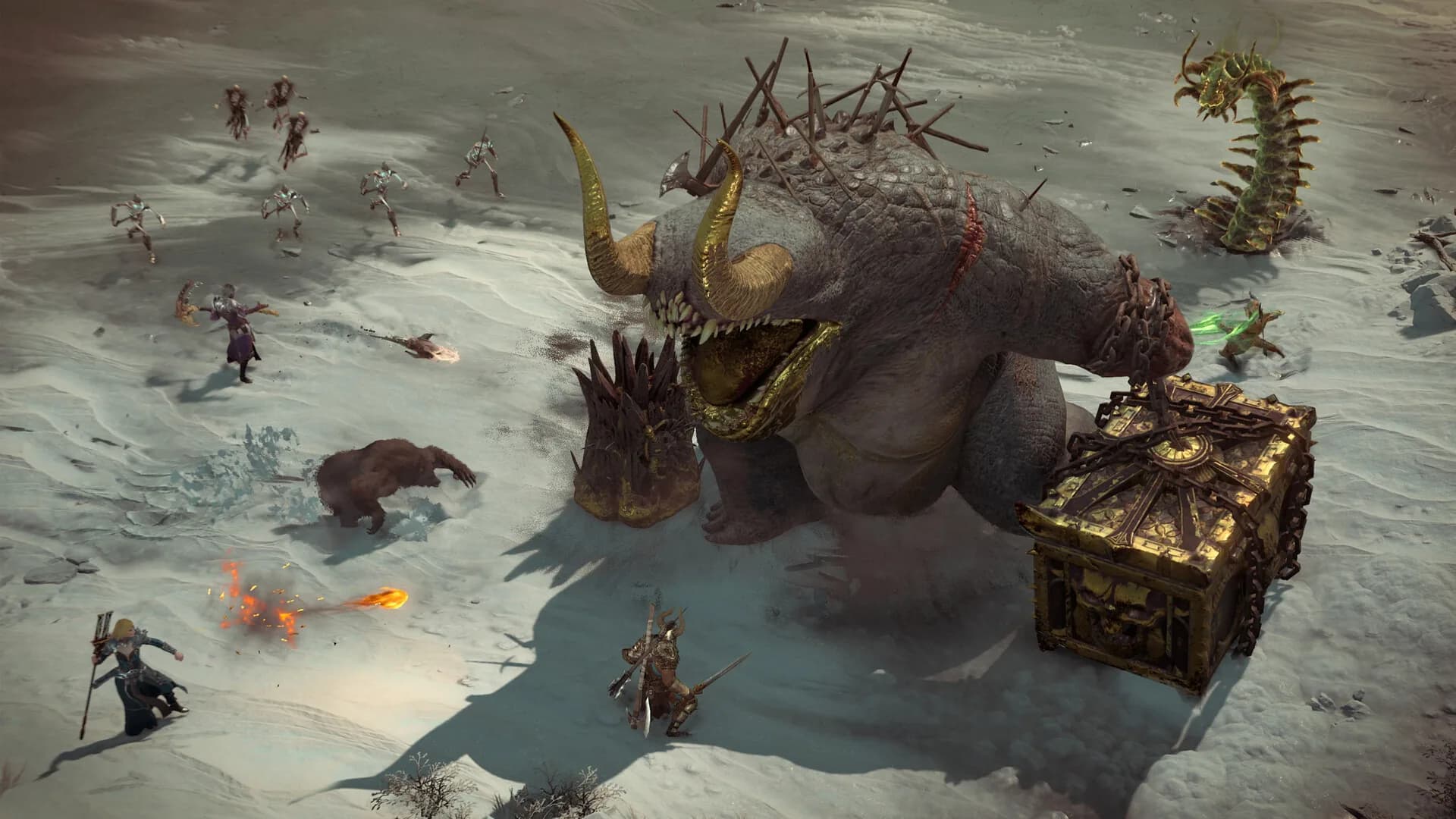
Fortnite invented the model. Since then it has infected practically every live service game that followed. Call of Duty, Apex Legends, Rocket League, Halo Infinite, Diablo 4, FIFA in the form of FUT passes, mobile games by the dozen. The list is long and keeps growing.
The battle pass creates what psychologists call loss aversion. You no longer play to gain something. You play to avoid losing what you already paid for. The distinction is enormous. One of these motivations is positive and organic. The other is anxiety disguised as a progression system.
Result: people logging in for twenty minutes every evening, night after night, not because they want to play, but because the season counter is running and they can't afford not to progress. It's unpaid labour with a timer.
On top of the battle pass, there's another layer: daily and weekly missions.
The concept was borrowed directly from mobile games, which borrowed it from casino games, which have long known that a daily habit creates dependency. You come back every day because your brain has associated "launching the game" with "getting a reward." It's operant conditioning. Pavlov would have loved live service games.
Genshin Impact is probably the game that pushed this model to its apex in the Western market. Resins to collect daily or risk wasting them. Temporary events with exclusive rewards. Exploration missions that require playing several days in a row to unlock the conclusion. The game is designed so that you think about it even when you're not playing it.
Streamers and content creators have absorbed it into their vocabulary: "I missed my dailies." The phrasing says everything. You don't say "I didn't play today." You say you failed at something. That you fell short of an obligation.
When a leisure activity generates guilt for non-practice, it has stopped being a leisure activity.
There is one thing that the generation of players from the 90s and 2000s has to explain to younger players, and that younger players struggle to believe: there were games where you unlocked characters, costumes, stages and items by... playing.
Not by paying. Not by repeating the same mission for forty hours. By playing, by advancing, by completing challenges that tested your mastery of the game. Super Smash Bros Melee had a starting roster and a roster to unlock. To get Marth, you fought him after meeting a specific condition. To get Mewtwo, you played a hundred hours of versus mode. It was content that rewarded time played with more game content.
Street Fighter 6 chose a different path. The costumes and accessories available in the game are largely locked behind a premium shop. Outfits that, in Street Fighter II, would have been colour palette swaps accessible at launch. Today, some of them cost the equivalent of several dollars. For a character in a game sold at seventy dollars.
Diablo 4, sold at full price, launched its first battle pass three weeks after release. A paid game with a paid battle pass. The logic of "but it's only cosmetics" has its limits when those cosmetics sometimes cost more than the base game.
The industry decided that what it used to give away, it could now sell. And it was right, because players paid.
Here is a calculation you will never see in an official studio communication.
An average serious Genshin Impact player spends, according to multiple community analyses, between fifty and two hundred dollars per month on primo-gem top-ups trying to pull characters from the new banner. Annualised, that's between six hundred and twenty-four hundred dollars per year.
For a free game.
A Game Pass Ultimate subscription at $29.99 per month over twelve months is $359.88. Access to hundreds of games, including day-one AAAs. Per game accessible, it's one of the best values on the market, despite the contested price.
The "no purchase required" free-to-play can therefore cost multiples of a premium service subscription if the player gets caught up in the collection and gacha logic. And the system is designed precisely so that the player gets caught up in it.
Gacha games have industrialised psychological exploitation with surgical precision. The pull rate is calibrated so that you hit the desired character just frequently enough to stay hooked and just rarely enough to keep spending. It's probability applied to addiction.
The impact isn't only financial. It goes deeper and is rarely discussed.
Studies on gaming burnout have been appearing since 2020. Players describing a compulsive relationship with games they no longer enjoy. People playing Destiny 2 or Final Fantasy XIV not because they're having fun, but because they're afraid of falling behind on content, of letting their guild down, of losing their PvP rank.
The vocabulary itself reveals the problem. People talk about "necessary grind," "mandatory content," "the meta to follow," "time optimisation." These are management terms, not leisure terms.
Recent studies show that a significant proportion of live service players report playing "out of obligation" at least once a week. That figure, in any other leisure context, would be considered alarming. Applied to video games, it has become normal.
The normalisation is perhaps the most serious problem. Players who start their gaming journey today have often never known anything different. For them, dailies, battle passes, character grinding, gacha are video games. Not a drift. The baseline model.
The picture would be incomplete without acknowledging that some games resist.
Baldur's Gate 3. An 80-to-100-hour RPG, sold for sixty dollars, with no microtransactions, no battle pass, no paid post-launch content. You buy the game. You play the game. All the content is there, accessible, without friction. Larian Studios not only produced one of the games of the decade, they proved that the "complete game, fair price" model can generate enormous revenue and record player satisfaction.
Hades. No battle pass. No dailies. No shop. A roguelite that makes you want to relaunch because every run is fun, not because a counter is forcing you to. Its massive commercial and critical success proves that retention through pleasure works better than retention through obligation.
Elden Ring. An open world with no boxes to tick, no map icons guiding you to the next task, no seasonal system. A game that trusts you to find what interests you. Sold tens of millions of copies.
These games have something in common: they respect the player's time. They don't capture it.
The industry didn't drift toward grind by accident or lack of imagination. It did so because it works. Because players pay. Because the analytics models measuring "daily active users," "average revenue per user" and "retention rate" took over from the simple and fundamental question: are people having fun?
And the honest answer, for a growing proportion of players, is no.
Fun hasn't disappeared from video games. It's in Baldur's Gate 3, in Hades, in Hollow Knight, in dozens of indie games that don't have the budget for a "player engagement optimisation" department. It's in the games that don't yet know they're supposed to turn you into a source of recurring revenue.
Fun is still out there. It's just been pushed away from the centre, progressively replaced by mechanics that look like fun without having its substance.
Video games became an industry that optimises for dependency. And as long as players keep paying for it, nothing will change.
The next time you log into a game out of obligation rather than desire, ask yourself: are you playing, or are you working for free on behalf of a publicly traded publisher?
The answer will ruin your evening. But at least it'll be honest.
Feature based on observed behaviours in the video game industry in 2026
Does the subject speak to you? We go into it at length on the InsertCoins Discord.
Community
Your rating
Loading comments...
You might also like
22 to 25 October, fifteen years of the show, Game of Roles at the Dome de Paris, and 300 square metres for French studios.
Six sales running, over 700 games, and only one that expires tomorrow morning. Our sort, with the prices worth taking and the ones that are not.
Eight months, 288 reviews, an average of 7.03. Here is what that says, and voting is open in four categories including the hall of shame.