I launched Scavland for an hour, just to have a look. I am writing this knowing full well that I am going back the moment I type the last full stop, and that the day is gone.
It has been a while since a game did that to me, and I think I know why.
Start with what hits you, because it is also what makes the game work.
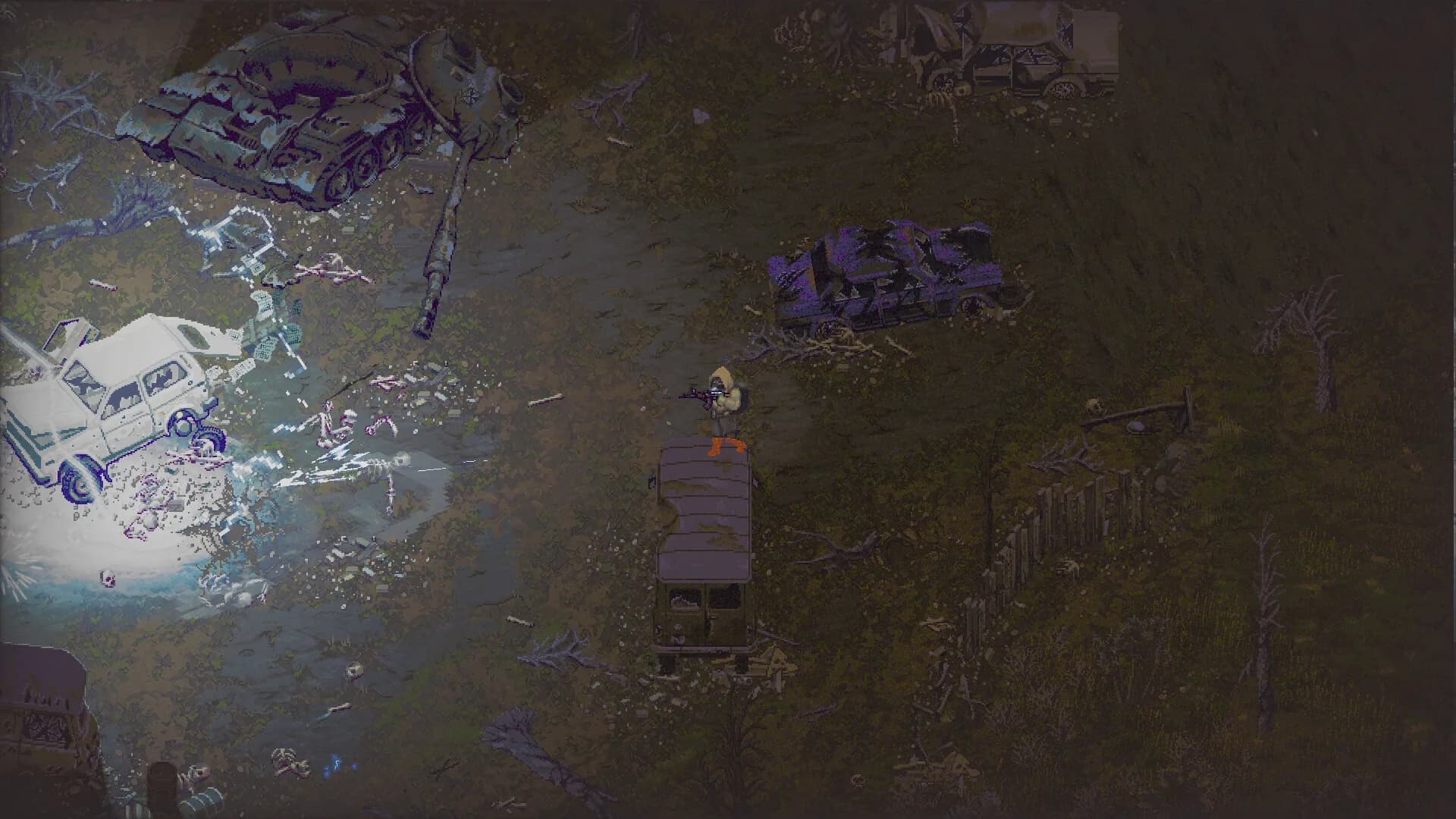
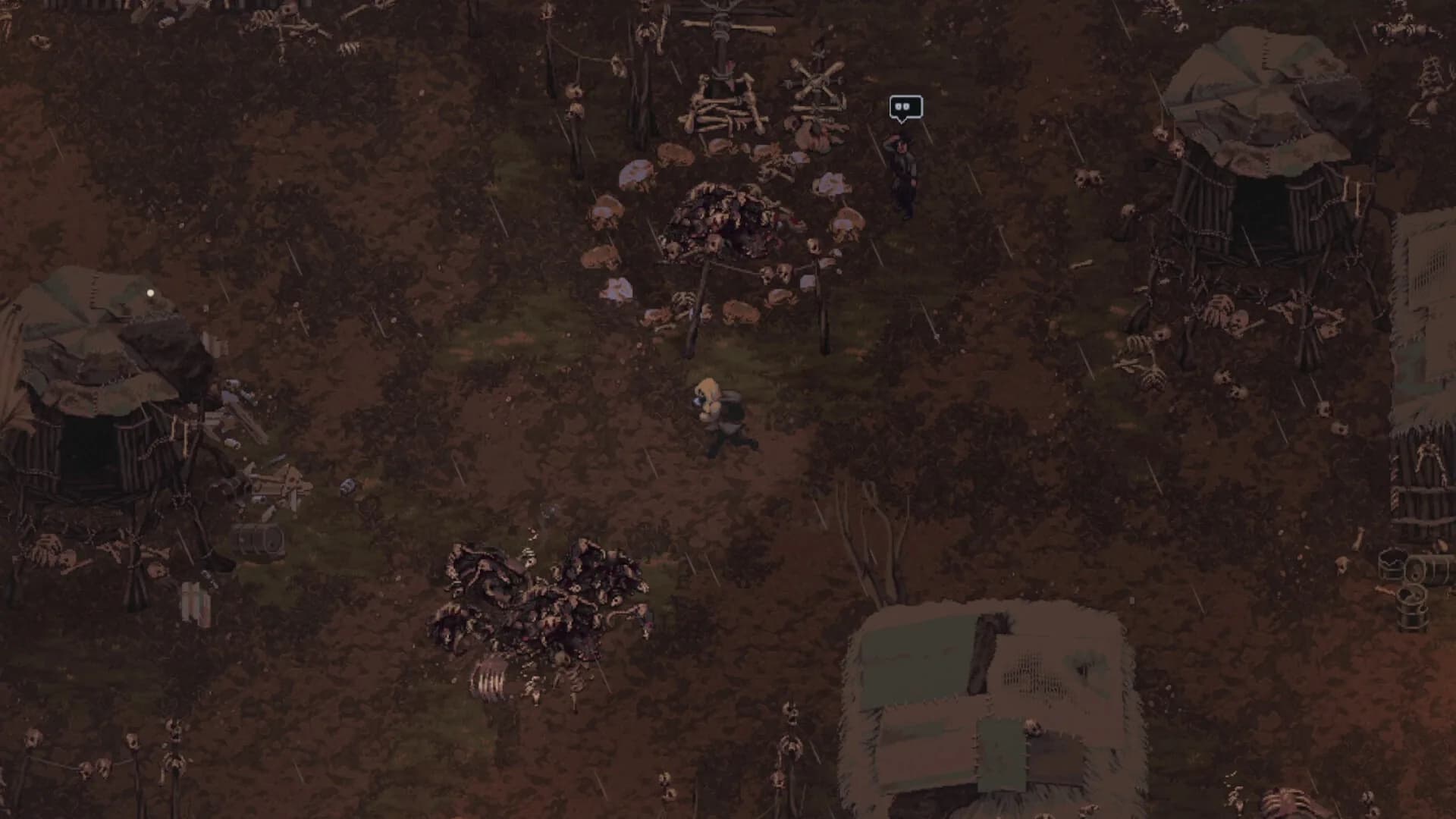
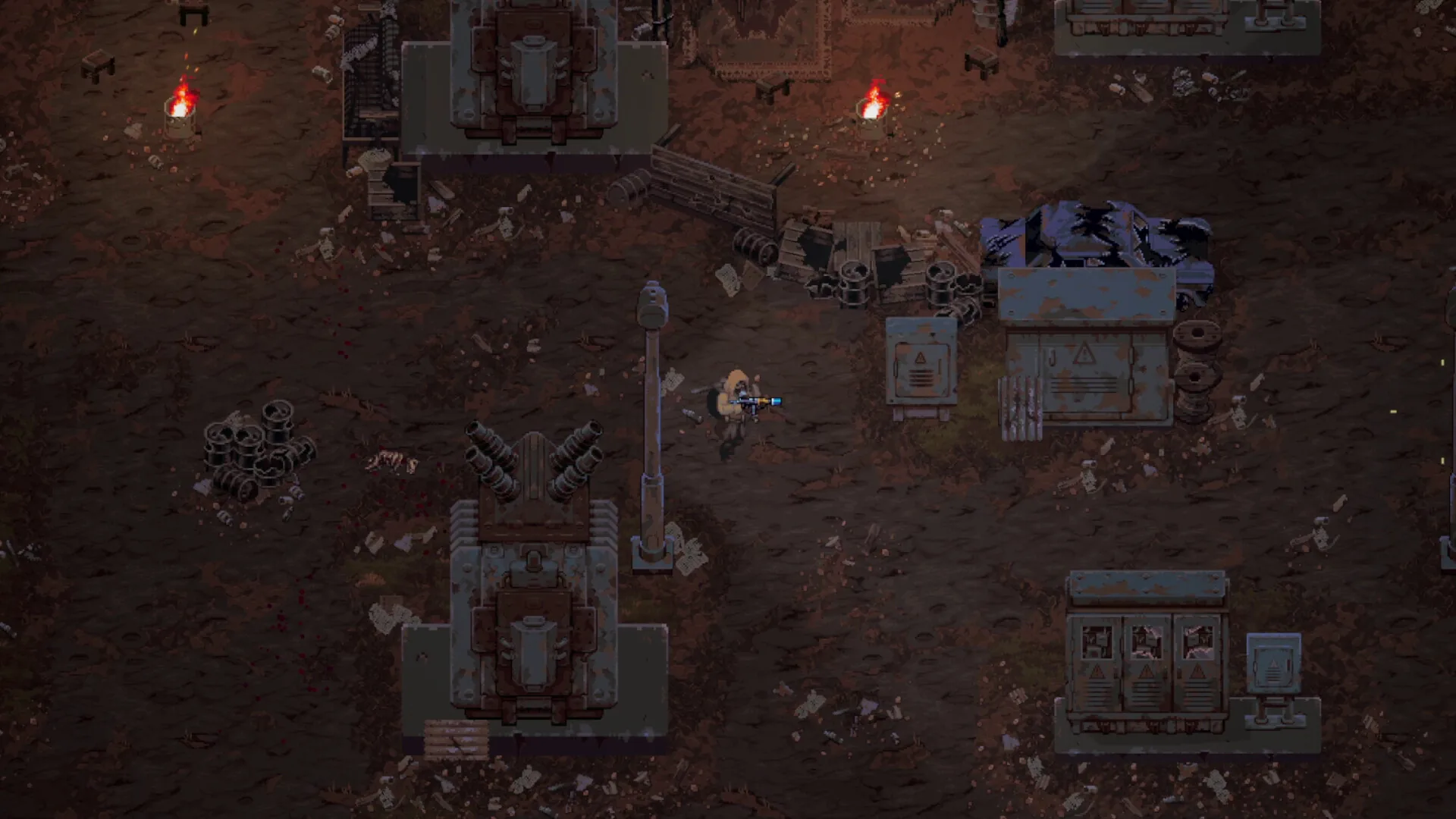
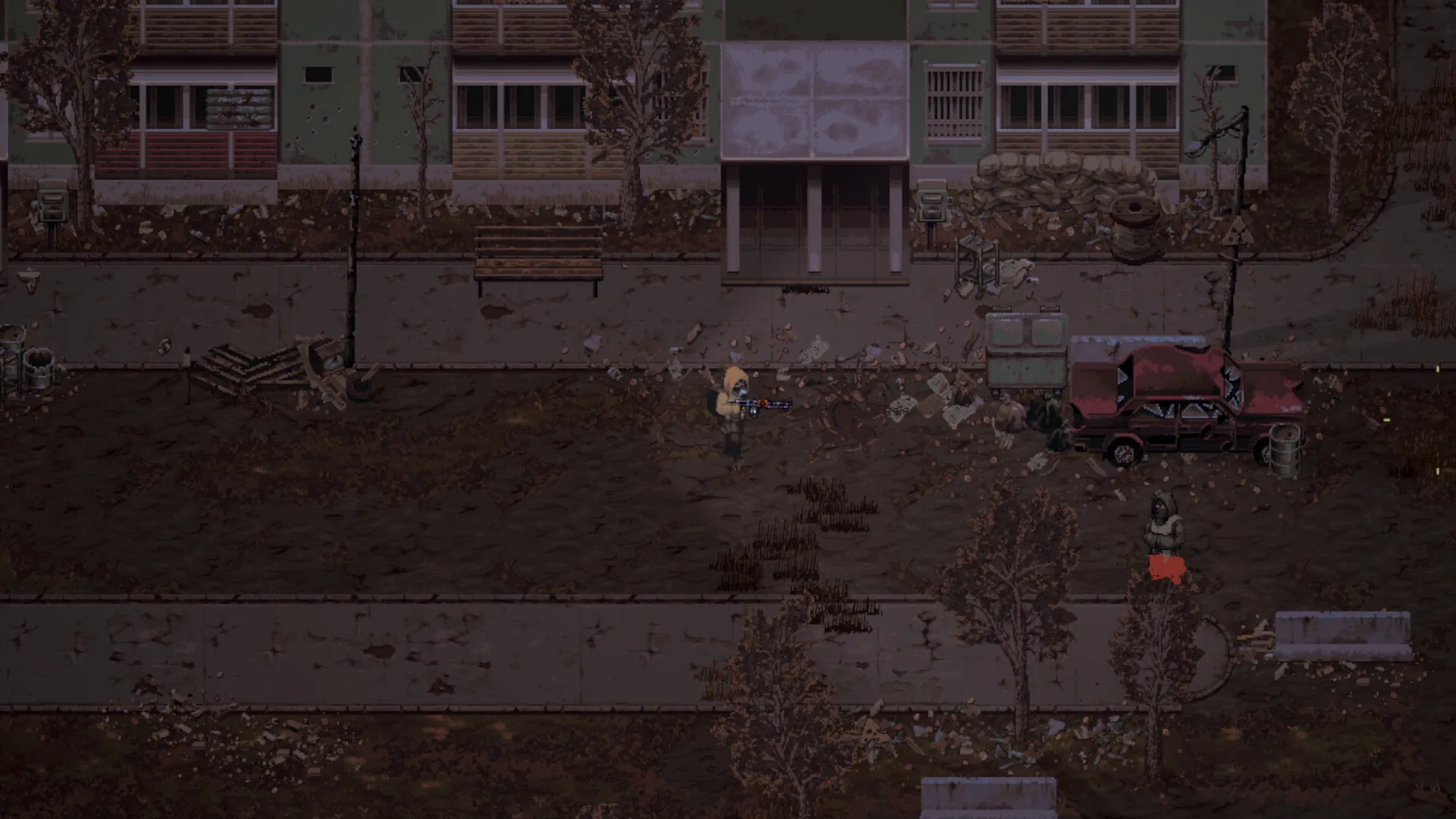
The pixel art is rarely well controlled. Not the cute control of games pretending to have sixteen colours, the real thing: ground textures that change every three metres, car wrecks that each have their own history of rust, a gutted tank whose barrel points at a stream full of bones.
But the cleverest part is the lighting. The frame is smothered by a vignette that eats the edges, and light comes only from specific sources: a van headlight left on, a lamp, a fire. Everything else sits in a dirty green-brown where you make out shapes without identifying them.
In a top-down game the camera could show you everything. Here it refuses. That is a design decision, not a graphical affectation, and it produces exactly the sensation that the whole world means you harm: a street, a junction, a building, and you do not know what is inside until you are in it.
The result is a post-Soviet apocalypse that needs no atmospheric text. Looking is enough.
You are a Vulture, a scavenger, in a region called Zalesye, ravaged by war and covered by a fog they call the Mist.
Your character survived bullets fired by soldiers said to have come from a country where the Mist does not exist. The people of Zalesye speak of a promised East, somewhere beyond the RO-29 highway, spared by whatever is devouring the continent. Whether that is true is another matter.
The rest is a cycle, and it takes few words: prepare, go out, scavenge, survive, return, upgrade, go further.
What makes the cycle addictive is that it is never free. Ammunition is scarce. Radiation is everywhere. Weapons jam. A badly prepared expedition is not a failed expedition, it is one you do not come back from, and everything you were carrying goes with you.
This is the layer that turns scavenging into a role-playing game.
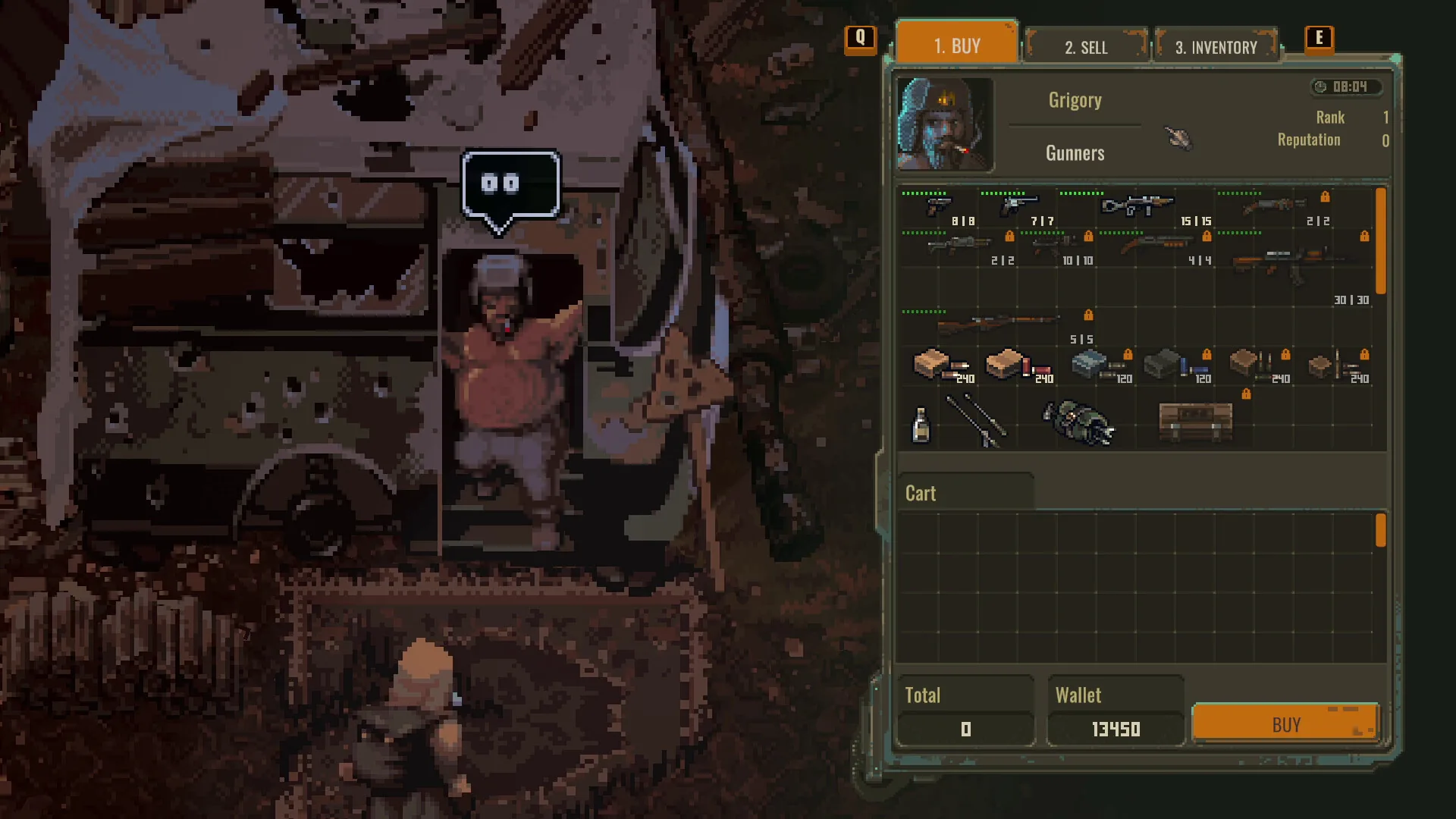
Zalesye holds ten factions, with a dynamic reputation system. Settlers, traders, raiders, survivors trying to rebuild something and others simply holding on.
Your contracts, your encounters and your choices change how each group treats you. Above all, it changes what traders are willing to sell you: their best stock is not bought, it is earned. Working for one group closes doors with another, and a merchant's inventory becomes a progression reward rather than a price list.
This is where I lost the most time, in the best way.
The game advertises over 25 weapons and over 300 attachments. These are not guns you replace with the next one that drops: you strip them, swap components, try configurations, and build a weapon around the way you play.
Combat follows the same tactical logic: firearms, melee, stealth, and suppression as a decision rather than a bonus. The studio also reworked vision during testing so the player can spot an enemy before being spotted, which is the right setting for a game that punishes this much.
In practice you pack your bag according to the destination: what you expect to find, what you accept risking, and what you are prepared to lose.
The surface world is handcrafted, with its abandoned installations, hostile forests and irradiated swamps.
Underground is a different matter: the bunkers use procedural layouts, which means the descent cannot be memorised. You can redo a surface area ten times knowing its angles, you never redo the same basement twice.
That is a good division. The map can be learned, the depths surprise, and the further you get from known roads, the better the risk-to-loot exchange becomes.
There is one, and I would rather state it plainly: the bestiary lacks a little variety.
You quickly meet silhouettes you have already met, and you end up knowing how to handle most threats apart from human encounters, which stay the most unpredictable. It is not disqualifying, because the tension does not come from the creatures but from what you cannot see yet, and because the studio has announced new creatures in the following acts.
But it is the point on which I will be watching the updates.
Be precise here, because the nuance decides the purchase.
What is there today: Act I, the first region, the handcrafted open world with its procedural bunkers, the map and minimap, the contract journal, the ten factions and their reputation, the 25 weapons and 300 attachments, crafting, looting, traders, main and side quests, the day-night cycle and an original soundtrack.
What is coming: Acts II and III with their regions, factions, creatures and quests, more weapons, more bunkers, and a cooperative mode that is not there at launch. The studio estimates the early access phase at twelve to twenty-four months.
A detail I appreciate: the price will not move between early access and the finished version, seasonal discounts aside. That is rarer than you would think, and it avoids the trick of raising the entry fee once the room is full.
And it is a light game, which is worth noting these days: two gigabytes of disk, eight gigabytes of memory, a graphics card with two gigabytes, full controller support and Steam Deck compatibility.
A word on the making, because it explains the level of finish.
NoShadow has been working on Scavland for around six years. The team went from about three people to roughly fifteen over the past year, and the studio announces a world about three times larger than before, with new locations, new faction territories and a complete visual overhaul.
It shows. Pixel art games of this density do not come out of a game-jam weekend, and the care taken over scenery detail is exactly what you get when a team spends years going back over the same areas.
On the anticipation side, the studio announced passing one hundred thousand wishlists on 25 August, then put the figure at one hundred and seventy-five thousand a few days before opening. Those are developer announcements, and they should be read for what they are: a measure of curiosity, not of purchases or of activity. The real number starts being written today.
Because this game understood something many survival games forget: fear does not come from monsters, it comes from missing information.
Scavland gives you a map, a bag that is too small, a weapon that can jam and a torch that does not reach far enough, then lets you decide how far you push. Every return to camp with a full bag is a personal victory, and every death is entirely your own fault, which is the definition of a good hard game.
There, the review is finished. I am heading back towards the RO-29 highway.
Found something better than the AK-50 in a bunker? Tell us on the InsertCoins Discord, we are comparing hauls and stupid deaths.