In FD 27 you never lose a match on match day. You lose it three months earlier by hiring a cut-price physio, or two seasons earlier by signing a shirt sponsorship deal that did not reflect the club's value.
It is disorienting for the first few hours, because no other football game keeps you this far from the pitch. Here is how to occupy that chair without sinking the club.
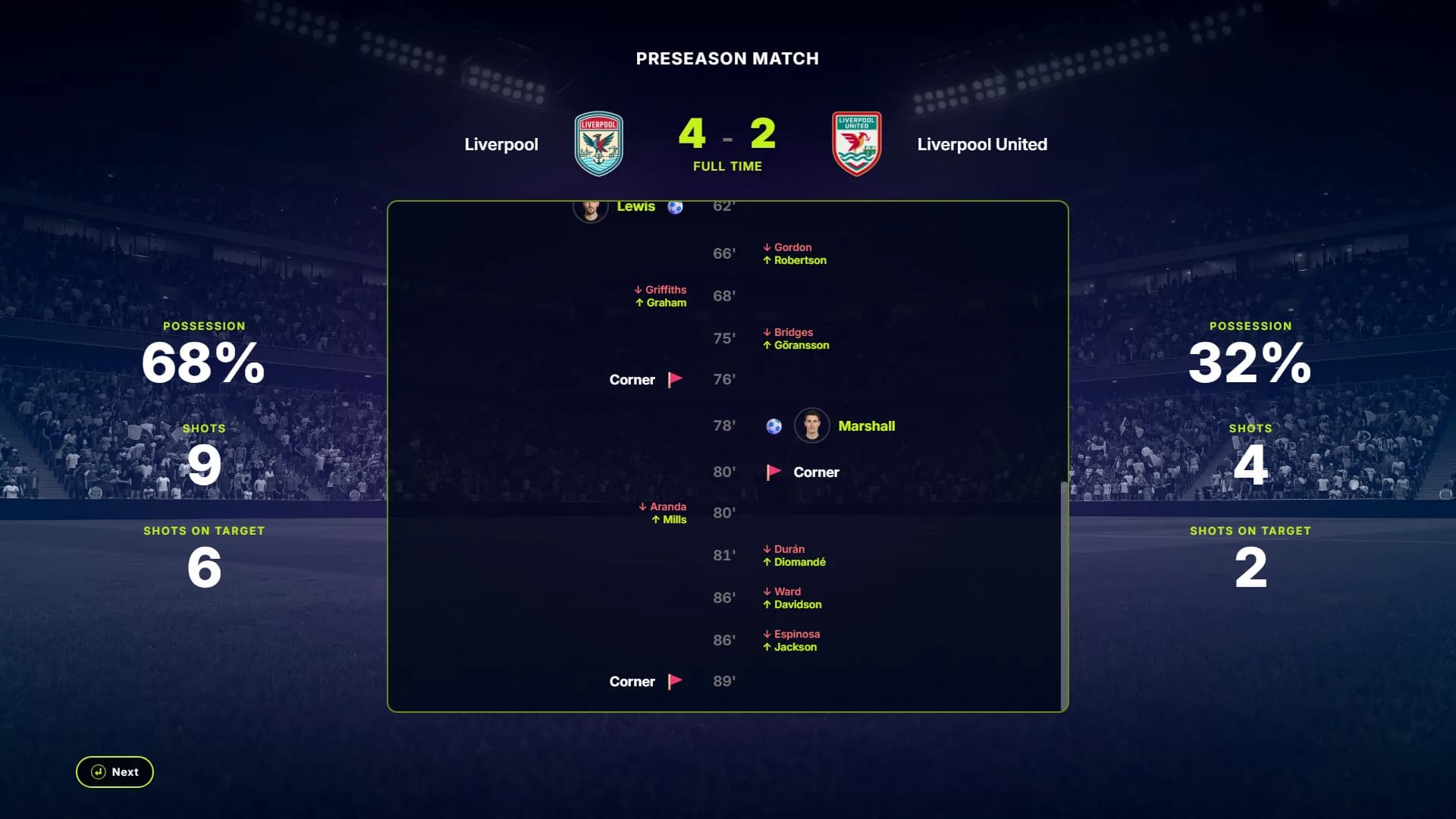
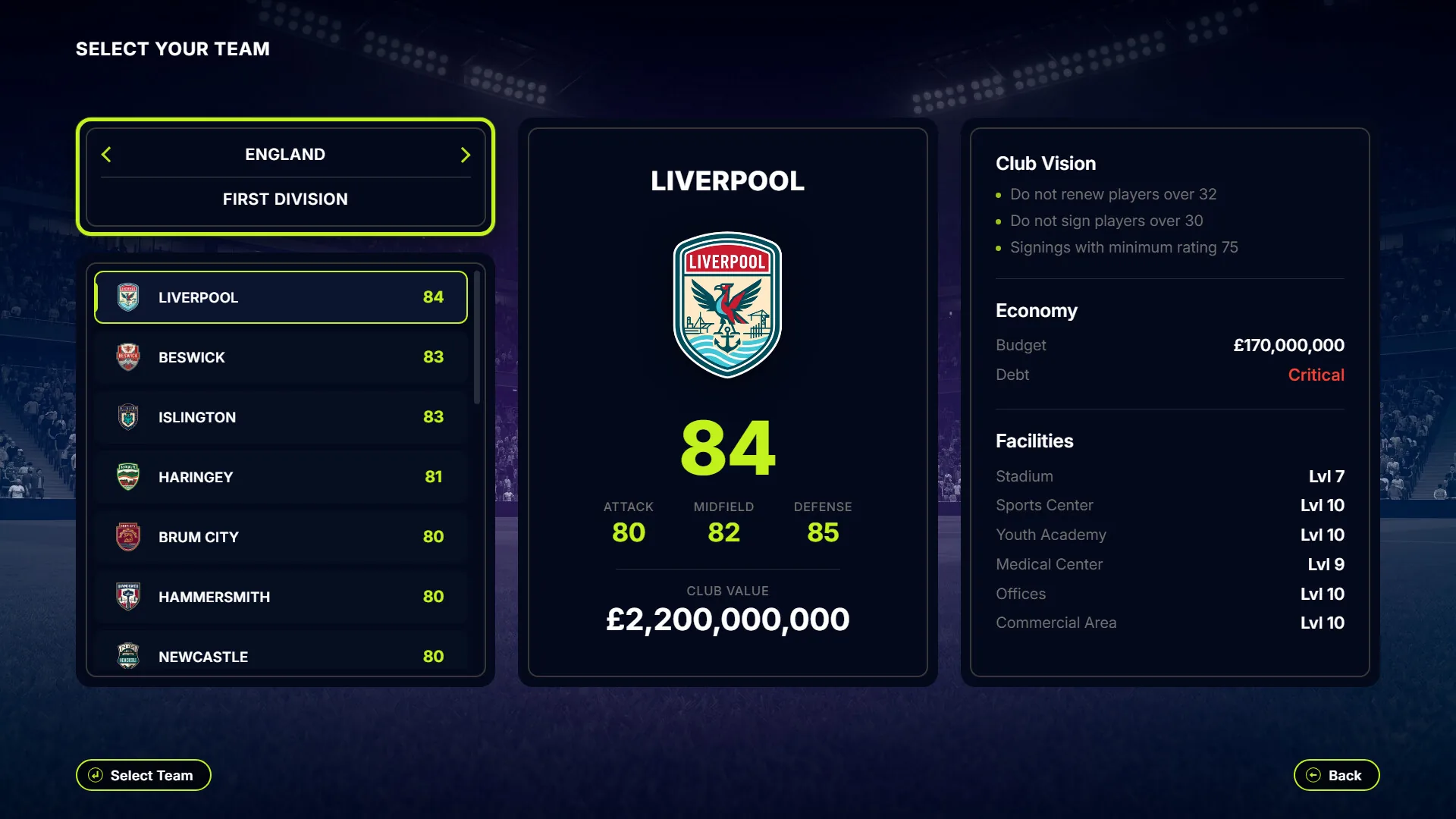
First screen, first trap. The choice of club is not cosmetic: the clubs you can buy depend on the difficulty you pick. In experience mode it is free and you take what you like. In campaign mode there is no budget available to acquire a club, which narrows the field considerably.
Version 0.1 gives you six divisions: Premier League, Championship, League One and League Two in England, La Liga and Segunda División in Spain. More than 6,000 players, more than 1,500 staff members, more than 100 sponsors.
My advice for a first save will surprise you: do not start in the Premier League. A big club hides your mistakes behind its budget, and you will never understand why your decisions matter. In League One or the Segunda, every wage weighs, every injury hurts, and the game's mechanics become legible in one season instead of five.
Look at the setup options before confirming: the game lets you disable tutorials, choose your responsibilities and set autosave. Responsibilities determine what you delegate, and they are properly applied in game, so do not tick them at random.
A welcome practical detail: you get three save slots, one current game and two copies dated from the previous month. You always have a net.
This is the heart of the game. A club is a four-service organisation that has to turn as one: sporting direction, medical, marketing, finance. Each service is staffed by employees with their own attributes, performance and salary.
On a limited budget you cannot tend all four at once. Here is the order that gets the best results, and above all why.
1. The medical department, before anything else. It is counter-intuitive, everybody wants the sporting director first, and that is a mistake. The head of medical determines how your players recover and how long they take to return. The game simulates traumatic injuries but also short muscular ones, right down to single-day knocks. A poor medical department is not the occasional absentee, it is a treatment room that never empties.
Above all, it is the expense whose effect arrives six months late. Skimp on it in August and you will not feel it until February, precisely when the season is decided and injuries pile up. No other line item punishes you this indirectly.
2. The sporting director next. He is your right hand in the transfer market, and a good one opens better signing options. He matters, but his effect is immediate and visible, therefore fixable. Unlike medical.
3. Marketing. It drives your ability to attract sponsors, and therefore your revenue. It is an investment that pays for itself, but it is useless if you have no attractive sponsorship slots to sell yet. It logically comes later.
4. Finance. The department keeps the accounts in order, or does not, depending on who you put in charge. In a small division, with simple cash flows, you can stall for a window or two. At the top of the pyramid, you cannot.
One addition from the 11 August update changes the sorting: staff reports on players gained thousands of new lines that adapt to each player's situation. Your scouts no longer recite generalities. Actually read them, they now carry information.
Every player carries a transfer cost and a salary that will weigh on your accounts for the whole length of the contract. It is that second part beginners underestimate.
The game asks one question every window, and it has no universal right answer: a star and an unbalanced squad, or an even group that competes on all fronts. In a small division the even squad wins almost every time, because your fixture list will make you play with injuries and depth is worth more than a peak.
On negotiations, two behaviours worth knowing. Player resistance to discussing wages has been sharply reduced: you will almost always get a conversation. But the difficulty stays where it belongs, meaning that if a player is significantly better than your squad average, or comes from a higher division, his demands will still match his level. You get the right to try, not the right to succeed cheaply.
When a club comes for one of your players, you are no longer limited to accept or reject: a full negotiation screen lets you make counter-offers on the fee. Use it every single time, the first offer is never the last.
Two safety mechanics are worth knowing. On relegation, the wage bill is automatically reduced to fit the club's new finances, which prevents clubs from folding after dropping a division. And assembly fines are now forecast in the financial balance, so you know in advance what breaking one of your league's laws will cost you, and whether you will end the year in the red.
Note in passing that the lower-division market was fixed on 11 August: getting offers there used to be very difficult because of player quality, and it now works correctly.
Your income comes from television, ticketing, merchandising and sponsorship. Your outgoings go to wages, transfers, infrastructure and personnel.
On sponsorship you negotiate four contract types: shirt, sleeve, shorts and stadium. Each brand has its own demands and brings different capital. When every type is filled, the game now tells you with a dedicated message. Do not undersell the shirt early on: it is your most valuable slot, and its value rises with the club's reputation.
Merchandising was rebalanced to give more weight to the club's level, which particularly helps teams in weaker divisions. It is a stream not to neglect at the bottom of the pyramid.
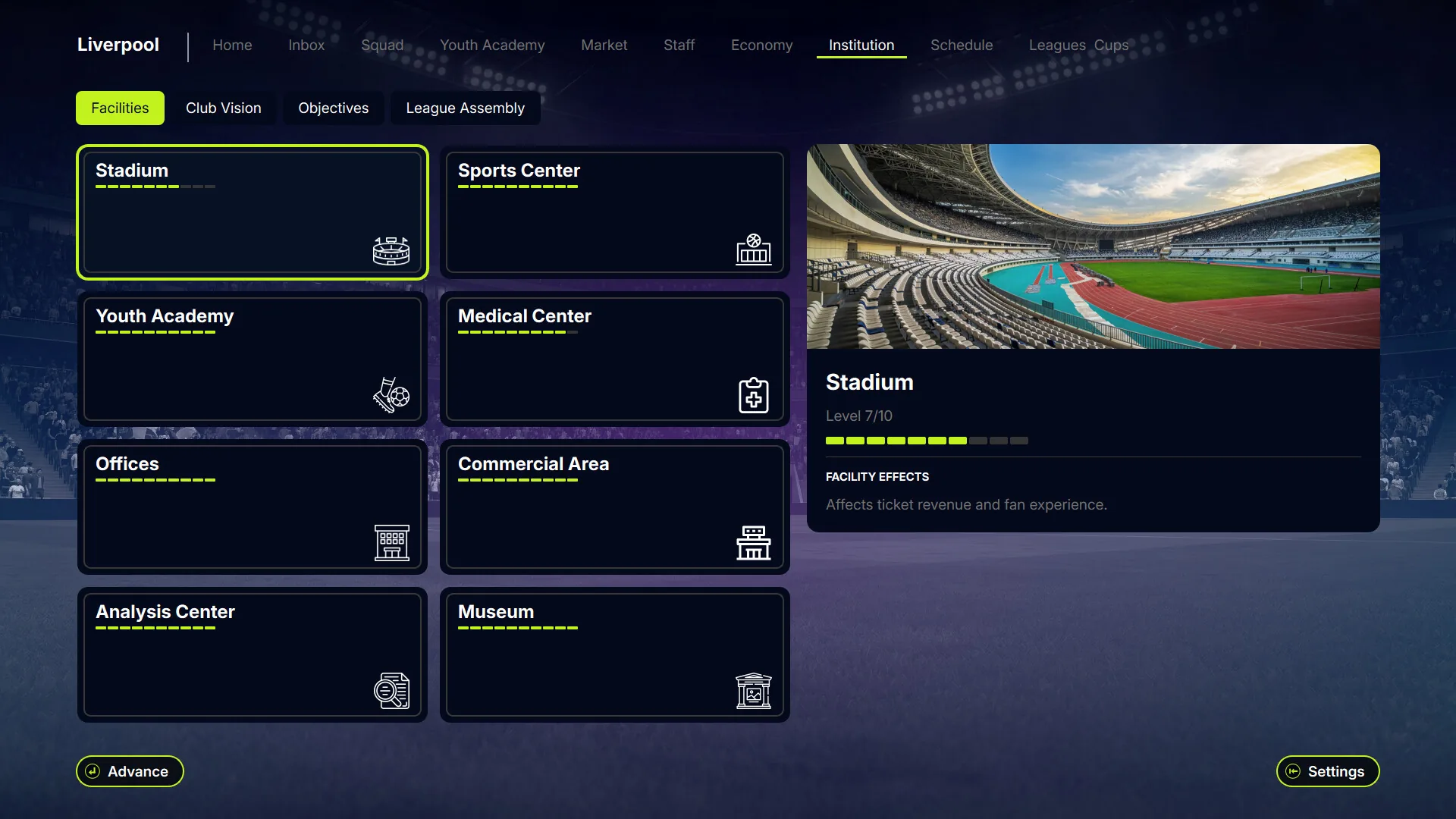
Eight facilities can be built or upgraded: stadium, training ground, gym, medical department, official store, museum, offices and scouting centre. The game notifies you when a facility or an upgrade is completed, which saves you watching the calendar.
A word of caution: the costs and revenues of the museum and the shopping centre were adjusted. These are comfort buildings, not priorities. Before them, go through the medical department and the training ground, which feed directly into what happens on Saturday.
Watch out for one awkward sequence: youth coaches and the youth coordinator are tied to the facility. Until you have built the academy, they will not even appear in your staff list. Do not hunt for a post you have not unlocked.
Finally, the economy offers investments and loans to finance growth. A loan in a lower division to finish a training ground pays for itself. A loan to sign a striker is paid off for years.
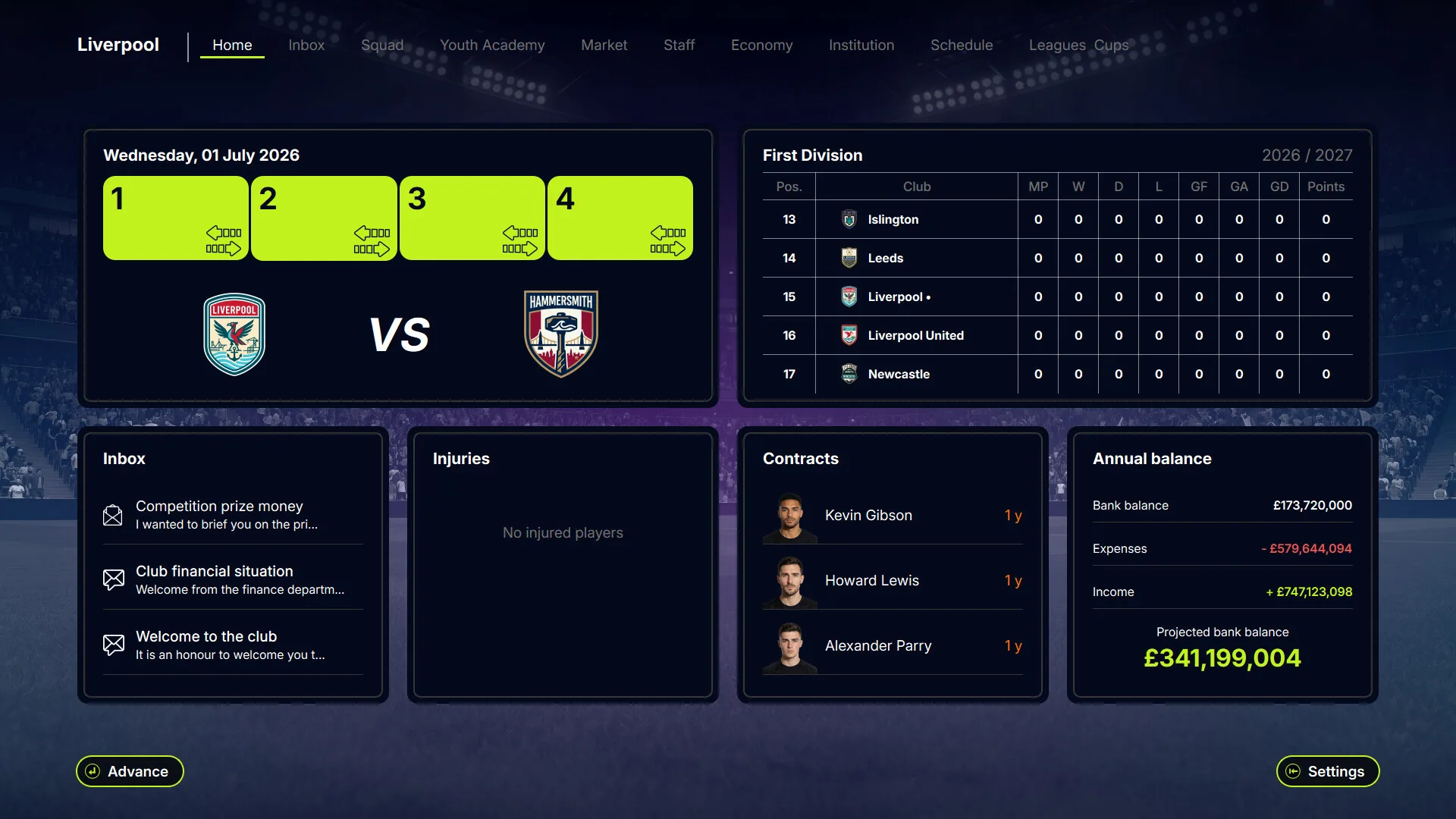
You give no instructions. The engine simulates every match minute by minute, accounting for individual quality, form, accumulated fatigue, morale, current injuries and the coaching staff's tactical capacity.
Which means the match is a diagnostic report, not a spectacle. You are not playing it, you are reading the result of your decisions in it. Watch three things precisely.
Wear over the ninety minutes: if your team collapses in the last quarter of an hour every week, your problem is physical preparation, so the training ground and the staff, not your attacking recruitment.
Players on low morale, who perform below their level. The type of conversation available with a player now depends on his mood, so dressing-room atmosphere is a variable you can act on away from match day.
Your coach's substitutions. The system respects the three regulation windows, and the staff's artificial intelligence decides by context: losing, exhausted player, result to protect. If the changes look stupid repeatedly, it is not a bug, it is a verdict on the coach you hired.
You can set simulation speed to normal, x2 or x4, and simulate whole days from the calendar. Use it without guilt: the game does not reward watching everything.
A word on fairness, because it is rare and deserves saying: the AI-run teams play by exactly the same rules as you. Their players tire, get injured, lose form and go through bad runs. There is no hidden advantage. Your defeats therefore always have an explanation to look for in your own organisation.
The vision system has you define a philosophy: playing style, transfer policy, commitment to the academy, financial profile. It is not set dressing. It is what gives your decisions a spine instead of letting them drift with whatever the transfer window throws up.
Choose it according to your division. At the bottom of the pyramid, a vision built on youth development and financial caution keeps you alive. At the top, it caps you.
The league assembly has you vote on upcoming laws that will change the competition. It is the easiest system to ignore and one of the most profitable, since it lets you steer the rules towards whatever your club is good at.
Let us be clear about the state of the game: this is a 0.1 in early access, sold at around ten euros, two countries, six divisions. Syra Games has announced what comes next, phase by phase.
0.2 brings European competition with a league phase and knockout rounds, the Chinese league, and ten new European leagues: Italy, Germany, France, Russia, the Netherlands, Portugal, Belgium, Czechia, Turkey, Poland and Scotland. 0.3 opens the full youth academy, tracking players from age eleven, with international training centres. 0.4 will let you create your own club from scratch.
In practice, if the absence of your national league is a deal-breaker, wait for 0.2. If you want to judge the management system, 0.1 is already coherent.
Skimping on medical. You will pay for it in February, when nothing can be corrected.
Signing the star. He eats your wage headroom for several seasons and leaves you with an empty bench when injuries arrive.
Building the museum before the training ground. The first flatters, the second wins points.
Accepting the first shirt sponsorship offer. It is your most valuable asset and its value rises with your results.
Ignoring the league assembly. Voting for rules that suit you costs nothing at all.
Which club are you running, and in which division? Tell us about your project on the InsertCoins Discord, we like comparing trajectories.