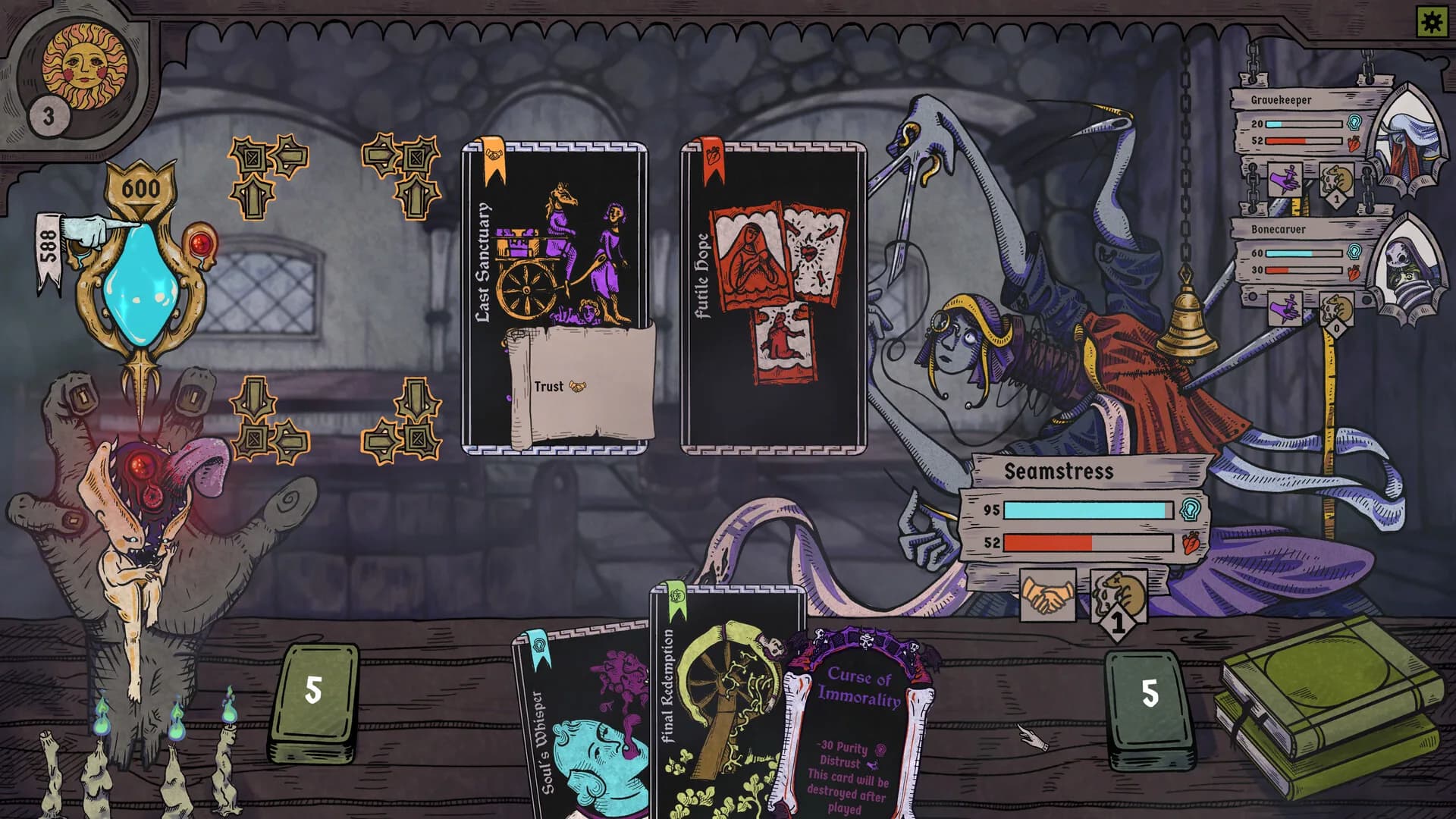
Most players lose their first BLOODLETTER runs for one simple reason: they play the deckbuilder they already know. They hunt for the damage engine, they hoard the big cards, they treat the patient in front of them.
Except there is no damage here, there is not really a single patient, and the most important card in your hand is often the one acting on somebody you have not started treating yet.
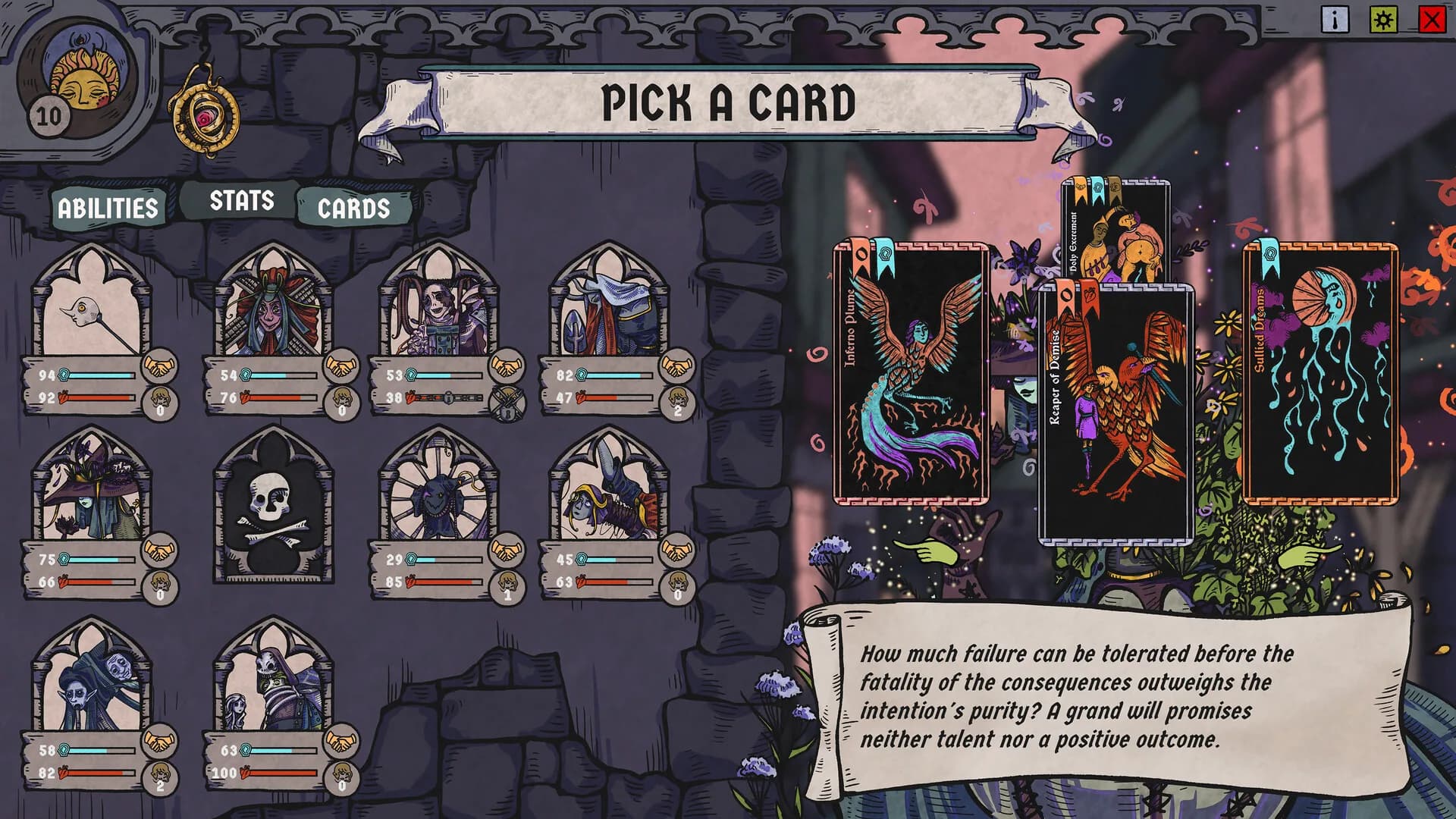
Everything runs through three values: Purity, Health and Sickness.
Purity is your cleansing objective, Health keeps the villager alive, Sickness works against you. The classic beginner error is treating Sickness as a simple penalty to offset, when it is the only one of the three that accumulates against the clock.
Hold on to this hierarchy, it settles most decisions: a card that removes Sickness is almost always worth more than a card adding equivalent Purity, because the first buys you turns back and the second merely advances a counter. Oath of Balance removes three Sickness, Blood Cleanse removes two: these are not cards you cut without a good reason.
This is the game's real subject, and what separates it from its competitors.
In front of you, villagers wait their turn. Many cards do not target the person you are treating but the other villagers in the queue. Herald of Cures gives fifteen Health to the other waiting patients. Welcome Sacrifice gives them fifteen Purity.
The strategic consequence is enormous and counter-intuitive: you have to prepare a patient you have not started. A villager who reaches you already loaded with Purity is one you will settle in two turns instead of five, and those three saved turns are exactly what lets you absorb the endgame.
So the right habit, from your first hand, is to look at the whole queue before looking at your patient. If you see a hard case coming, water it in advance while you handle an easy one.
Here every opponent is a different problem, not an enemy with more health. It is the game's best idea, and each entity needs its own plan.
The Corrupting One is the entry entity, the one you begin with, and its easy difficulty asks for three bloodstone extractions. It is your training ground for the gauges, and it also unlocks two important cards: Infernal Gate on easy, and Herald of Cures on hard.
The Impaled One runs on a collection mechanic: you must gather sword pieces. Be careful, this is the point that earned the studio an emergency hotfix in April, because duplicating or upgrading cards containing sword pieces could stop the missing pieces reappearing in rewards and lock the run. It is fixed, but keep the principle in mind: with this entity, do not duplicate your sword pieces for convenience, complete the set first. It unlocks Rebirth on medium.
Avarice and Cupidity is the most interesting entity to play. It is famished, and it asks you to choose which stat to sacrifice to satisfy that hunger. There is no universal right answer: the answer depends on what your deck can rebuild. If you have cards that restore Health in bulk, sacrifice Health. If your deck lives on Purity, do not touch Purity. This is also the entity that introduced mergeable cards and the MERGE mechanic.
The fourth entity, from the final version, changes the rules: you cannot beat it alone. You must recruit your villagers as allies and begin the rite of severance. In other words, all the work you did on the queue across the first three entities becomes the very condition of victory. It is a neat way to close a game.
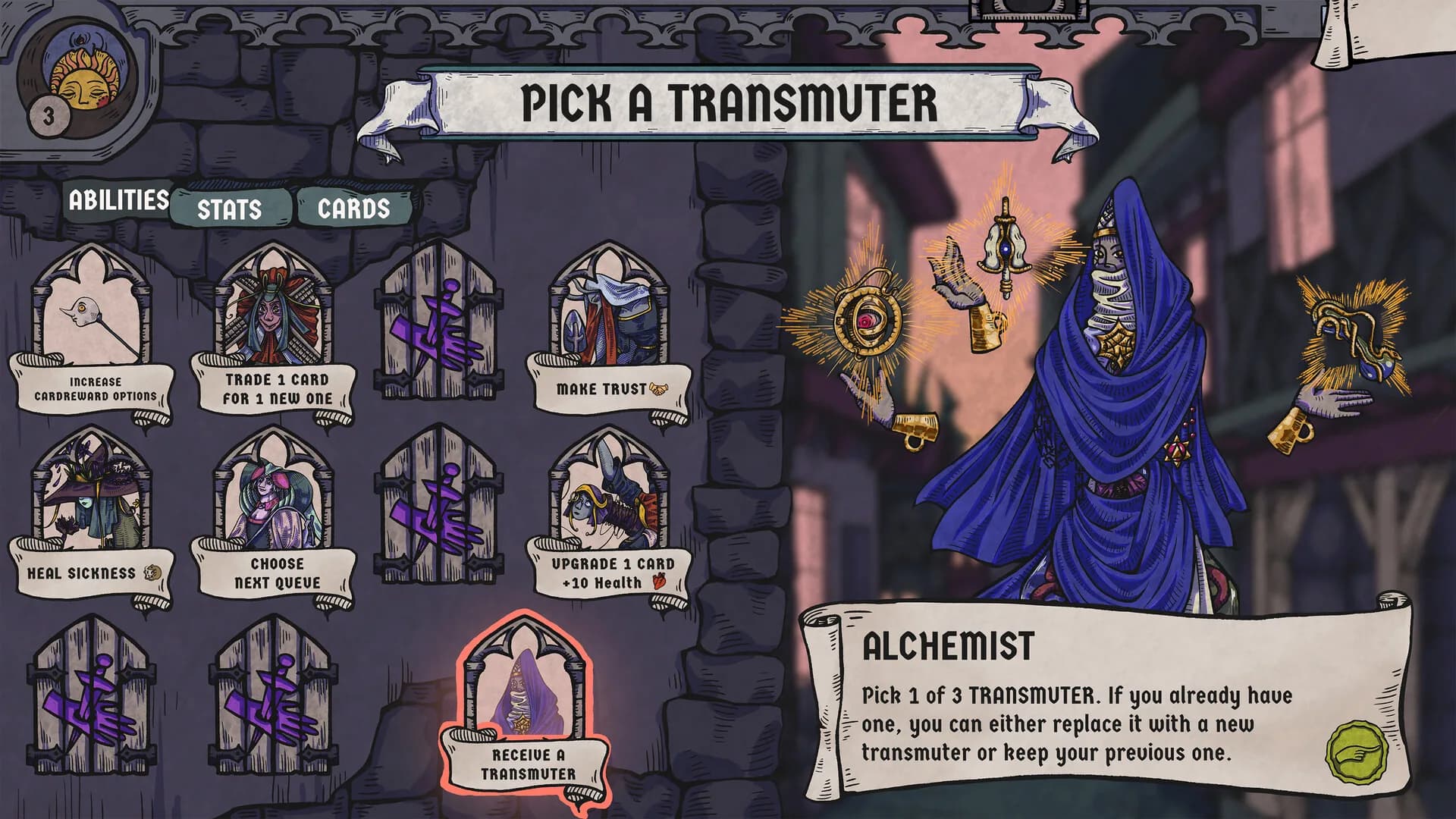
A dozen transmuters change what your cards are worth depending on which is active. This is not a passive bonus, it is a change of context.
The golden rule: choose your cards according to the transmuter, never the reverse. A card that is mediocre in the abstract can become a run's centrepiece if the active transmuter rewards exactly its behaviour, and an excellent card can end up inert.
In practice, before your first card reward, take ten seconds to reread the current transmuter and decide which axis you are playing. Failed runs are almost always runs where you built a coherent deck that completely ignored the context.
Bloodstone extractions are your card source. You need to complete a certain number depending on the entity and difficulty.
One important point, because it changed and explains a lot of frustration: in June, the chance of drawing a rare card fell from 35 to 10 percent. The studio owns it and explains its thinking, namely that rares should be able to define a run through unique effects, which stops meaning anything if you find them all every time.
What that implies for you: do not build your plan around a rare you are hoping for. Nine times out of ten it will not come. A coherent deck of commons and uncommons beats a deck waiting for its miracle.
These figures are those in force after the May and June balance passes. They may move again, but they give the orders of magnitude.
On Purity: Holy Excrement gives 20, making it one of the best raw cards in the game. Misery Wyrm gives 15. Inferno Plume gives 8 Purity per card discarded, making it a fearsome end-of-turn card in a deck built to discard. Sullied Dreams gives 4 per card in your discard pile, so a card that climbs all run.
On Health: Weeping Peasants restores 35, the largest flat heal in the game. Purity Through Flame restores 4 per card in the discard, the same scaling logic.
On Sickness: Oath of Balance removes 3, Blood Cleanse removes 2.
On the queue: Herald of Cures, 15 Health to the others, and Welcome Sacrifice, 15 Purity to the others.
Worth watching: Gluttony was nerfed in June, down from 15 to 10 Purity and Health. It remains good, it is no longer the automatic pick it was. Despair discards itself immediately, which makes it a card to combine deliberately with discard-counting effects rather than a dud. Marvelous Zest and Marvelous Tang give 3 while they stay in hand: these are cards you specifically must not play, their value is in staying put.
Butcher's Nail costs 5 Purity. That is cheap, and it is the sort of cost you accept too readily early on without checking what it offsets.
Treating the patient in front of you and ignoring the queue. This is mistake number one, and it costs three quarters of avoidable losses.
Playing your permanent in-hand cards. Marvelous Zest and Tang lose all value the second you put them down.
Building your deck before reading the transmuter. You will get an elegant deck that does nothing.
Counting on rares. They land one time in ten, that is not a plan.
Duplicating sword pieces against The Impaled One. Complete the set first.
Neglecting Sickness. It is the only gauge racing the clock.
The final version launches today and adds an entity, twenty-one cards and two transmuters, with a visual rework of the mergeable cards to improve readability. The exact values of that new content, and the combinations it opens, will need a few weeks of collective practice before a consensus forms.
So this guide covers the system's logic and the established content. We will expand it once the community has mapped the rite of severance.
Found a combination that folds an entity? Tell us on the InsertCoins Discord, we will happily test it.