There is a line in the 30 August patch notes that made me smile and that sums this game up better than any sales pitch.
After listing three new leagues, twelve international sides and a hundred and fifty player headshots, the developer writes: "There have also been several bug fixes carried out since Wednesday, so hopefully this build is hugely improved! I have been working really hard on it and have failed to remember a lot of the bugs that I have fixed!"
I have. Singular. Thirty-nine numbered patches in two months, a database of sixty-four international sides, a match engine that simulates swing according to the weather, and one person behind it.
You have to understand the state of the field first, because it explains everything.
Cricket is one of the most followed sports on the planet. And on PC, its management simulation offering has rested for decades on a handful of titles, Cricket Captain foremost, with an interface that aged at its own pace and no serious competition to shake it.
Meanwhile football has had forty years of Football Manager, basketball has its simulators, cycling has its own, and even Formula 1 has several management games.
So when a player writes in an August review that it was about time somebody made a decent cricket management game, that is not politeness. It is relief.
Cricket Management 26 launched into early access in late July. It has been in full release since 29 September, with a 1.1 patch three days later. It costs 16.49 euros.
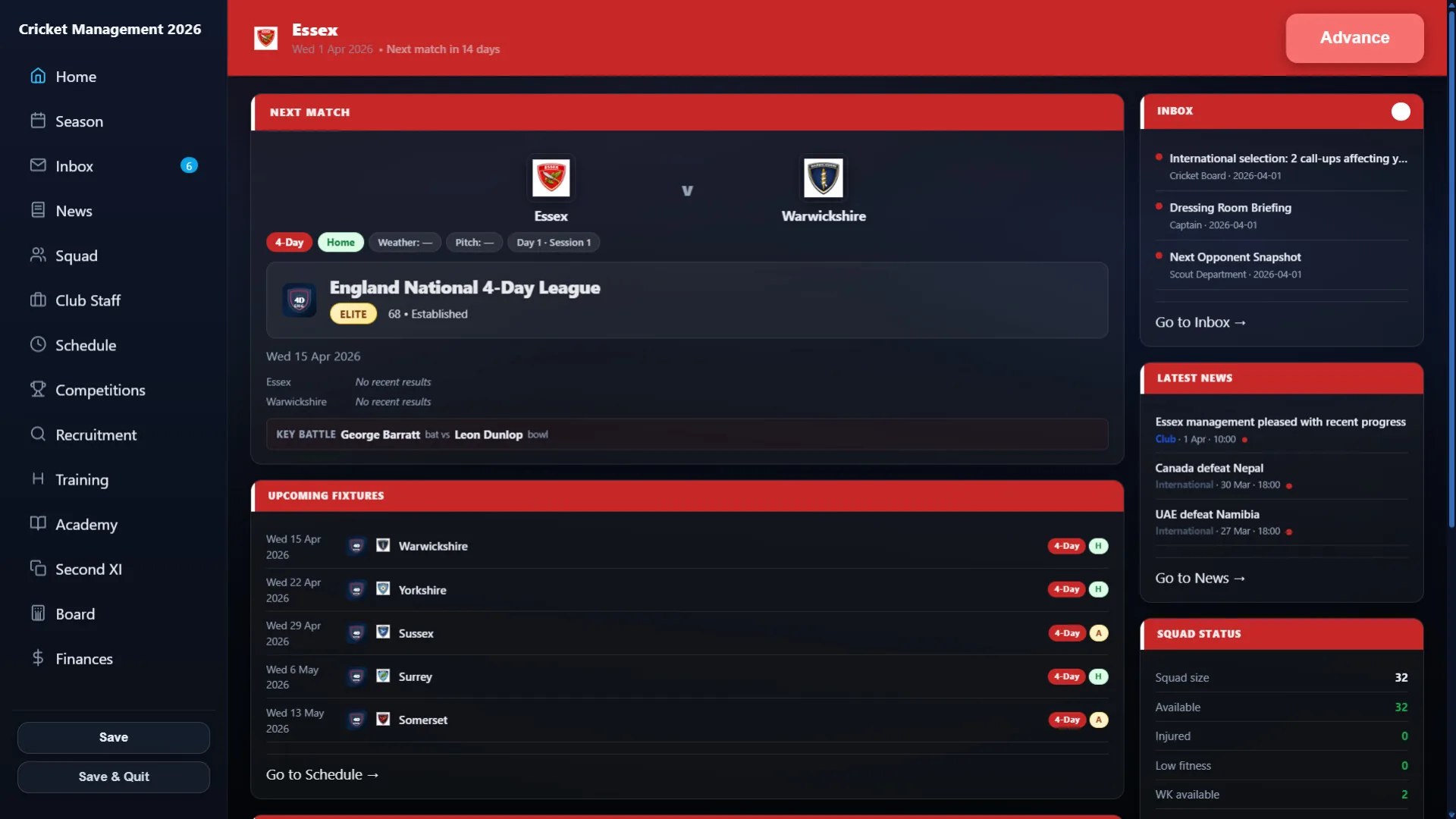
Open the sidebar and you get an immediate answer to the question of whether this is serious.
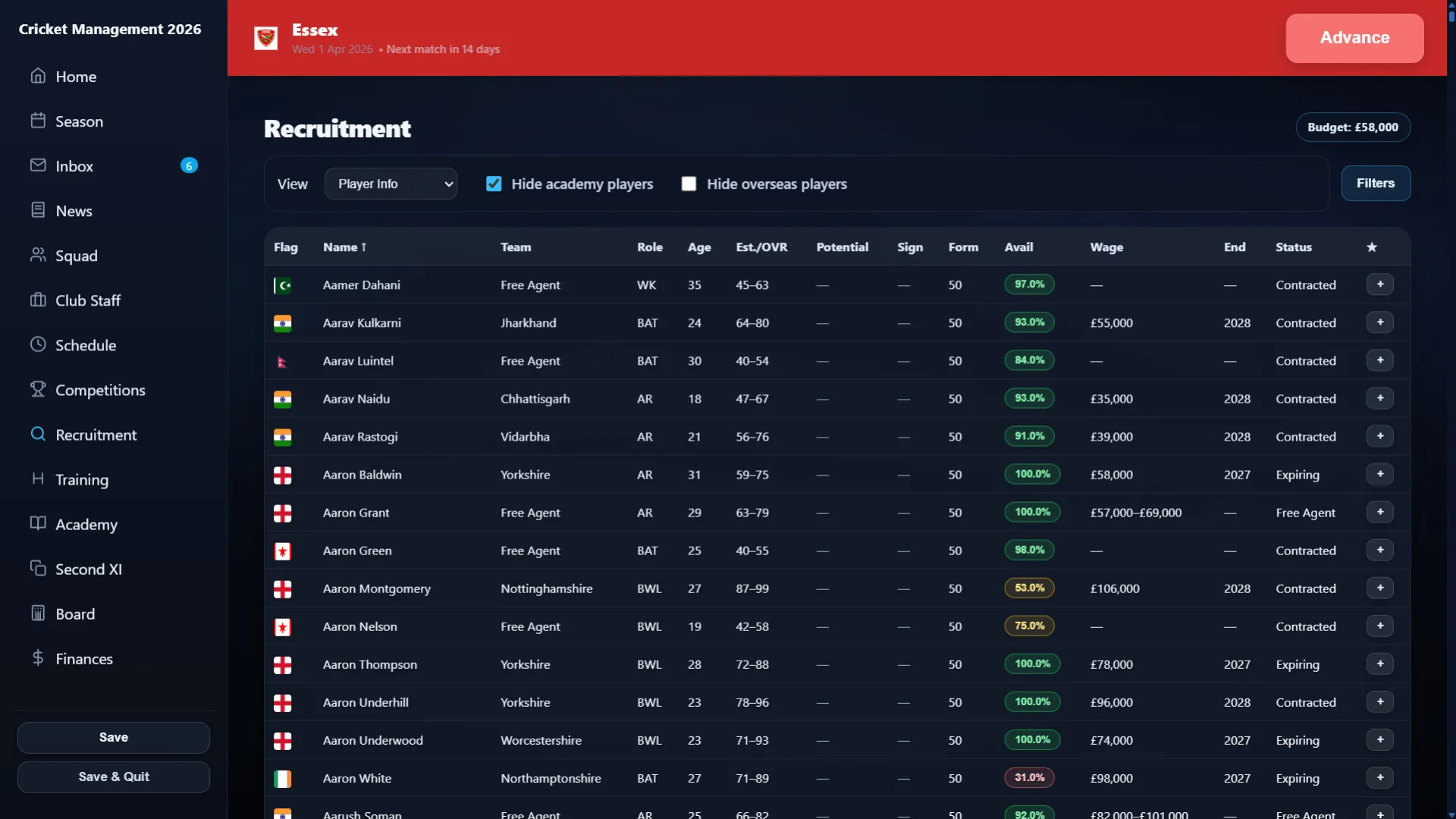
Home, Season, Inbox, News, Squad, Club Staff, Schedule, Competitions, Recruitment, Training, Academy, Second XI, Board, Finances.
Second XI. The game has a reserve side, with its own layout, its own players and its own development role. That is the detail separating a simulator from a team management game: you need somewhere to play the youngsters and the players returning from injury.
The three formats are present, and they are not cosmetic: red ball over four days, the one-day format, and T20. These are not three modes, they are three sports with different skills, rhythms and strategies, and you have to build a squad capable of answering all of them.
On content, the counter rose fast during early access. Playable international sides went from 32 to 64 in the space of a month. Leagues were added in Bangladesh, the UAE and the United States. English county cricket is represented with its divisions, its tables and its cups.
This is the screen that convinced me somebody genuinely knows the subject.
When you choose a national side, you do not get a list of names with an overall rating. You get a job description.
Take Afghanistan. The game displays: full Test status, with the task of balancing red-ball foundations against white-ball ambition. Career difficulty: medium. Then the competition programme, the Tests, ODIs, T20s, global qualification events and multi-year championship cycles. Then the central challenge, which is ranking growth and tightening the margins against top-tier opposition. Then the board expectation: established Test nation, strong expectations in bilateral series and major tournaments.
And a note in brackets: full programme, subject to the FTP and in-game windows.
The FTP is the Future Tours Programme, the international calendar determining who plays whom and when. Putting that in a game means accepting that your schedule is not entirely yours, exactly as in the real life of a head coach.
Twenty-eight nations are offered at that level, each with its own briefing. That is not a list of flags, it is a choice of context.
And here, for anyone coming from management games, there is an evening to be lost.
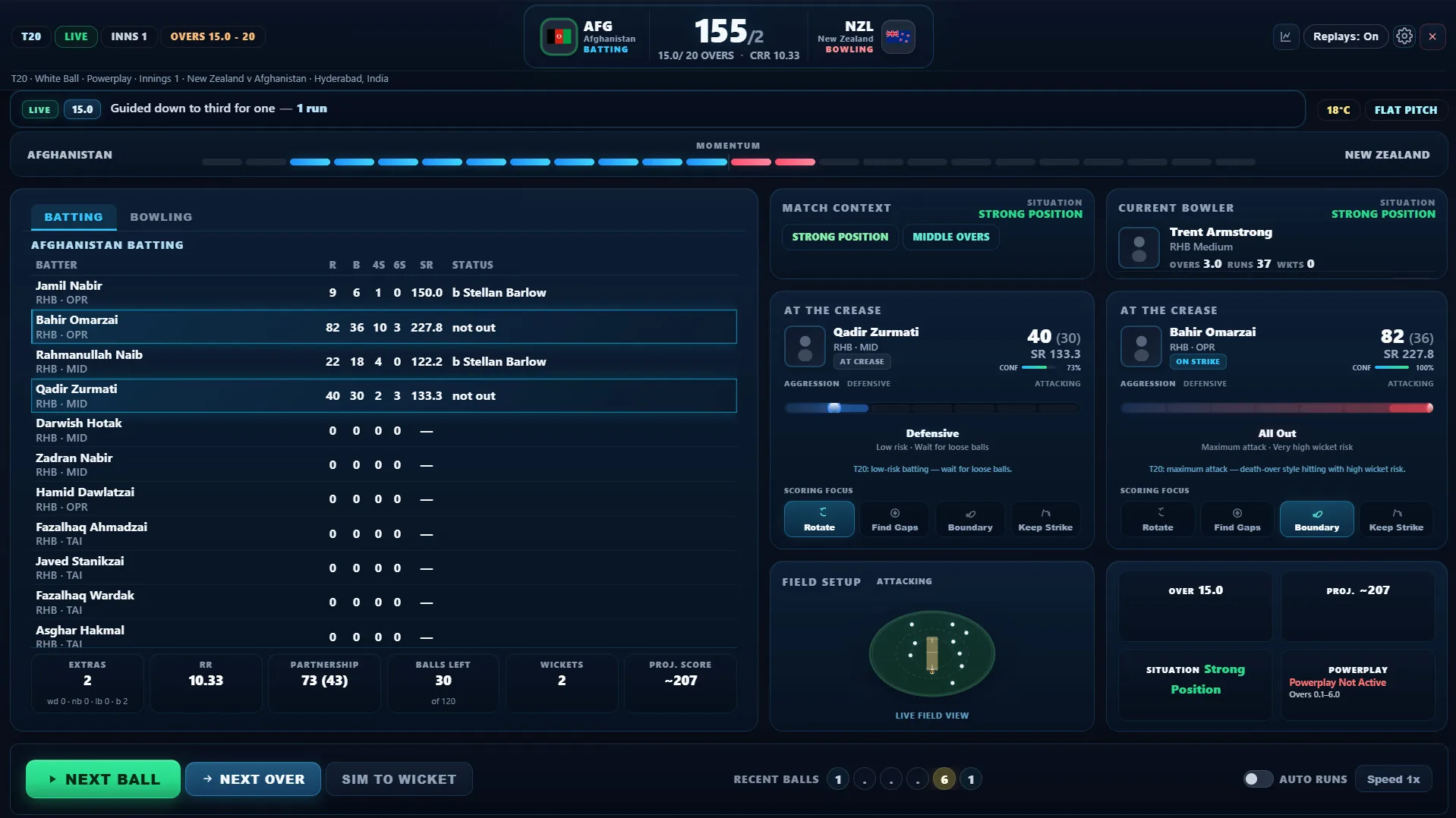
The match screen gives you the live score, the innings, the overs, and a full scorecard with detailed dismissals. So far, nothing remarkable.
What is remarkable is the layer around it.
A momentum bar that swings ball by ball. A match context telling you where you stand, strong position, middle overs. A current bowler card with his figures for the day. Two batters at the crease with their aggression settings, from defensive to all-out.
Bowling plans are chosen by intent rather than by coordinates: rotate the strike, find gaps, go for the boundary, keep strike. That is exactly the right abstraction for a management game, where you give an instruction and let the player execute it according to his qualities.
Field placement happens on a pitch view. The weather and the pitch type are displayed, because they matter.
And they genuinely matter: a September update added swing and spin percentages to the match engine, computed from the state of the ball, the weather conditions and the bowler's attributes. A new ball under cloud cover does not behave like an old ball on a dry pitch.
You can follow the match ball by ball, over by over, or sim to the next wicket. There is DRS and there are replays.
Seeing that level of granularity, you understand why one player posted a review at 390 hours.
I am going to linger here, because this is the sort of screen that decides whether I stay.
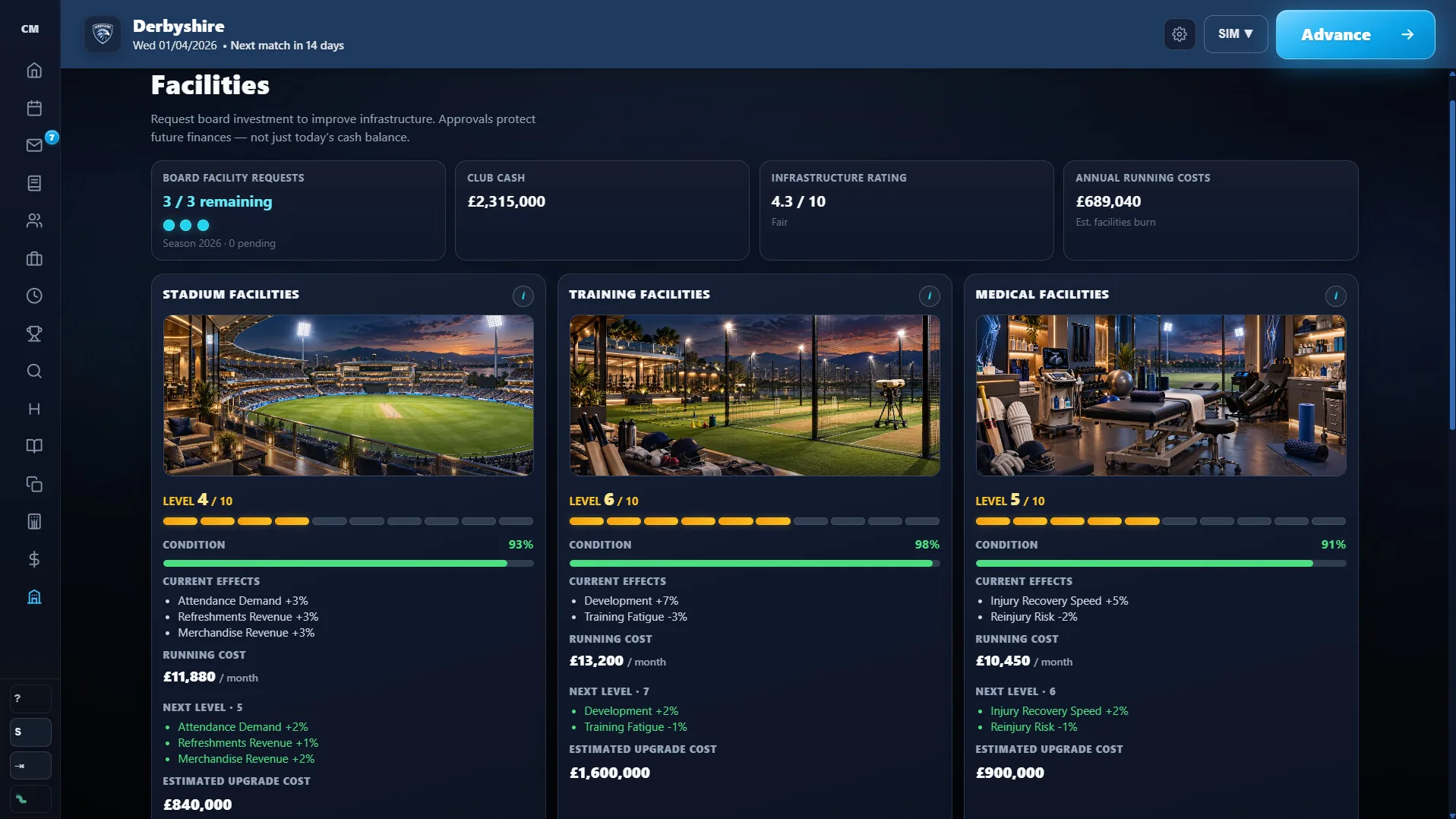
You have six facilities to run, split across stadium, training and medical infrastructure. Each has a level out of ten, a condition percentage, a monthly running cost, and an estimated upgrade cost.
And each has legible effects.
The stadium raises ticket demand, refreshment revenue and merchandise revenue. Training improves development and reduces training fatigue. Medical speeds up recovery and lowers reinjury risk.
The board approves a limited number of facility requests, and your current finances limit what you can commit to.
Add dynamic ticketing where you set your own prices, attendance that reacts to your results, and separate budgets, and you have a genuine club economic model rather than a money counter.
For somebody like me, who has spent more nights than he will admit tuning budgets in management games, that is precisely the layer that turns a season into an obsession.
Two September additions deserve naming, because they address the genre's classic weakness.
The World Story Engine produces contextual stories: captaincy debates, breakthrough youngsters, veteran comebacks.
The Career Arc Engine assigns players career trajectories: late bloomer, club legend, franchise journeyman.
The eternal problem with a management game is that players are columns of numbers going up and down. Giving a player an arc, and a season a thread of stories, is what makes a squad memorable. It is precisely what took Football Manager twenty years to refine.
Head coach philosophies and scouting assignments, added at the same time, pull in the same direction: giving decisions a colour rather than a slider.
I am not going to sell you a perfect game, and the developer does not either.
There are no real player names. That is a licensing question, and it is the entry price for a studio this size. There is an in-game editor, and part of the community is waiting on community databases with real names. If nominal authenticity is essential to your enjoyment, know that before you click.
The reception is mixed, and it needs reading correctly. The game shows twenty-four positive reviews out of thirty-five. That is a mixed reception on a tiny sample, and crucially: nearly all of those reviews were written during early access, between late July and late September.
And when you reread the negative ones, you find freezes at the end of an innings, an interface that stopped responding, an Indian Premier League halting in its second half, a T20 cutting out after two overs. And when you reread the patch notes, you find those same problems addressed, by name, one after another.
That is not an excuse, it is a chronology. The people who were disappointed in August were right to be. The question for you is what the October build looks like, and not many people have rated it yet.
The Steam page carries a generative AI disclosure, limited in its wording: the studio states that AI tools were used to assist with certain promotional artwork, visual assets and marketing materials. I flag it because it is written on the page and you are entitled to know.
And this is a niche game inside a niche. Thirty-five reviews is the audience. Do not expect a vast community with databases for every league in the world by tomorrow.
I have an admitted weakness for this kind of project. The hyper-specialised management simulator made by somebody who knows their sport and codes in the evening is a tradition that produced some of the best games in my library, and that is disappearing under calibrated productions.
What impresses me here is not that a cricket game exists. It is the ambition of the list: three formats, sixty-four international sides, the English counties, Asian and American leagues, a reserve side, an academy, loans, facilities with running costs, dynamic ticketing, a constrained international calendar, a match engine that models swing, and two narrative engines.
Any studio would have shipped a third of that and called it a complete game.
There is work left. The full release is young, stability was built painfully and in public, and the community is small. But the foundation is laid, and it is markedly broader than its competitors'.
If you like cricket and spreadsheets, that is sixteen euros for a season that will cost you a great deal more than sixteen euros in sleep.
And if you know nothing about cricket, note that one player wrote it plainly in his review: he knew nothing either, he found it fairly easy to pick up, and he stayed.
Running an English county or a national side? Come and tell us about your season on the InsertCoins Discord, we want the tables.